
We have some exciting news to share! The Motley Fool UK has now become The Twelfth Magpie -- an independent, UK-owned company, led by our long-serving UK management team — Mark Rogers, Chris Nials and Heather Adlington. In practical terms, it’s the same team you know, now fully focused on serving our UK readers and members.

Just as importantly, our approach remains unchanged: long-term, jargon-free, and on your side. This site is our new home, and there will be extra tweaks made across the coming few days as we settle in. So if anything looks a little off, please bear with us!

The content of this article was relevant at the time of publishing. Circumstances change continuously and caution should therefore be exercised when relying upon any content contained within this article.

Was buying bank shares my biggest mistake?

Bank shares have been tumbling on the back of SVB’s collapse. With fears of a contagion event, have I made a mistake investing in banks?

Photo of a man going through financial problems

Image source: Getty Images

You’re reading a free article with opinions that may differ from The Motley Fool’s Premium Investing Services. Become a Motley Fool member today to get instant access to our top analyst recommendations, in-depth research, investing resources, and more. Learn More.

Bank stocks have wiped out their gains from earlier this year. This stems from the collapse of one of the largest US banks, Silicon Valley Bank (SVB). This sparked contagion fears about other banks and whether they’re actually safe investments. So, have I made a mistake investing in bank shares?

Losing credibility

Due to the inherently different business model of banks, compared to other companies, investing in them can be rather risky. That’s because they operate on leverage. In other words, banks use their customers’ deposits to finance their assets, such as loans and investments, and earn profits from them.

XXX

This is risky because in the event that those assets lose their value, and customers come asking for their money, the bank may have to sell those assets at a loss. And if enough of those assets are liquidated, the bank may collapse, as was the case with SVB and Signature Bank earlier this month.

As such, banking as an industry is only as strong as the customers’ confidence. Once that’s lost, banks can very quickly and easily plunge, no matter how strong their fundamentals are.

Thus, it’s no surprise to see the recent sell-off in bank shares. Investors fear that the dominos won’t stop falling, with bigger banks to come next — and Credit Suisse‘s recent demise has only worsened the sentiment.

High risk, low reward?

There is a notion that taking high risks has the potential to produce high rewards. However, that’s not always the case, and banks are a prime example of this. Even the FTSE 100‘s best-performing bank stock (Lloyds) comes nowhere close to replicating the success of the S&P 500 over the past five years.

This is because bank shares tend to be cyclical in nature, meaning they only perform well when certain economic and trading conditions are right.

Lenders tend to do better in a thriving economy and when interest rates are higher. But with a slow-growing economy and interest rates staying at almost zero over the past decade, it’s no wonder Lloyds shares have stayed flat.

Therefore, if rates remain in the goldilocks zone (2%-3%) over the medium to long term, bank shares could start riding upwards. This is when interest rates are high enough to generate interest income, and low enough to spur economic growth.

Are bank shares worth a buy?

That said, it doesn’t change the fact that banks are still risky investments. Their financials are complex, and their balance sheets may have many unrealised losses that aren’t disclosed. For that reason, it’s important to invest in banks with strong liquidity and low-risk deposit bases, such as the ones in the UK.

This is due to the fact that UK banks are more strictly regulated. They hold a significantly lower number of risk-weighted assets, and a larger chunk of customers’ deposits are insured, by the Financial Services Compensation Scheme. This means a bank run is less likely to occur.
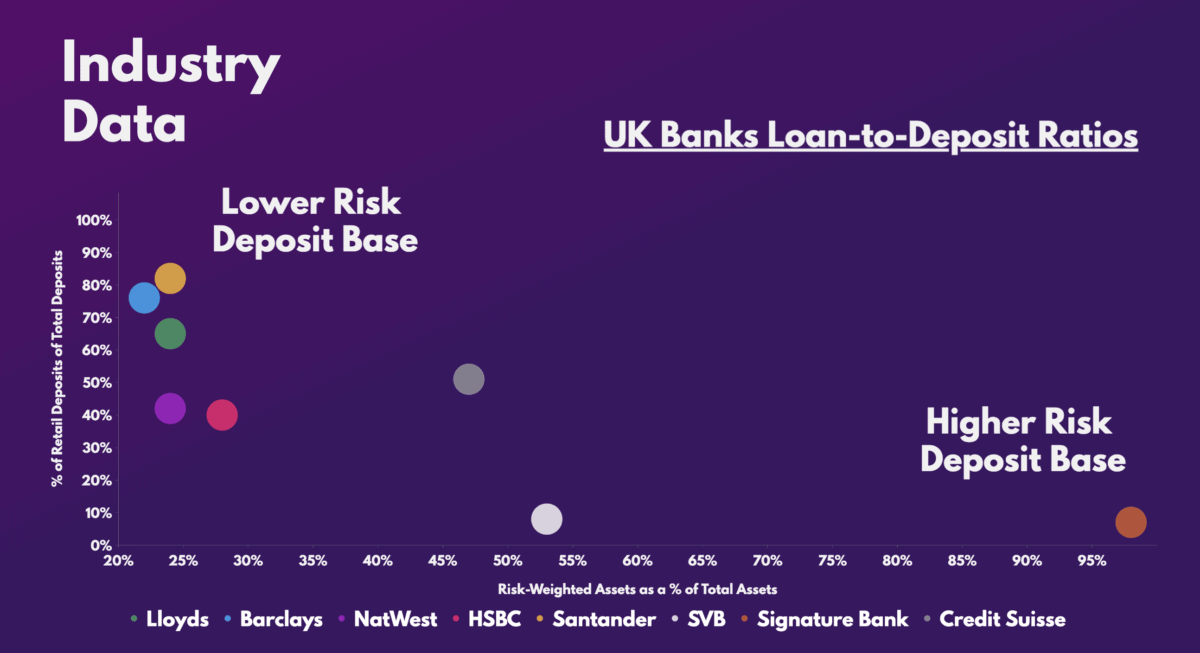
UK Banks Loan to Deposit Ratios.
Data sources: Lloyds, Barclays, NatWest, HSBC, Santander UK, Credit Suisse, SVB, Signature Bank

Although bank shares haven’t always been my cup of tea, I think the recent sell-off has presented buying opportunities I can’t ignore.

Most of their valuation multiples are at decade lows, and given the margin of safety, the risk-reward proposition is certainly attractive. Hence, I don’t think investing in bank shares have been a mistake — at least not yet — and is why I’ll be looking to add more to my Lloyds position and buy names like Barclays.

MetricsLloydsBarclaysNatWestHSBCSantanderIndustry average
Price-to-book (P/B) ratio0.60.30.70.70.60.7
Price-to-earnings (P/E) ratio6.14.37.08.96.09.0
Forward price-to-earnings (FP/E) ratio6.54.56.05.45.75.6
Data source: Google Finance

HSBC Holdings is an advertising partner of The Ascent, a Motley Fool company. John Choong has positions in Lloyds Banking Group Plc. The Motley Fool UK has recommended Barclays Plc, HSBC Holdings, and Lloyds Banking Group Plc. Views expressed on the companies mentioned in this article are those of the writer and therefore may differ from the official recommendations we make in our subscription services such as Share Advisor, Hidden Winners and Pro. Here at The Motley Fool we believe that considering a diverse range of insights makes us better investors.

More on Dividend Shares

Woman riding her old fashioned bicycle along the Beach Esplanade at Aberdeen, Scotland.
Investing Articles

Just 97 shares of this UK dividend stock generate £238 in passive income

A 5.7% yield, £238 in passive income from just 97 shares, and one of the most divisive dividend stocks on…

Read more »

ISA coins
Investing Articles

£10,000 in an ISA generates a second income of…

The London Stock Exchange is home to some of the world's most generous dividends. But how big a second income…

Read more »

Shot of a senior man drinking coffee and looking thoughtfully out of a window
Investing Articles

Expert recommendations: 2 top income stocks yielding 7%+!

With yields of 7.2% and 7.8% respectively, these two income stocks are catching the eyes of institutional analysts. Should investors…

Read more »

A mature woman help a senior woman out of a car as she takes her to the shops.
Investing Articles

How to invest £150 a month in shares to target a £7,660 passive income for life

Investing a small sum regularly in quality UK shares can generate a solid passive income in the long term. Zaven…

Read more »

Couple working from home while daughter watches video on smartphone with headphones on
Investing Articles

How much do you need in an ISA to earn a second income of £14,713 a year? 

Harvey Jones says it's possible to get a second income without the effort of finding another job, by investing in…

Read more »

Portrait Of Senior Couple Climbing Hill On Hike Through Countryside In Lake District UK Together
Investing Articles

The Legal & General share price is at a 10-year low – but the dividend income is stunning!

Harvey Jones is frustrated by the Legal & General share price, which has struggled to grow in recent years. But…

Read more »

Tree lined "tunnel" in the English countryside of West Sussex in autumn
Investing Articles

How much do you need in an ISA for a £1,525 monthly second income?

Alan Oscroft takes a look at how long-term investors can use a Stocks and Shares ISA to target a welcome…

Read more »

Little girl helping her Grandad plant tomatoes in a greenhouse in his garden.
Investing Articles

How much does an ISA investor need to target a £767 monthly income?

Harvey Jones crunches the numbers to show how much Stocks and Shares ISA investors need to build a high-and-rising passive…

Read more »