

We have some exciting news to share! The Motley Fool UK has now become The Twelfth Magpie -- an independent, UK-owned company, led by our long-serving UK management team — Mark Rogers, Chris Nials and Heather Adlington. In practical terms, it’s the same team you know, now fully focused on serving our UK readers and members.

Just as importantly, our approach remains unchanged: long-term, jargon-free, and on your side. This site is our new home, and there will be extra tweaks made across the coming few days as we settle in. So if anything looks a little off, please bear with us!

The content of this article was relevant at the time of publishing. Circumstances change continuously and caution should therefore be exercised when relying upon any content contained within this article.

To invest amid the Coronavirus market crash, start with this strategy

Rule one: Don’t try to to time the bottom in a stock market that’s more volatile than it’s been in decades.

You’re reading a free article with opinions that may differ from The Motley Fool’s Premium Investing Services. Become a Motley Fool member today to get instant access to our top analyst recommendations, in-depth research, investing resources, and more. Learn More.

A version of this article was originally published on Fool.com, by Jason Hall

Global stock markets are in absolute turmoil as the COVID-19 pandemic wreaks havoc around the world. Few investors have ever experienced the extreme volatility the past month has brought as a significant share of normal economic activity has been grinding to a halt. Major market indexes like the S&P 500 and Dow Jones Industrials have made more daily swings up or down by 5% in the past few weeks than they had in the prior 12 years.

XXX

Since the stock market set a record for the fastest 10% decline in history in late February, it has broken that record at least two more times, and even lost more than 10% of its value in a single day on March 11.  

It’s enough to make you want to pull everything out of the market and hide in a cave for six months until things return to normal — whatever normal will look like on the other side of this. 

And if that’s your instinct, trust me, I understand: Since reaching a major financial milestone in late February, I’ve seen my portfolio lose substantial value. 

Yet if we can look beyond this rising emotional and financial turmoil, history tells us that, now, with the market in an extended period of panic, is when we should act aggressively as buyers. 

The historical case for buying now

As of noon Friday 20th, the S&P 500 index was down about 29% from its 2020 peak, and almost three years worth of gains had been wiped out: 

^SPX Chart

^SPX DATA BY YCHARTS

And let’s be honest: Most of us expect stocks will continue to fall. We don’t even know how bad things really are out there yet, because there isn’t enough up-to-date economic data, but we know the travel and hospitality industries are all but shut down, sports leagues are closed for the foreseeable future, and in many parts of the country, pretty much all businesses that are open to the public but not essential to our well-being are being forced to close their doors or seriously curtail their operations. 

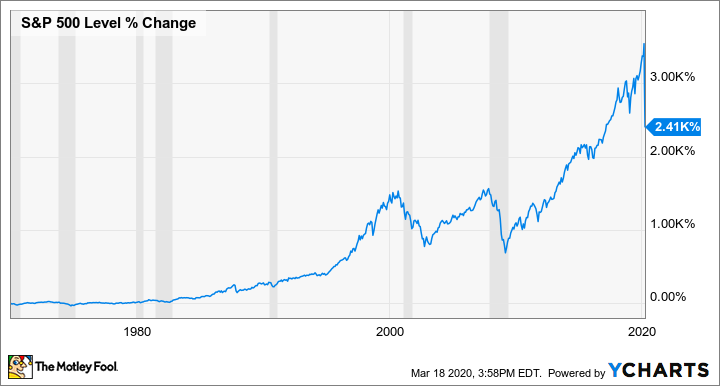
But what we don’t know is exactly how stocks will behave. Yes, they probably will fall more, but it’s a mistake to try too hard to be precise about when to “get in” during a market crash. A look at the long-term returns of the S&P 500 should help put that into better context:
^SPX Chart

^SPX DATA BY YCHARTS

As you can see in the chart above, every major stock market crash presented people with an opportunity to invest; and even investors who bought in the middle of a crash and watched stocks fall even further before they recovered still profited enormously. 

Avoiding the fallacy of “catching the bottom”

Let’s use the 2007-2009 Global Financial Crisis as an example. On Nov. 20, 2008, the S&P 500 was at 752.44, down 52% from the pre-crash peak it hit in October 2007: 

^SPX Chart

^SPX DATA BY YCHARTS

This was during the heart of the worst financial crisis the world had faced in 80 years. Over the six weeks that followed, stocks began to recover, but that recovery faltered, and by March 9, 2009, stocks had fallen 28% from their January peak:

^SPX Chart

^SPX DATA BY YCHARTS

A lot of people who bought during the late-2008 low probably felt like geniuses for a month or two, before feeling like idiots for having “gotten in too soon” after the market fell sharply once again. 

But whether they bought near the first bottom in November 2008 or the actual bottom in March 2009, those investors have done incredibly well. As of 20th March, the S&P 500 was up 212% from the first bottom, and 248% from the final bottom in March 2009. And when you add in the dividends paid, the total returns surge to 303% and 342% respectively. 

To put it bluntly, don’t let the fear that an investment might look stupid in a few weeks or months cause you to miss out on what should prove to be incredible market returns over the next five, 10, or 20 years. 

Jason Hall has no position in any of the stocks mentioned. The Motley Fool UK has no position in any of the shares mentioned. Views expressed on the companies mentioned in this article are those of the writer and therefore may differ from the official recommendations we make in our subscription services such as Share Advisor, Hidden Winners and Pro. Here at The Motley Fool we believe that considering a diverse range of insights makes us better investors.

More on Investing Articles

Friends and sisters exploring the outdoors together in Cornwall. They are standing with their arms around each other at the coast.
Investing Articles

£503 buys 14 shares in this FTSE 250 stock that returned 23.9% annually for the last 15 years

This FTSE 250 stock has averaged a huge return for 15 years. At today's price, £503 buys 14 shares. But…

Read more »

Black woman using loudspeaker to be heard
Investing Articles

£1,000 buys 25 shares in this FTSE 100 stock that’s returned 29.2% annually for the last 10 years

This FTSE 100 mining stock has returned close to 30% a year for a decade. At 3,995p, £1,000 buys 25…

Read more »

Female student sitting at the steps and using laptop
Investing Articles

Down 47%, is this growth stock finally worth buying in May?

With a £288m order book and a hidden pipeline of defence and nuclear contracts, is this growth stock now too…

Read more »

House models and one with REIT - standing for real estate investment trust - written on it.
Investing Articles

2 REITs yielding 7%+ to consider for passive income in 2026

A REIT backed by the NHS and another backed by Tesco and Sainsbury's with both yielding 7%+. Here's why I'm…

Read more »

Woman riding her old fashioned bicycle along the Beach Esplanade at Aberdeen, Scotland.
Investing Articles

Just 97 shares of this UK dividend stock generate £238 in passive income

A 5.7% yield, £238 in passive income from just 97 shares, and one of the most divisive dividend stocks on…

Read more »

ISA coins
Investing Articles

£10,000 in an ISA generates a second income of…

The London Stock Exchange is home to some of the world's most generous dividends. But how big a second income…

Read more »

Shot of a senior man drinking coffee and looking thoughtfully out of a window
Investing Articles

Expert recommendations: 2 top income stocks yielding 7%+!

With yields of 7.2% and 7.8% respectively, these two income stocks are catching the eyes of institutional analysts. Should investors…

Read more »

Illustration of flames over a black background
Investing Articles

3 top income-focused stocks to buy in May 2026, according to experts

Looking for a stock to buy for income in May 2026? Experts have flagged these three UK dividend shares as…

Read more »






