

We have some exciting news to share! The Motley Fool UK has now become The Twelfth Magpie -- an independent, UK-owned company, led by our long-serving UK management team — Mark Rogers, Chris Nials and Heather Adlington. In practical terms, it’s the same team you know, now fully focused on serving our UK readers and members.

Just as importantly, our approach remains unchanged: long-term, jargon-free, and on your side. This site is our new home, and there will be extra tweaks made across the coming few days as we settle in. So if anything looks a little off, please bear with us!

The content of this article was relevant at the time of publishing. Circumstances change continuously and caution should therefore be exercised when relying upon any content contained within this article.

Why is the FTSE 100 lagging the Dow Jones and the S&P 500?

The Dow Jones and S&P 500 both made new all-time highs yesterday, but the FTSE 100 is still well short of recovering its market-crash losses. James J. McCombie looks into it.

You’re reading a free article with opinions that may differ from The Motley Fool’s Premium Investing Services. Become a Motley Fool member today to get instant access to our top analyst recommendations, in-depth research, investing resources, and more. Learn More.

Yesterday the Dow Jones Industrial Average closed above 30,000 for the first time. That is a remarkable turnaround, given that the Dow slumped to under 19,000 in March this year. From its March low of under 2,250, the S&P 500 index has risen to over 3,600.

Both the S&P 500 and the Dow are back above their pre-market crash highs. Meanwhile, the FTSE 100, while still well over 1,000 points above its market crash lows, is well shy of its pre-crash highs.

XXX

And it’s not just the FTSE 100. Both the French CAC 40 and the German DAX also sit below their pre-crash highs and lag their American counterparts.

Why is the S&P 500 outperforming?

In the US, unemployment benefits were increased in light of the coronavirus pandemic. In the UK and Europe, firms were given support to pay wages to furloughed staff. One theory is that allowing people to lose their jobs in the US means they can, over time, move into more profitable parts of the economy. In Europe and the UK, furloughing staff in otherwise unprofitable areas of the economy, and keeping ailing firms alive, might hold up the creation of more productive jobs and place a drag on the economy.

The spectre of Brexit is still hanging over the UK and Europe. Uncertainty around the future relationship between the UK and Europe will be a headache for businesses looking to plan for the future on both sides of the channel. Investors might also be lacking confidence. This is not positive for the FTSE 100 and European stock markets.

A weakening US dollar, against both the pound and euro, is also favourable for profits of American firms and its stock markets. A weaker dollar means foreign profits converted back to dollars are increased. That’s good for US markets. However, since the dollar is weaker, the pound and euro are stronger, so any US profits will shrink in pound and euro terms. That isn’t good for European markets.

FTSE 100 lacking tech stocks

I think the main reason the FTSE 100 lags both the S&P 500 and the Dow is down to the type of stocks in it. In the chart below, the sector weightings of the FTSE 100 and the S&P 500 are compared. The S&P 500 has significantly more tech exposure than the FTSE 100. The FTSE 100 has much more exposure to energy (including oil and gas stocks) and financials (which includes banks).
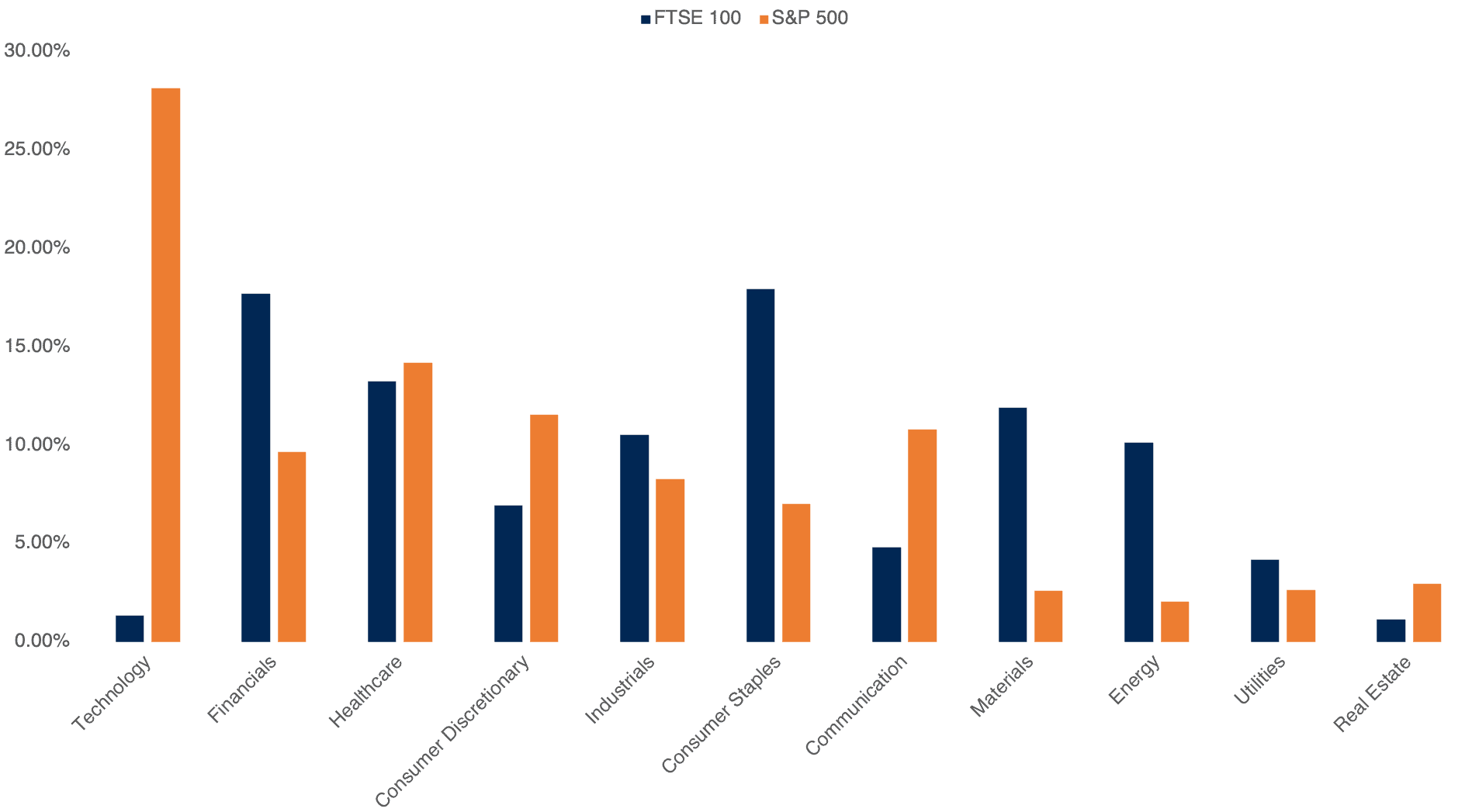
A chart showing FTSE 100 and S&P 500 sector weightings

Source: Author’s own calculations

Tech stocks have been on a tear this year. Banks and oil majors have suffered. Of all the reasons offered, I think the fact that the FTSE 100 is underexposed to the best performing sectors and overexposed to the worst explains its underperformance best. The Dow, although often considered stodgy and old economy-focused, has the likes of Microsoft and Apple in it.

Unless the structure of the FTSE 100 changes, then it will likely continue to underperform the S&P 500. However, that does not mean all FTSE 100 stocks are laggards. Some, like Ocado and Scottish Mortgage Investment Trust, are up 90% over a year.  So, picking the right stocks can make a huge difference to returns. And let’s not forget that over the last 10 years, the FTSE 100’s dividend yield has been a little under around 4% on average. The S&P 500’s average yield is closer to 2%. So, income investors might find the FTSE 100 a fertile hunting ground.


James J. McCombie owns shares of Scottish Mortgage Inv Trust. The Motley Fool UK has no position in any of the shares mentioned. Views expressed on the companies mentioned in this article are those of the writer and therefore may differ from the official recommendations we make in our subscription services such as Share Advisor, Hidden Winners and Pro. Here at The Motley Fool we believe that considering a diverse range of insights makes us better investors.

More on Investing Articles

Friends and sisters exploring the outdoors together in Cornwall. They are standing with their arms around each other at the coast.
Investing Articles

£503 buys 14 shares in this FTSE 250 stock that returned 23.9% annually for the last 15 years

This FTSE 250 stock has averaged a huge return for 15 years. At today's price, £503 buys 14 shares. But…

Read more »

Black woman using loudspeaker to be heard
Investing Articles

£1,000 buys 25 shares in this FTSE 100 stock that’s returned 29.2% annually for the last 10 years

This FTSE 100 mining stock has returned close to 30% a year for a decade. At 3,995p, £1,000 buys 25…

Read more »

Female student sitting at the steps and using laptop
Investing Articles

Down 47%, is this growth stock finally worth buying in May?

With a £288m order book and a hidden pipeline of defence and nuclear contracts, is this growth stock now too…

Read more »

House models and one with REIT - standing for real estate investment trust - written on it.
Investing Articles

2 REITs yielding 7%+ to consider for passive income in 2026

A REIT backed by the NHS and another backed by Tesco and Sainsbury's with both yielding 7%+. Here's why I'm…

Read more »

Woman riding her old fashioned bicycle along the Beach Esplanade at Aberdeen, Scotland.
Investing Articles

Just 97 shares of this UK dividend stock generate £238 in passive income

A 5.7% yield, £238 in passive income from just 97 shares, and one of the most divisive dividend stocks on…

Read more »

ISA coins
Investing Articles

£10,000 in an ISA generates a second income of…

The London Stock Exchange is home to some of the world's most generous dividends. But how big a second income…

Read more »

Shot of a senior man drinking coffee and looking thoughtfully out of a window
Investing Articles

Expert recommendations: 2 top income stocks yielding 7%+!

With yields of 7.2% and 7.8% respectively, these two income stocks are catching the eyes of institutional analysts. Should investors…

Read more »

Illustration of flames over a black background
Investing Articles

3 top income-focused stocks to buy in May 2026, according to experts

Looking for a stock to buy for income in May 2026? Experts have flagged these three UK dividend shares as…

Read more »





