

We have some exciting news to share! The Motley Fool UK has now become The Twelfth Magpie -- an independent, UK-owned company, led by our long-serving UK management team — Mark Rogers, Chris Nials and Heather Adlington. In practical terms, it’s the same team you know, now fully focused on serving our UK readers and members.

Just as importantly, our approach remains unchanged: long-term, jargon-free, and on your side. This site is our new home, and there will be extra tweaks made across the coming few days as we settle in. So if anything looks a little off, please bear with us!

The content of this article was relevant at the time of publishing. Circumstances change continuously and caution should therefore be exercised when relying upon any content contained within this article.

This is why I’m buying Microsoft stock

Microsoft stock has delivered outsized returns to its shareholders. I think what made it a success is still in play and I’m buying.

| More on:

You’re reading a free article with opinions that may differ from The Motley Fool’s Premium Investing Services. Become a Motley Fool member today to get instant access to our top analyst recommendations, in-depth research, investing resources, and more. Learn More.

I became a Microsoft (NASDAQ: MSFT) shareholder in November 2020. Although I bought after the stock had dropped about 10% below its all-time high, which it hit in September, I missed out on the incredible gains made after the market crash, and indeed before it. However, I believe Microsoft stock still has a lot to offer, and here is why.

Reason 1: Microsoft stock’s track record

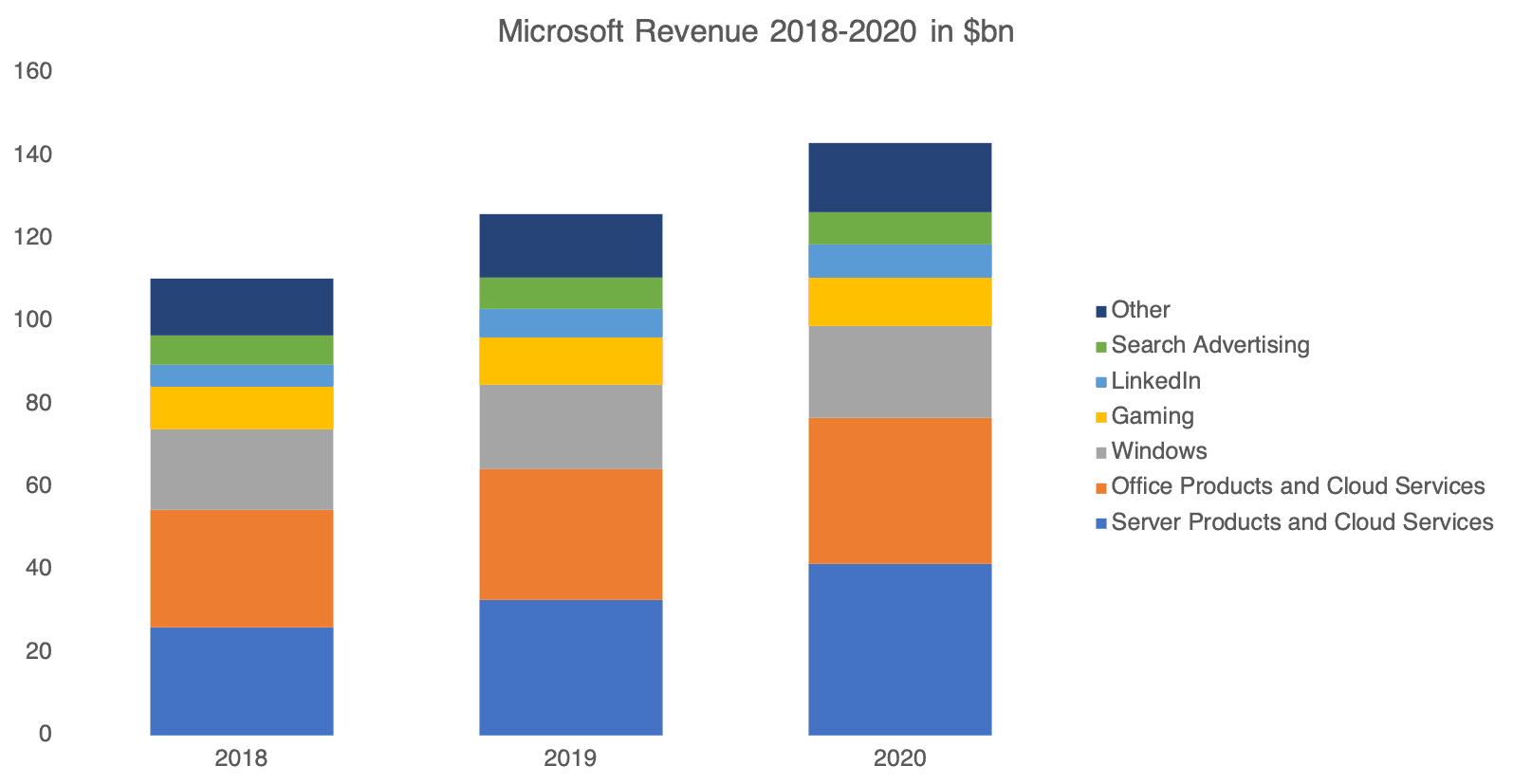
In 2018 Microsoft reported revenues of $110bn. Microsoft’s reported revenue grew to $143bn in 2020. Revenue growth has averaged 13.98% per year over the last three fiscal years. That is impressive for a company that has been around as long as Microsoft has.
XXX

A chart showing Microsoft revenue 2018 to 2020

Source: Microsoft data and author’s own calculations

Microsoft’s operating and net income has also been growing healthily from $35.1bn and $16.6bn in 2018 to $53bn and 44.3bn in 2020 respectively. Operating margins have increased from 31.8% in 2018 to 37% in 2020. Net income margin, aside from 2017 in which it suffered from exceptional charges, has held steady at 31% over the last couple of years.
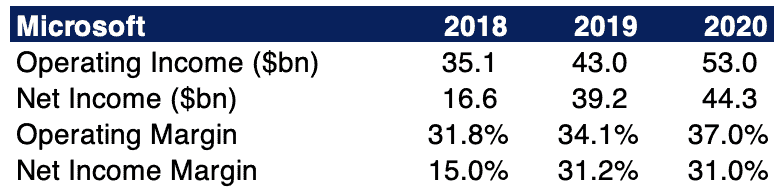
A table showing Microsoft stock operating and net income in billions of dollars and margins from 2018 to 2020

Source: Microsoft data and author’s own calculations

These margins are impressive. They hint indirectly at Microsoft’s impressive return on invested capital (ROIC). A high ROIC combined with healthy revenue growth is a recipe for creating shareholder value. To keep ROIC high Microsoft needs to be able to maintain its competitive advantage and I think it will.

Reason 2: Microsoft’s competitive strength

Software like Microsoft Excel gets more valuable to users as the number of other users increases, as it makes exchanging and sharing files easier. What’s more, Microsoft can deliver its software products at a meagre marginal cost. A product or service that gets more valuable to users, while at the same time becoming cheaper to deliver, is a good example of network effects, or increasing returns to scale.

This also applies to Mircosoft Windows platform, which is the most popular licensed operating system for personal computers. Customers get locked into Microsoft’s products as it takes time and money to switch. Also, Microsoft bundles different software solutions into subscription packages, and steady revenue streams are always a good thing. 

After a slow start, Microsoft has put together a dedicated cloud computing serviceThis has the second biggest market share (and it’s increasing) after Amazon’s offering. I see market share for Microsoft’s cloud service increasing further because it can bundle it and all its other software offerings together into a one-stop solution for businesses. 

Microsoft’s competitive edge looks sound across all its business divisions.

Reason 3: Total shareholder returns

It’s easy to forget that Microsoft has paid a quarterly dividend since the fourth quarter of 2004. The dividend yield on Microsoft shares is currently around 1%. That’s not at all high, but Microsoft has been increasing its dividend by 14% per year on average. If that continues then a share bought today could be yielding over 4% in a decade.

The total return on Microsoft shares, including dividend reinvestment, stands at 24.3% per year on average over the last decade. With Microsoft’s track record and continuing competitive edge, I expect total shareholder returns to hold up well over the next decade. Microsoft is a large-cap growth stock, that’s in the tech business, and also pays a dividend. It’s a popular investment for a reason: there are not many stocks quite like it.


Teresa Kersten, an employee of LinkedIn, a Microsoft subsidiary, is a member of The Motley Fool’s board of directors. James J. McCombie owns shares of Microsoft. The Motley Fool UK owns shares of and has recommended Microsoft and recommends the following options: long January 2021 $85 calls on Microsoft and short January 2021 $115 calls on Microsoft. Views expressed on the companies mentioned in this article are those of the writer and therefore may differ from the official recommendations we make in our subscription services such as Share Advisor, Hidden Winners and Pro. Here at The Motley Fool we believe that considering a diverse range of insights makes us better investors.

More on Investing Articles

Friends and sisters exploring the outdoors together in Cornwall. They are standing with their arms around each other at the coast.
Investing Articles

£503 buys 14 shares in this FTSE 250 stock that returned 23.9% annually for the last 15 years

This FTSE 250 stock has averaged a huge return for 15 years. At today's price, £503 buys 14 shares. But…

Read more »

Black woman using loudspeaker to be heard
Investing Articles

£1,000 buys 25 shares in this FTSE 100 stock that’s returned 29.2% annually for the last 10 years

This FTSE 100 mining stock has returned close to 30% a year for a decade. At 3,995p, £1,000 buys 25…

Read more »

Female student sitting at the steps and using laptop
Investing Articles

Down 47%, is this growth stock finally worth buying in May?

With a £288m order book and a hidden pipeline of defence and nuclear contracts, is this growth stock now too…

Read more »

House models and one with REIT - standing for real estate investment trust - written on it.
Investing Articles

2 REITs yielding 7%+ to consider for passive income in 2026

A REIT backed by the NHS and another backed by Tesco and Sainsbury's with both yielding 7%+. Here's why I'm…

Read more »

Woman riding her old fashioned bicycle along the Beach Esplanade at Aberdeen, Scotland.
Investing Articles

Just 97 shares of this UK dividend stock generate £238 in passive income

A 5.7% yield, £238 in passive income from just 97 shares, and one of the most divisive dividend stocks on…

Read more »

ISA coins
Investing Articles

£10,000 in an ISA generates a second income of…

The London Stock Exchange is home to some of the world's most generous dividends. But how big a second income…

Read more »

Shot of a senior man drinking coffee and looking thoughtfully out of a window
Investing Articles

Expert recommendations: 2 top income stocks yielding 7%+!

With yields of 7.2% and 7.8% respectively, these two income stocks are catching the eyes of institutional analysts. Should investors…

Read more »

Illustration of flames over a black background
Investing Articles

3 top income-focused stocks to buy in May 2026, according to experts

Looking for a stock to buy for income in May 2026? Experts have flagged these three UK dividend shares as…

Read more »





