

We have some exciting news to share! The Motley Fool UK has now become The Twelfth Magpie -- an independent, UK-owned company, led by our long-serving UK management team — Mark Rogers, Chris Nials and Heather Adlington. In practical terms, it’s the same team you know, now fully focused on serving our UK readers and members.

Just as importantly, our approach remains unchanged: long-term, jargon-free, and on your side. This site is our new home, and there will be extra tweaks made across the coming few days as we settle in. So if anything looks a little off, please bear with us!

The content of this article was relevant at the time of publishing. Circumstances change continuously and caution should therefore be exercised when relying upon any content contained within this article.

Thinking of investing in FTSE 100 companies in 2021? Get familiar with their income statements first

Getting to grips with an income statement is the first thing I do when deciding whether or not to invest in a FTSE 100 stock. Here are some tips and tricks I use.

| More on:

You’re reading a free article with opinions that may differ from The Motley Fool’s Premium Investing Services. Become a Motley Fool member today to get instant access to our top analyst recommendations, in-depth research, investing resources, and more. Learn More.

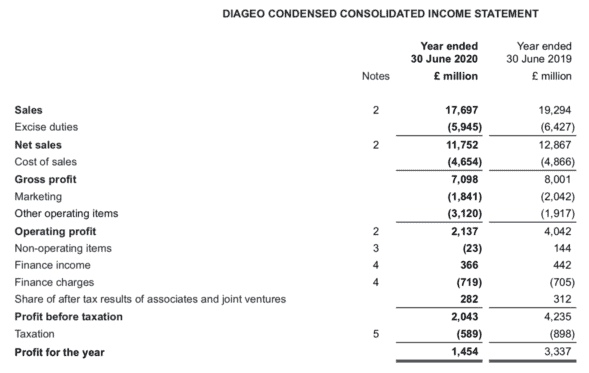
Before I decide to invest in a FTSE 100 stock, I need to understand its income statement. FTSE 100 member Diageo‘s (LSE:DGE) income statement up to and including profit for 2020 is presented below. Let’s take a walk through it.

The first line reports the proceeds from sales of goods or services made during the business’s ordinary operations. Diageo reports sales of £17,697m for 2020. Excise duties are effectively production taxes payable when goods move from bonded premises. Diageo’s deducts excise duties of £5,945m from sales to arrive at net sales of £11,752m for 2020.
XXX

diageo abbreviated income statement 2020

Source: Diageo

Getting bottles and cans of alcoholic beverages into bonded premises ready for sale costs money. There are ingredients to buy and employees to pay. There are also utility bills to pay when the employees use energy to turn those ingredients into something drinkable, then bottle it and make it ready for sale. These are the direct costs that make up the cost-of-sales expense, which for Diageo was £4,654m for 2020.

Profit and loss

Deducting the cost of sales from net sales give Diageo’s 2020 gross profit of £7,098m for 2020. Diageo it only recognises the cost of producing a box of drinks (in cost of sales) when it sells the box. But there are other costs like marketing, insurance, and head office salaries, that are incurred whether or not that particular box of drinks is sold or not. These operating expenses are deducted from gross profit to give Diageo’s 2020 operating profit of £2,137m.

Non-operating items, which are expenses or income not directly related to Diageo’s ordinary business, are subtracted or added to operating income next. Then there is financing income, perhaps from interest on cash balances, to add to operating income, and finance expenses, like interest on debt, to deduct. Diageo has stakes in other companies and joint ventures where it does not have full control. It recognises a share of their after-tax results in proportion to its control on its income statement.

Adding or subtracting non-operating items, adding finance income, deducting finance expense, and adding (or deducting in case of a loss) the share of after-tax results gives a profit before tax of £2,043m for 2020. Taxes of £589m are then deducted to give Diageo’s 2020 profit of £1,454m.

A good FTSE 100 company?

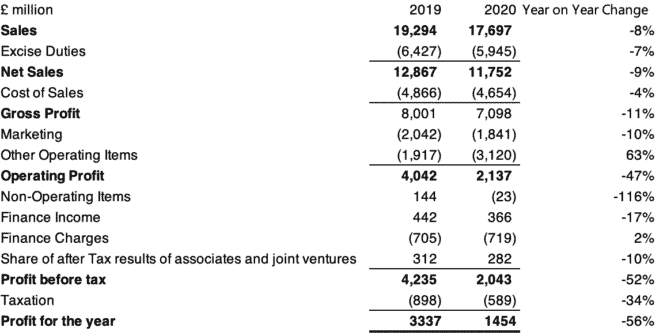
Is Diageo’s profit for 2020 good or bad? Compared to 2019 it is down 56%. Calculating the year-on-year changes for each line item on the income statement, as shown below, can help understand why. Sales fell by 8%, because of the pandemic, but other operating items expense increased by 63%.
FTSE 100 member Diageo income statememt showing year on year changes

Source: Diageo and author’s calculations

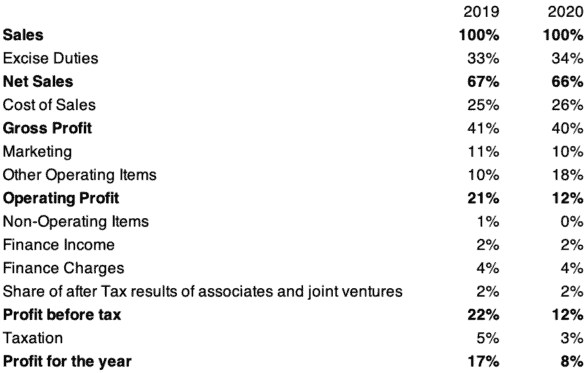
I show a common size income statement below, in which I calculated each line item as a percentage of sales. What draws my eye is that the other operating items percentage increases from 2019 to 2020, while other items are fairly stable. Again this seems to be driving the operating, before, and after-tax profits down for 2020. A careful reading of the notes accompanying the financial statements might reveal why this happened.
diageo income statement 2019 and 2020 in common size

Source: Diageo and author’s calculations

Common size income statements and year-on-year change calculations are good ways to build an understanding of the performance of FTSE 100 companies like Diageo. Percentage-based calculations make comparisons with competitors straightforward. A consistently profitable company that is still growing, and outperforming its peers, is probably a good investment. 

James J. McCombie owns shares of Diageo. The Motley Fool UK has recommended Diageo. Views expressed on the companies mentioned in this article are those of the writer and therefore may differ from the official recommendations we make in our subscription services such as Share Advisor, Hidden Winners and Pro. Here at The Motley Fool we believe that considering a diverse range of insights makes us better investors.

More on Investing Articles

Friends and sisters exploring the outdoors together in Cornwall. They are standing with their arms around each other at the coast.
Investing Articles

£503 buys 14 shares in this FTSE 250 stock that returned 23.9% annually for the last 15 years

This FTSE 250 stock has averaged a huge return for 15 years. At today's price, £503 buys 14 shares. But…

Read more »

Black woman using loudspeaker to be heard
Investing Articles

£1,000 buys 25 shares in this FTSE 100 stock that’s returned 29.2% annually for the last 10 years

This FTSE 100 mining stock has returned close to 30% a year for a decade. At 3,995p, £1,000 buys 25…

Read more »

Female student sitting at the steps and using laptop
Investing Articles

Down 47%, is this growth stock finally worth buying in May?

With a £288m order book and a hidden pipeline of defence and nuclear contracts, is this growth stock now too…

Read more »

House models and one with REIT - standing for real estate investment trust - written on it.
Investing Articles

2 REITs yielding 7%+ to consider for passive income in 2026

A REIT backed by the NHS and another backed by Tesco and Sainsbury's with both yielding 7%+. Here's why I'm…

Read more »

Woman riding her old fashioned bicycle along the Beach Esplanade at Aberdeen, Scotland.
Investing Articles

Just 97 shares of this UK dividend stock generate £238 in passive income

A 5.7% yield, £238 in passive income from just 97 shares, and one of the most divisive dividend stocks on…

Read more »

ISA coins
Investing Articles

£10,000 in an ISA generates a second income of…

The London Stock Exchange is home to some of the world's most generous dividends. But how big a second income…

Read more »

Shot of a senior man drinking coffee and looking thoughtfully out of a window
Investing Articles

Expert recommendations: 2 top income stocks yielding 7%+!

With yields of 7.2% and 7.8% respectively, these two income stocks are catching the eyes of institutional analysts. Should investors…

Read more »

Illustration of flames over a black background
Investing Articles

3 top income-focused stocks to buy in May 2026, according to experts

Looking for a stock to buy for income in May 2026? Experts have flagged these three UK dividend shares as…

Read more »






