


We have some exciting news to share! The Motley Fool UK has now become The Twelfth Magpie -- an independent, UK-owned company, led by our long-serving UK management team — Mark Rogers, Chris Nials and Heather Adlington. In practical terms, it’s the same team you know, now fully focused on serving our UK readers and members.

Just as importantly, our approach remains unchanged: long-term, jargon-free, and on your side. This site is our new home, and there will be extra tweaks made across the coming few days as we settle in. So if anything looks a little off, please bear with us!

The content of this article was relevant at the time of publishing. Circumstances change continuously and caution should therefore be exercised when relying upon any content contained within this article.

Rolls-Royce stock’s problems in 5 charts

Debt and reliance on large engines that power long-haul flights help explain why the Rolls-Royce stock price remains grounded.

| More on:
Middle-aged white man pulling an aggrieved face while looking at a screen

Image source: Getty Images

You’re reading a free article with opinions that may differ from The Motley Fool’s Premium Investing Services. Become a Motley Fool member today to get instant access to our top analyst recommendations, in-depth research, investing resources, and more. Learn More.

Key Points

  • Rolls-Royce relies on large engined planes flying for a big chunk of its revenue, but large engine flying hours are not expected to recover until 2024
  • Significant debt and equity were added to Rolls-Royce's balance sheet to survive the pandemic
  • The effects of shareholder dilution, and the long road to recovery for the civil aviation business, will weigh on the Rolls-Royce share price for years to come

The Rolls-Royce (LSE: RR) stock price nosedived as the COVID-19 pandemic rattled markets in early 2020. Stock markets have staged a meaningful recovery since then. Rolls-Royce stock has not. Here’s why.

XXX

Flight times

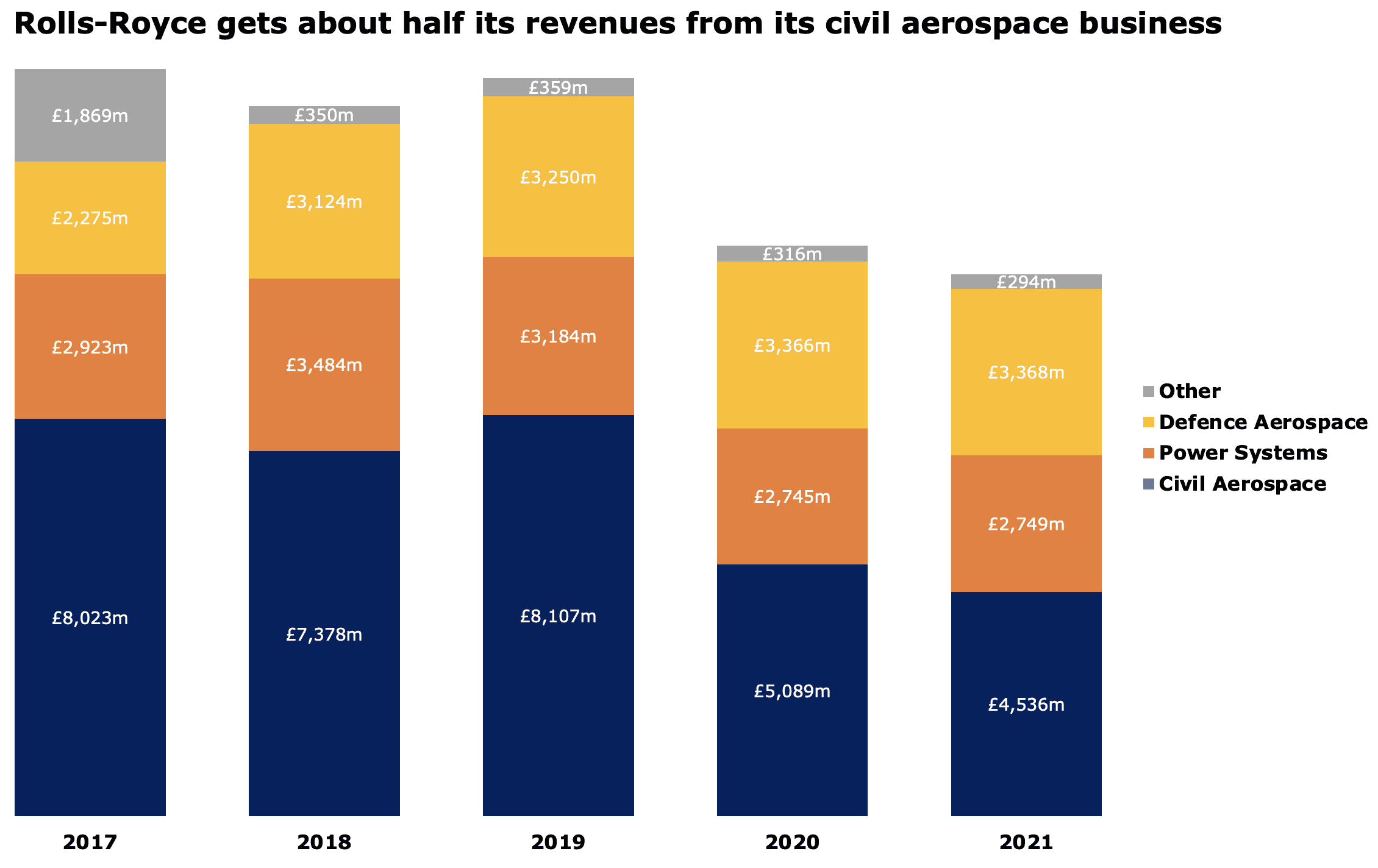
Rolls-Royce makes aircraft engines. But, it doesn’t collect as much revenue from selling the engines as it does from servicing them. Take 2019, for example. Rolls-Royce took £8,107m in revenue from its civil aviation business. But, 60% of that came from after-market services. When the pandemic hit, aircraft stopped flying. When aircraft are not flying, their engines do not require much in the way of servicing. So, Rolls-Royce saw a significant chunk of revenue and, perhaps more importantly, steady cash flow evaporate when the pandemic hit.
Source: Rolls-Royce annual reports 2017 to 2021

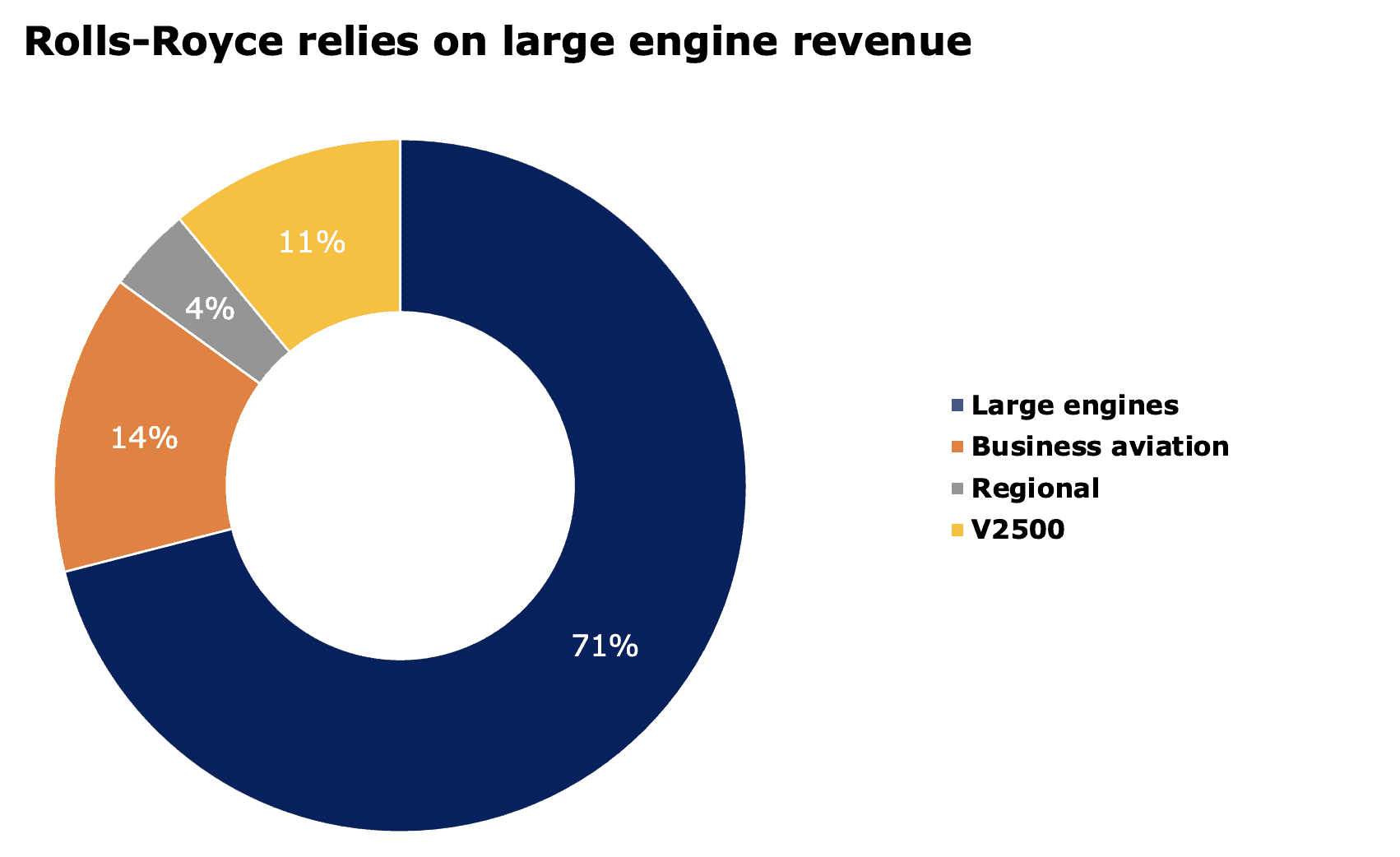
For the Rolls-Royce stock price to gain altitude, planes must start flying again, particularly wide-body ones. These fly long-haul routes and have large engines slung under their wings. Rolls-Royce leant heavily into the large engine market before the pandemic. That might have been a mistake, as long-haul air travel seems to have been pivoting to narrowbody aircraft even before the pandemic.
Source: Rolls-Royce 2019 annual report

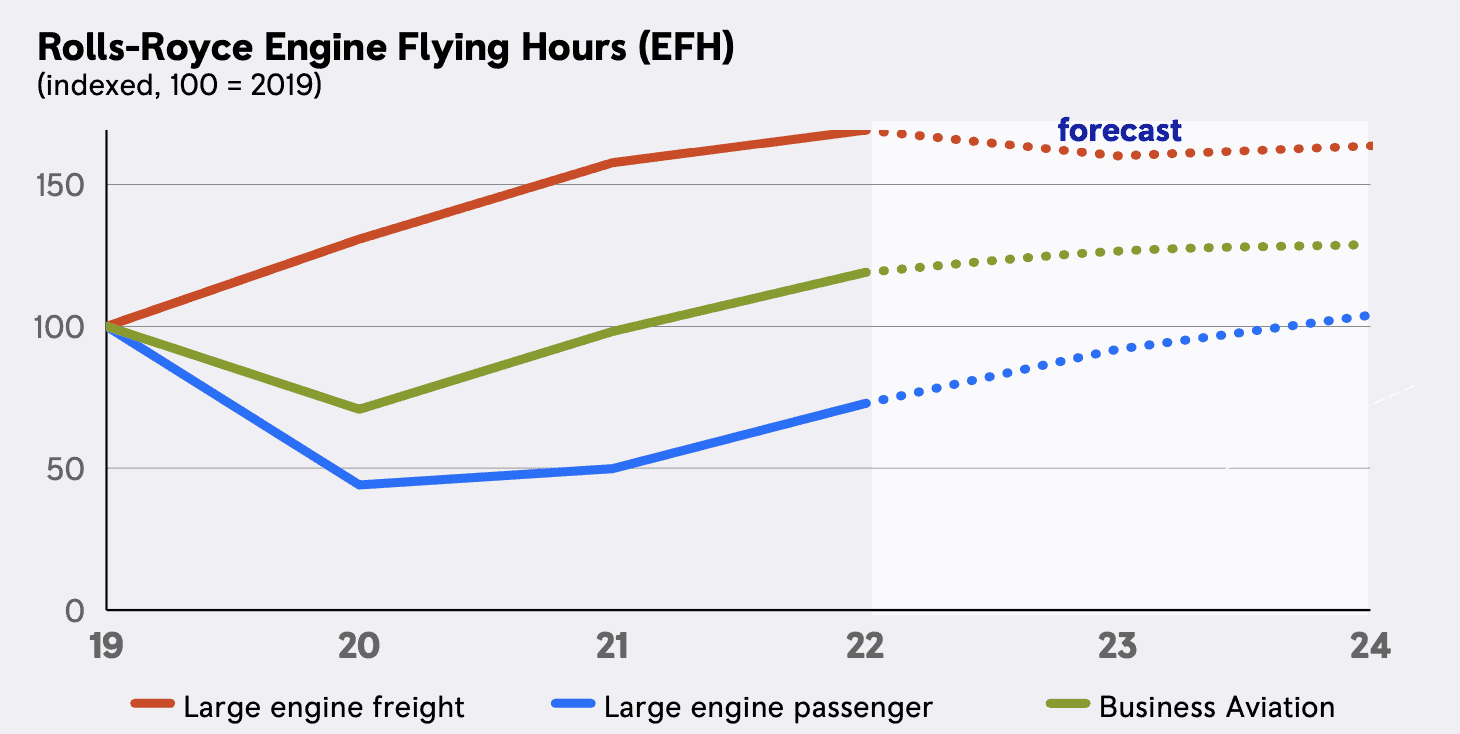
Planes are taking to the skies again. However, in line with other industry forecasts, Rolls-Royce does not see large engine passenger flying hours returning to pre-pandemic levels before 2024. Therefore, Rolls-Royce cannot expect its revenues to bounce back until then, either.
Source: Rolls-Royce civil aerospace investor day presentation, 13 May 2022

Of course, Rolls-Royce does have other business segments. However, Civil Aviation is by far the largest. The ups and downs of the aviation business will likely continue to dominate the mood around the Rolls-Royce share price until at least 2024.

Debt and dilution will drag on the Rolls-Royce stock price

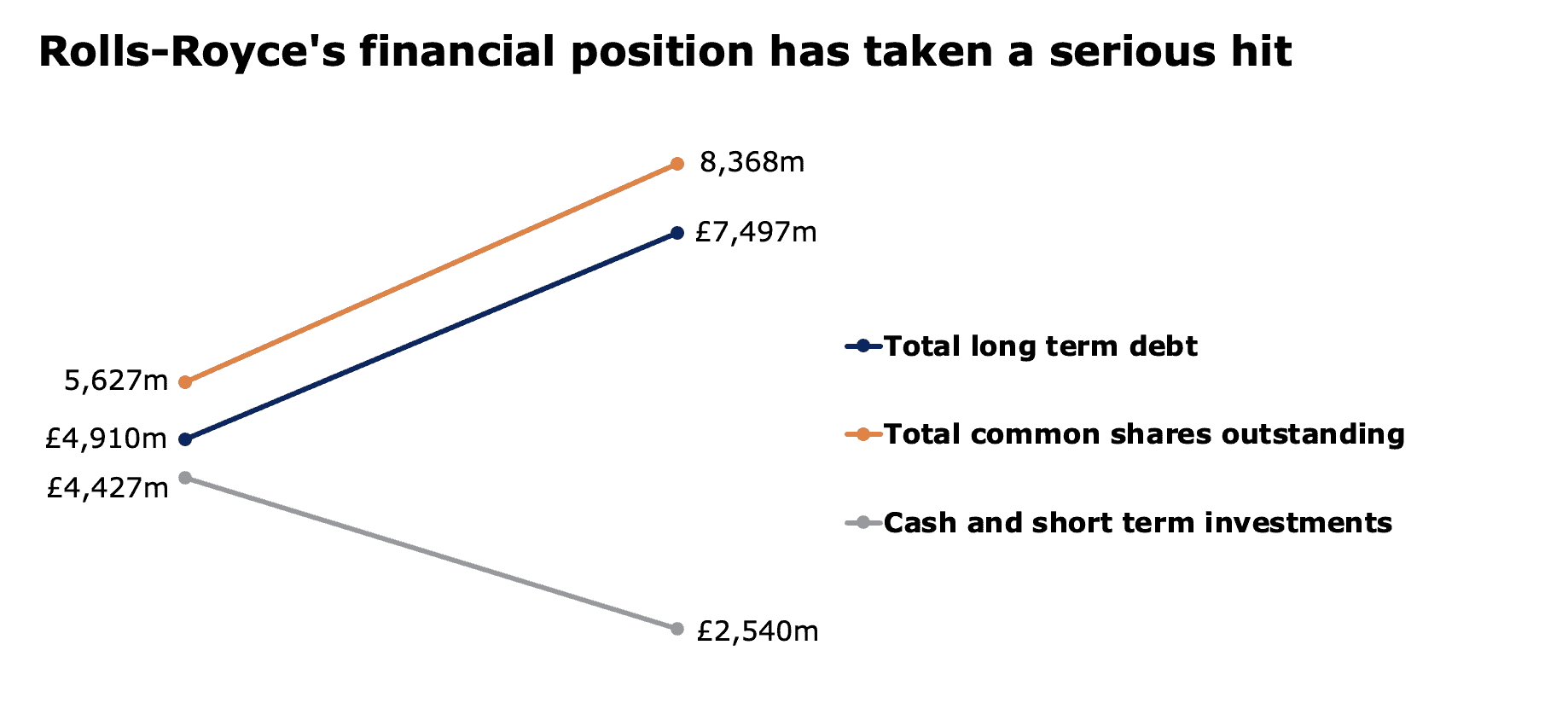
The drop in cash flow during the pandemic forced Rolls-Royce into emergency measures. It cut its dividend and significantly changed its balance sheet and business operations.
Source: Rolls-Royce annual reports for 2019 and 2021

Rolls-Royce’s long-term debt almost doubled from £4,910m to £7,497m between 2019 and 2021. Without this debt raise, the company might not have survived. In addition, it sold new shares to raise funds in the form of equity. The common share count of the company rose from 5,627m to 8,368m over two years. To make matters worse, it sold the shares at knockdown prices as the Rolls-Royce’s stock price had collapsed. Despite all of this, the company’s cash position worsened significantly.

Rolls-Royce has raised some cash through asset sales of underperforming and non-core businesses. A restructuring effort seems to have started to improve its operating margin. Then there are forrays into green technologies to get excited about alongside that 2024 forecast for a return to form for Rolls-Royce’s biggest business.

But, shareholders old and new own a far smaller slice of Roll-Royce, and claim on its earnings, than they did in 2019. Until the balance is paid down, debt holders will collect lofty interest payments that could have been reinvested into the business or paid as dividends. I don’t think it’s over for Rolls-Royce, nor do I thinks its best days are behind it. But I do believe a Rolls-Royce stock price recovery will take years.


James McCombie has positions in Rolls-Royce. The Motley Fool UK has no position in any of the shares mentioned. Views expressed on the companies mentioned in this article are those of the writer and therefore may differ from the official recommendations we make in our subscription services such as Share Advisor, Hidden Winners and Pro. Here at The Motley Fool we believe that considering a diverse range of insights makes us better investors.

More on Investing Articles

Friends and sisters exploring the outdoors together in Cornwall. They are standing with their arms around each other at the coast.
Investing Articles

£503 buys 14 shares in this FTSE 250 stock that returned 23.9% annually for the last 15 years

This FTSE 250 stock has averaged a huge return for 15 years. At today's price, £503 buys 14 shares. But…

Read more »

Black woman using loudspeaker to be heard
Investing Articles

£1,000 buys 25 shares in this FTSE 100 stock that’s returned 29.2% annually for the last 10 years

This FTSE 100 mining stock has returned close to 30% a year for a decade. At 3,995p, £1,000 buys 25…

Read more »

Female student sitting at the steps and using laptop
Investing Articles

Down 47%, is this growth stock finally worth buying in May?

With a £288m order book and a hidden pipeline of defence and nuclear contracts, is this growth stock now too…

Read more »

House models and one with REIT - standing for real estate investment trust - written on it.
Investing Articles

2 REITs yielding 7%+ to consider for passive income in 2026

A REIT backed by the NHS and another backed by Tesco and Sainsbury's with both yielding 7%+. Here's why I'm…

Read more »

Woman riding her old fashioned bicycle along the Beach Esplanade at Aberdeen, Scotland.
Investing Articles

Just 97 shares of this UK dividend stock generate £238 in passive income

A 5.7% yield, £238 in passive income from just 97 shares, and one of the most divisive dividend stocks on…

Read more »

ISA coins
Investing Articles

£10,000 in an ISA generates a second income of…

The London Stock Exchange is home to some of the world's most generous dividends. But how big a second income…

Read more »

Shot of a senior man drinking coffee and looking thoughtfully out of a window
Investing Articles

Expert recommendations: 2 top income stocks yielding 7%+!

With yields of 7.2% and 7.8% respectively, these two income stocks are catching the eyes of institutional analysts. Should investors…

Read more »

Illustration of flames over a black background
Investing Articles

3 top income-focused stocks to buy in May 2026, according to experts

Looking for a stock to buy for income in May 2026? Experts have flagged these three UK dividend shares as…

Read more »





