
We have some exciting news to share! The Motley Fool UK has now become The Twelfth Magpie -- an independent, UK-owned company, led by our long-serving UK management team — Mark Rogers, Chris Nials and Heather Adlington. In practical terms, it’s the same team you know, now fully focused on serving our UK readers and members.

Just as importantly, our approach remains unchanged: long-term, jargon-free, and on your side. This site is our new home, and there will be extra tweaks made across the coming few days as we settle in. So if anything looks a little off, please bear with us!

The content of this article was relevant at the time of publishing. Circumstances change continuously and caution should therefore be exercised when relying upon any content contained within this article.

Should I buy Lloyds shares after SVB’s collapse?

FTSE bank shares are falling after the recent collapse of SVB, and Lloyds has been no exception. Could this be a buying opportunity?

| More on:
Young Black woman looking concerned while in front of her laptop

Image source: Getty Images

You’re reading a free article with opinions that may differ from The Motley Fool’s Premium Investing Services. Become a Motley Fool member today to get instant access to our top analyst recommendations, in-depth research, investing resources, and more. Learn More.

The collapse of Silicon Valley Bank (SVB) has investors running for the hills, fearing a repeat of the 2008 financial crisis. That said, there’s reason to believe that this fear may be overdone, especially with Lloyds (LSE:LLOY) shares, which have dropped almost 10% in a week.

How did SVB collapse?

SVB’s fall started when it opted to invest the bulk of its customers’ deposits into risk-weighted assets, such as long-dated government bonds. These securities are very sensitive to interest rates. Thus, they saw a massive decline in value when the Federal Reserve aggressively raised rates last year.

XXX

The lender was then forced to sell those bonds at a huge loss when the majority of its clients in the tech and crypto industry came banging on its door for cash. To put it simply, SVB faced a liquidity crisis in the middle of a bank run.

To mitigate the catastrophe, the board attempted to raise capital via equity. However, this spooked investors and led to more withdrawals. It sent the stock crashing along with many of its peers, such as Silvergate Capital and First Republic Bank, which saw drops of up to 80%.

Can the same happen to Lloyds?

It’s no surprise to see the Lloyds share price drop too as investors fear a contagion event. And while a similar scenario could play out with Lloyds, it’s highly unlikely for several reasons.

Firstly, unlike its US counterpart, the Black Horse bank discloses its liquidity coverage ratio. As of its latest earnings report, this stands at 144%. What’s more, it has a solid CET1 ratio (which compares a bank’s capital against its assets) of 15.1% — much stronger than most other banks.

Additionally, investors may find comfort in Lloyds’ in low-risk deposit base. That’s because unlike SVB, the bulk of its clients are retail customers. This means that a bank run is unlikely to test the FTSE 100 stalwart’s liquidity as retail customers don’t tend to hold as much cash as commercial clients.
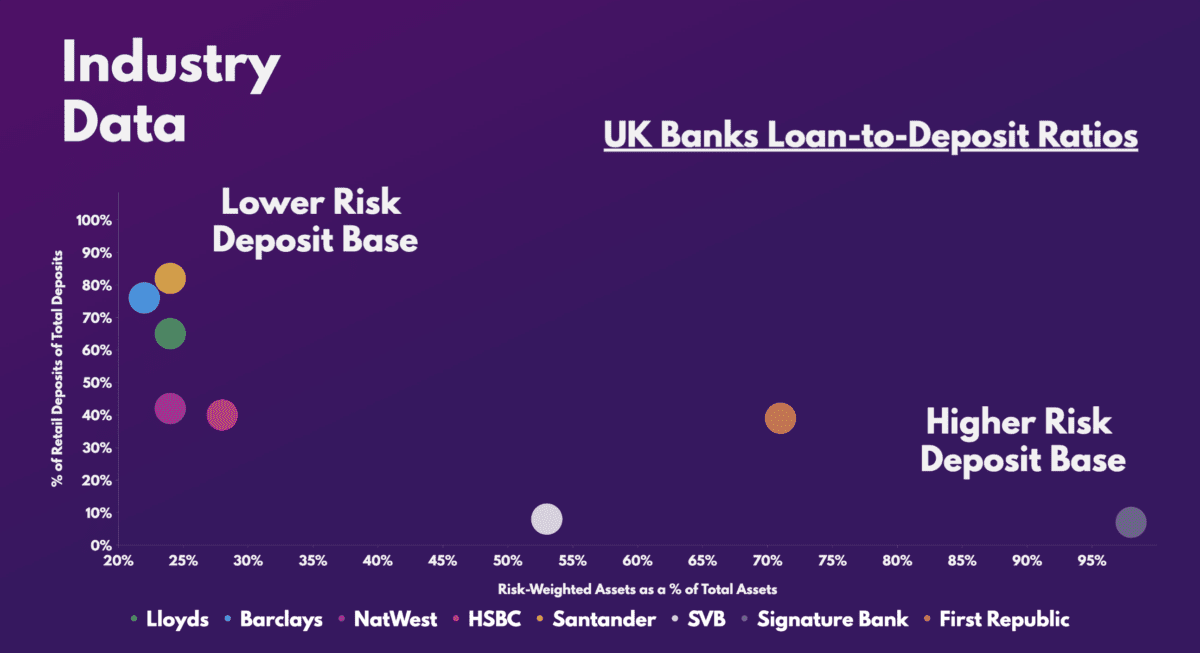
Lloyds Shares - UK Banks Loan-to-Deposit Ratios.
Data source: Lloyds, Barclays, NatWest, HSBC, Santander UK, SVB, Signature Bank, First Republic

More importantly, its percentage of risk-weighted assets isn’t nearly as high as its collapsing US counterparts. Pair this with the fact that Lloyds stores a healthy pile of its cash (£9.14bn) with the Bank of England, and it reinforces its margin of safety.

Should I buy Lloyds shares?

Investing in bank stocks carry a high amount of risks. Hence, it’s important to buy shares only in banks with strong fundamentals and a low exposure to risk, especially times like these. Lloyds is one such example.

Given its strong financial footing, and less risky asset base, it seems well equipped to weather the current downturn and a potential contagion event. This sentiment is echoed by the likes of JP Morgan and Liberium, who say that the current decline presents an opportunity for investors.

And when considering its valuation multiples, it certainly seems like it. After all, Citi reiterated its ‘top pick’ rating for the stock, with Goldman Sachs and Barclays also rating the shares a ‘buy’ with an average price target of 75p. This presents a 60% upside from current levels.

MetricsLloydsIndustry average
Price-to-book (P/B) ratio0.70.7
Price-to-earnings (P/E) ratio6.69.5
Forward price-to-earnings (FP/E) ratio6.98.0
Data source: Google Finance

So, having considered Lloyds’ financial position and weighing out the risk-reward proposition, I believe the stock’s decline presents a buying opportunity for me. Therefore, I’ll be increasing my position while capitalising on its lucrative dividend yield, which currently sits at 5.1%.


SVB Financial provides credit and banking services to The Motley Fool. Citigroup is an advertising partner of The Ascent, a Motley Fool company. JPMorgan Chase is an advertising partner of The Ascent, a Motley Fool company. John Choong has positions in Lloyds Banking Group Plc. The Motley Fool UK has recommended Barclays Plc and Lloyds Banking Group Plc. Views expressed on the companies mentioned in this article are those of the writer and therefore may differ from the official recommendations we make in our subscription services such as Share Advisor, Hidden Winners and Pro. Here at The Motley Fool we believe that considering a diverse range of insights makes us better investors.

More on Dividend Shares

Woman riding her old fashioned bicycle along the Beach Esplanade at Aberdeen, Scotland.
Investing Articles

Just 97 shares of this UK dividend stock generate £238 in passive income

A 5.7% yield, £238 in passive income from just 97 shares, and one of the most divisive dividend stocks on…

Read more »

ISA coins
Investing Articles

£10,000 in an ISA generates a second income of…

The London Stock Exchange is home to some of the world's most generous dividends. But how big a second income…

Read more »

Shot of a senior man drinking coffee and looking thoughtfully out of a window
Investing Articles

Expert recommendations: 2 top income stocks yielding 7%+!

With yields of 7.2% and 7.8% respectively, these two income stocks are catching the eyes of institutional analysts. Should investors…

Read more »

A mature woman help a senior woman out of a car as she takes her to the shops.
Investing Articles

How to invest £150 a month in shares to target a £7,660 passive income for life

Investing a small sum regularly in quality UK shares can generate a solid passive income in the long term. Zaven…

Read more »

Couple working from home while daughter watches video on smartphone with headphones on
Investing Articles

How much do you need in an ISA to earn a second income of £14,713 a year? 

Harvey Jones says it's possible to get a second income without the effort of finding another job, by investing in…

Read more »

Portrait Of Senior Couple Climbing Hill On Hike Through Countryside In Lake District UK Together
Investing Articles

The Legal & General share price is at a 10-year low – but the dividend income is stunning!

Harvey Jones is frustrated by the Legal & General share price, which has struggled to grow in recent years. But…

Read more »

Tree lined "tunnel" in the English countryside of West Sussex in autumn
Investing Articles

How much do you need in an ISA for a £1,525 monthly second income?

Alan Oscroft takes a look at how long-term investors can use a Stocks and Shares ISA to target a welcome…

Read more »

Little girl helping her Grandad plant tomatoes in a greenhouse in his garden.
Investing Articles

How much does an ISA investor need to target a £767 monthly income?

Harvey Jones crunches the numbers to show how much Stocks and Shares ISA investors need to build a high-and-rising passive…

Read more »