


We have some exciting news to share! The Motley Fool UK has now become The Twelfth Magpie -- an independent, UK-owned company, led by our long-serving UK management team — Mark Rogers, Chris Nials and Heather Adlington. In practical terms, it’s the same team you know, now fully focused on serving our UK readers and members.

Just as importantly, our approach remains unchanged: long-term, jargon-free, and on your side. This site is our new home, and there will be extra tweaks made across the coming few days as we settle in. So if anything looks a little off, please bear with us!

The content of this article was relevant at the time of publishing. Circumstances change continuously and caution should therefore be exercised when relying upon any content contained within this article.

Stock market depression: a once-in-a-decade chance to get richer

The stock market has an impressive way of getting back on track. So what should investors make of the depressed FTSE 100 today?

Young woman working at modern office. Technical price graph and indicator, red and green candlestick chart and stock trading computer screen background.

Image source: Getty Images

You’re reading a free article with opinions that may differ from The Motley Fool’s Premium Investing Services. Become a Motley Fool member today to get instant access to our top analyst recommendations, in-depth research, investing resources, and more. Learn More.

We haven’t experienced a stock market correction in the technical sense in recent months, but it’s clear for everyone to see, the FTSE 100 is underperforming.

In fact, over five years, the FTSE 100 is up just 2%. It’s among the worst performing major indexes worldwide.

XXX

The UK stock market

There are many negative pressures taking their toll on the lead index. These include:

  1. Rising interest rates (part 1). As interest rates rise, capital is often reallocated is cash and debt. These asset classes offer stronger returns when interest rates are higher
  2. Rising interest rates (part 2). Higher interest rates can increase borrowing costs for businesses. It also dampens investment activities and increase servicing costs
  3. Ukraine conflict. The ongoing war has introduced uncertainty and volatility into the global economy, affecting stock markets. Investors are concerned about the potential consequences on economic growth and stability
  4. Weak economic indicators. Recent economic data from both the US and Europe has displayed signs of weakness, further contributing to the decline in stock prices
  5. Raised commodity prices. Prices of commodities like oil and gas remain high, placing additional pressure on businesses
  6. Self-fulfilling prophecy. Investors don’t want to put their money in underperforming markets. The index, despite attractive valuations, continues to perform worse than the S&P 500.
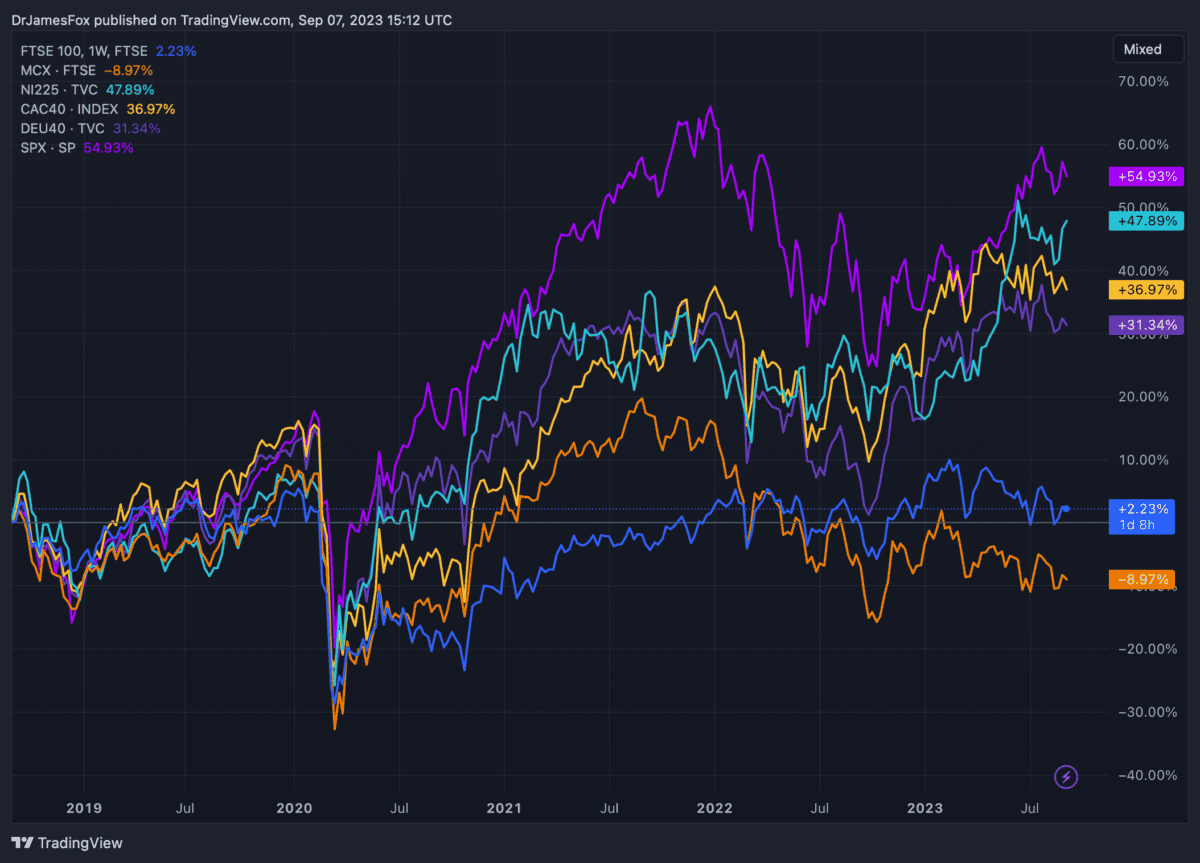
Created at TradingView

The above chart highlights the relative performance of the FTSE 100 over five years. Only the FTSE 250 has performed worse over the time period.

Investing in depressed markets

Investing in tricky times, a strategy favoured by renowned investor Warren Buffett, involves seizing opportunities when stock prices are undervalued due to market pessimism.

During market downturns, quality companies can often be found trading at a discount to their intrinsic value, making them attractive prospects for value-oriented investors.

Buffett’s approach to depressed markets emphasises patience and a long-term outlook. Instead of succumbing to short-term market volatility and emotional reactions, investors following his lead focus on the fundamentals of the businesses they invest in.

Market-beating returns

By identifying financially strong companies with competitive advantages and enduring appeal, and holding onto these over time, investors can potentially reap substantial rewards when market sentiment eventually improves.

Buffett’s successful track record underscores the effectiveness of this strategy, demonstrating that investing with a rational and disciplined approach in depressed markets can lead to long-term wealth accumulation. It’s not a risk-free strategy, but it does work.

It’s important to remember that historically, markets have eventually rebounded. For instance, after the 2008 financial crisis, the FTSE 100 dropped to about 3,500 points. By 2021, it had surpassed 7,000 points, nearly doubling.

This means investors who bought during the downturns benefited from substantial growth when the market recovered.

Market-beating returns can be achieved by seizing opportunities in depressed markets, as they tend to be temporary setbacks. By buying low and holding quality investments patiently, investors have the potential to benefit from significant gains when market sentiment improves and stock prices rise.

This is how investors could get richer!

James Fox has no position in any of the shares mentioned. The Motley Fool UK has no position in any of the shares mentioned. Views expressed on the companies mentioned in this article are those of the writer and therefore may differ from the official recommendations we make in our subscription services such as Share Advisor, Hidden Winners and Pro. Here at The Motley Fool we believe that considering a diverse range of insights makes us better investors.

More on Investing Articles

Friends and sisters exploring the outdoors together in Cornwall. They are standing with their arms around each other at the coast.
Investing Articles

£503 buys 14 shares in this FTSE 250 stock that returned 23.9% annually for the last 15 years

This FTSE 250 stock has averaged a huge return for 15 years. At today's price, £503 buys 14 shares. But…

Read more »

Black woman using loudspeaker to be heard
Investing Articles

£1,000 buys 25 shares in this FTSE 100 stock that’s returned 29.2% annually for the last 10 years

This FTSE 100 mining stock has returned close to 30% a year for a decade. At 3,995p, £1,000 buys 25…

Read more »

Female student sitting at the steps and using laptop
Investing Articles

Down 47%, is this growth stock finally worth buying in May?

With a £288m order book and a hidden pipeline of defence and nuclear contracts, is this growth stock now too…

Read more »

House models and one with REIT - standing for real estate investment trust - written on it.
Investing Articles

2 REITs yielding 7%+ to consider for passive income in 2026

A REIT backed by the NHS and another backed by Tesco and Sainsbury's with both yielding 7%+. Here's why I'm…

Read more »

Woman riding her old fashioned bicycle along the Beach Esplanade at Aberdeen, Scotland.
Investing Articles

Just 97 shares of this UK dividend stock generate £238 in passive income

A 5.7% yield, £238 in passive income from just 97 shares, and one of the most divisive dividend stocks on…

Read more »

ISA coins
Investing Articles

£10,000 in an ISA generates a second income of…

The London Stock Exchange is home to some of the world's most generous dividends. But how big a second income…

Read more »

Shot of a senior man drinking coffee and looking thoughtfully out of a window
Investing Articles

Expert recommendations: 2 top income stocks yielding 7%+!

With yields of 7.2% and 7.8% respectively, these two income stocks are catching the eyes of institutional analysts. Should investors…

Read more »

Illustration of flames over a black background
Investing Articles

3 top income-focused stocks to buy in May 2026, according to experts

Looking for a stock to buy for income in May 2026? Experts have flagged these three UK dividend shares as…

Read more »






