


We have some exciting news to share! The Motley Fool UK has now become The Twelfth Magpie -- an independent, UK-owned company, led by our long-serving UK management team — Mark Rogers, Chris Nials and Heather Adlington. In practical terms, it’s the same team you know, now fully focused on serving our UK readers and members.

Just as importantly, our approach remains unchanged: long-term, jargon-free, and on your side. This site is our new home, and there will be extra tweaks made across the coming few days as we settle in. So if anything looks a little off, please bear with us!

The content of this article was relevant at the time of publishing. Circumstances change continuously and caution should therefore be exercised when relying upon any content contained within this article.

With no savings at 30, I’d use the Warren Buffett method to try and get rich!

Warren Buffett has built a fortune worth $120bn+. Here’s how investors, even with no starting capital, can embark on their own wealth-creating journeys.

Smiling white woman holding iPhone with Airpods in ear

Image source: Getty Images

You’re reading a free article with opinions that may differ from The Motley Fool’s Premium Investing Services. Become a Motley Fool member today to get instant access to our top analyst recommendations, in-depth research, investing resources, and more. Learn More.

Given Warren Buffett‘s success, investors can do a lot worse than following his lead. The 93-year-old has carved out a fortune worth £123bn, making him one of the wealthiest individuals in the world.

So, how did Buffett do it? Let’s explore his method for building wealth.

XXX

Don’t lose money

It sounds obvious and easier said than done, but not losing money is key. However, this reflects Buffett’s approach to investing, which emphasises investing in undervalued shares with significant margins of safety.

To understand this properly, we have to remind ourselves that investing in stocks is actually about owning shares of companies. And when Buffett invests in companies, he wants to know that he’s getting a discount.

So, how do we know if we’re getting a discount?

Well, to find the answer we’ve got to do our research. There are numerous models and metrics we can use, such as the price-to-earnings (P/E) ratio, the price-to-book (P/B) ratio, and the discounted cash flow model.

For example, I’d suggest that if Buffett invested more readily in UK stocks, he’d like Barclays. That’s because the blue-chip stock trades at just 5.2 times earnings, and 0.45 times P/B.

The P/B is particularly interesting as it suggests that Barclays is at a 55% discount versus its tangible net asset value. In this respect, Barclays is phenomenally cheap compared to its peers. Most US banks trade with a P/B ratio around one, so their valuation is in line with asset value.

Generating wealth

Buffett has a long investment horizon. He holds stocks for decades and he also continually reinvests. This has allowed him to benefit from a concept known as compound returns.

Compound returns happens when we reinvest our returns year after year. In turn, this allows us to earn interest on our returns in addition to our original investment. It literally compounds year over year. This strategy also leads to an exponential growth rate as highlighted below.
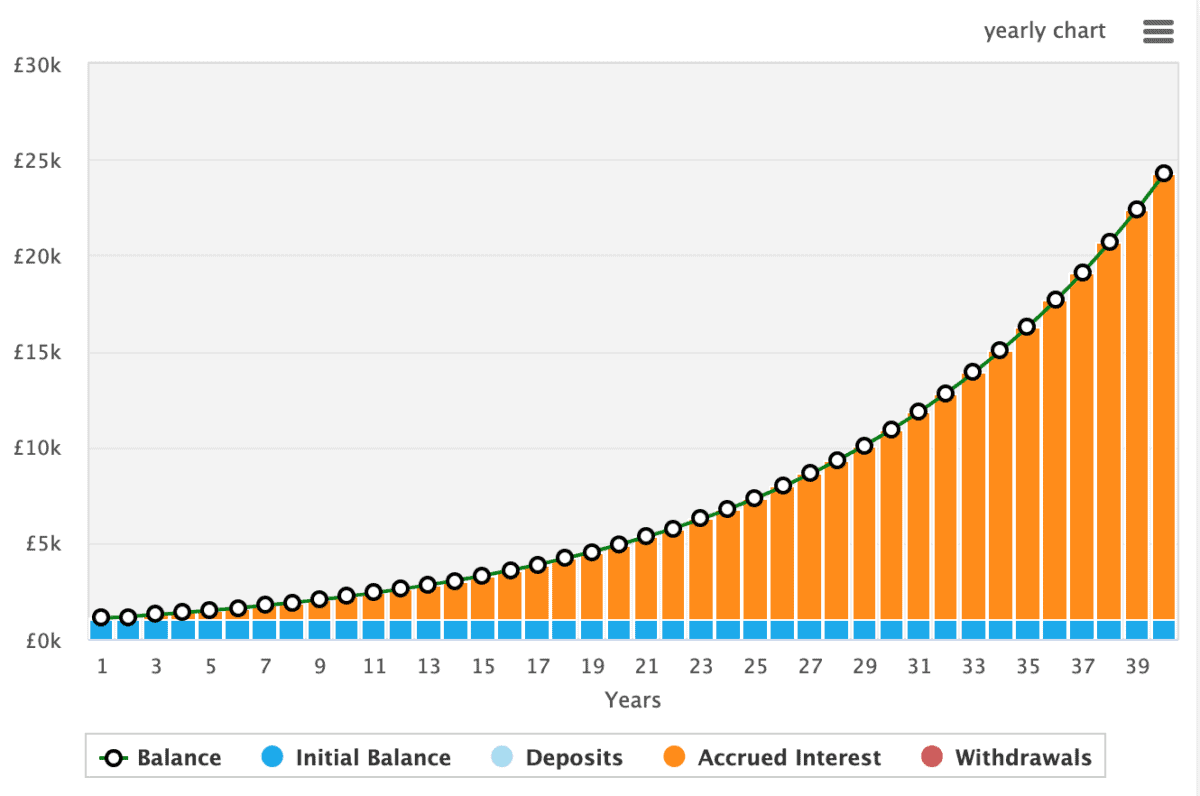
Created at thecalculatorsite.com

Regular and disciplined savings play a fundamental role in building wealth in stocks over the long run. Consistency in contributing to my investment portfolio, even with modest amounts, has the power of compounding on its side.

Moreover, when I consistently invest a fixed amount at regular intervals, I’m essentially buying shares at various price points, benefiting from both market highs and lows. This strategy, known as pound-cost averaging, minimises the impact of market volatility and reduces the risk associated with trying to time the market.

But risk can’t be ignored. I need to recognise that if I invest poorly, I could lose money.

What if we have no starting capital?

These days we can kickstart an account just by committing to invest a proportion of our monthly earnings. With £100 a month, I could slowly but surely build wealth, and by following Warren Buffett’s investment lessons, hopefully get rich.

Of course, being ‘rich’ is a subjective concept, but when starting with nothing, even developing a portfolio worth in excess of £10,000 could feel like a win!


James Fox has no position in any of the shares mentioned. The Motley Fool UK has no position in any of the shares mentioned. Views expressed on the companies mentioned in this article are those of the writer and therefore may differ from the official recommendations we make in our subscription services such as Share Advisor, Hidden Winners and Pro. Here at The Motley Fool we believe that considering a diverse range of insights makes us better investors.

More on Investing Articles

Friends and sisters exploring the outdoors together in Cornwall. They are standing with their arms around each other at the coast.
Investing Articles

£503 buys 14 shares in this FTSE 250 stock that returned 23.9% annually for the last 15 years

This FTSE 250 stock has averaged a huge return for 15 years. At today's price, £503 buys 14 shares. But…

Read more »

Black woman using loudspeaker to be heard
Investing Articles

£1,000 buys 25 shares in this FTSE 100 stock that’s returned 29.2% annually for the last 10 years

This FTSE 100 mining stock has returned close to 30% a year for a decade. At 3,995p, £1,000 buys 25…

Read more »

Female student sitting at the steps and using laptop
Investing Articles

Down 47%, is this growth stock finally worth buying in May?

With a £288m order book and a hidden pipeline of defence and nuclear contracts, is this growth stock now too…

Read more »

House models and one with REIT - standing for real estate investment trust - written on it.
Investing Articles

2 REITs yielding 7%+ to consider for passive income in 2026

A REIT backed by the NHS and another backed by Tesco and Sainsbury's with both yielding 7%+. Here's why I'm…

Read more »

Woman riding her old fashioned bicycle along the Beach Esplanade at Aberdeen, Scotland.
Investing Articles

Just 97 shares of this UK dividend stock generate £238 in passive income

A 5.7% yield, £238 in passive income from just 97 shares, and one of the most divisive dividend stocks on…

Read more »

ISA coins
Investing Articles

£10,000 in an ISA generates a second income of…

The London Stock Exchange is home to some of the world's most generous dividends. But how big a second income…

Read more »

Shot of a senior man drinking coffee and looking thoughtfully out of a window
Investing Articles

Expert recommendations: 2 top income stocks yielding 7%+!

With yields of 7.2% and 7.8% respectively, these two income stocks are catching the eyes of institutional analysts. Should investors…

Read more »

Illustration of flames over a black background
Investing Articles

3 top income-focused stocks to buy in May 2026, according to experts

Looking for a stock to buy for income in May 2026? Experts have flagged these three UK dividend shares as…

Read more »





