


We have some exciting news to share! The Motley Fool UK has now become The Twelfth Magpie -- an independent, UK-owned company, led by our long-serving UK management team — Mark Rogers, Chris Nials and Heather Adlington. In practical terms, it’s the same team you know, now fully focused on serving our UK readers and members.

Just as importantly, our approach remains unchanged: long-term, jargon-free, and on your side. This site is our new home, and there will be extra tweaks made across the coming few days as we settle in. So if anything looks a little off, please bear with us!

The content of this article was relevant at the time of publishing. Circumstances change continuously and caution should therefore be exercised when relying upon any content contained within this article.

When will Lloyds shares hit 60p again?

Before the pandemic, Lloyds shares frequently traded around 60p. The bank’s fundamentals have improved so why is the stock so discounted?

| More on:
2024 year number handwritten on a sandy beach at sunrise

Image source: Getty Images

You’re reading a free article with opinions that may differ from The Motley Fool’s Premium Investing Services. Become a Motley Fool member today to get instant access to our top analyst recommendations, in-depth research, investing resources, and more. Learn More.

I’ve been taking advantage of the recent deterioration in the price of Lloyds (LSE:LLOY) shares to top up my holdings. The blue-chip bank is currently trading around 43p, down from highs around 54p earlier in the year.


XXX

Trading at a discount

Prior to the pandemic, Lloyds shares were frequently hovering around the 60p mark. The stock has not reached that high in the years since. And I find this particularly interesting.

After all, at the time, the UK had already voted for Brexit — a risk factor that kept the stock depressed for a while — and interest rates were near zero to stimulate growth.

Lloyds was also less profitable than it is today. The bank delivered £4.2bn in profit before tax in 2019 versus £6.9bn last year. So, why are Lloyds shares trading at a discount versus their pre-pandemic levels?

Default risks

Lloyds shares, like other banks, were pushing upwards until February when the SVB fiasco sent financial stocks into reverse.

While SVB was something of a warning for the industry, interest rates have since pushed higher, extending far beyond the Goldilocks zone.

The relationship between interest rates and bank profitability isn’t a simple one. On one side, there’s a tailwind as net interest margins have increased with rising interest rates.

On the other hand, as interest rates have extended beyond 3%, there’s been increasing concern about the capacity of individuals and businesses to make their growing repayments.

Under the bank’s worst-case forecast, expected credit losses could reach £10.1bn. To put that into context, under the base-case scenario, the bank foresees expected credit losses of £4.2bn.
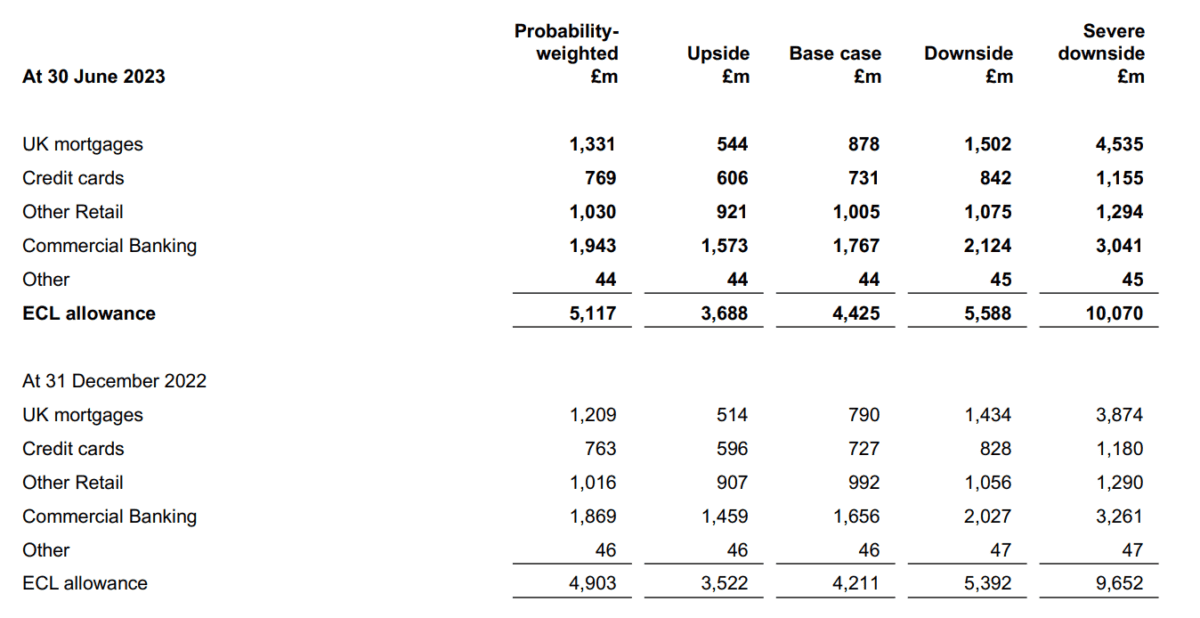
Source: Lloyds

Is it really that bad?

Since Lloyds published the above forecasts in its half-year results in late-July, there have been some broad sentiment changes.

With UK economic growth supposedly stronger than we had expected, and more signs that interest rates have peaked, it’s possible that the worst-case scenario has been avoided.

Moreover, investors may find some peace in the recent UK banks stress stress. Under the stress scenario, its Common Equity Tier 1 (a measure of liquidity) would fall to 11.6%. Lloyds was the second-best performer of all UK banks.

The recent struggles of Metro Bank may have contributed to some further concerns about the health of the UK banking sector. However, after a new deal, announced on Sunday, an SVB-esque fiasco has been avoided.

Heading to 60p

Trading at 5.5 times earnings, Lloyds isn’t expensive. In fact, it trades at a significant discount to peers including HSBC, Standard Chartered, and other non-UK focused institutions. If we were to apply a price-to-earnings ratio comparable with its international peers (8 times), the stock would be trading around 65p.

Likewise, we can see that Lloyds trades with a price-to-book ratio of 0.58 times, inferring a 42% discount versus its tangible net asset value. Risk, in my opinion, is too heavily factored into the share price.

By comparison, US institutions trade with a P/B around one. As such, if we applied a P/B of one, we’d expect to see the Lloyds share price at 75p.

So, barring any severe economic slowdowns or mass defaults, I expect to see the Lloyds share price creep towards 60p.


HSBC Holdings is an advertising partner of The Ascent, a Motley Fool company. James Fox has positions in HSBC Holdings, Lloyds Banking Group Plc, and Standard Chartered Plc. The Motley Fool UK has recommended HSBC Holdings, Lloyds Banking Group Plc, and Standard Chartered Plc. Views expressed on the companies mentioned in this article are those of the writer and therefore may differ from the official recommendations we make in our subscription services such as Share Advisor, Hidden Winners and Pro. Here at The Motley Fool we believe that considering a diverse range of insights makes us better investors.

More on Investing Articles

Friends and sisters exploring the outdoors together in Cornwall. They are standing with their arms around each other at the coast.
Investing Articles

£503 buys 14 shares in this FTSE 250 stock that returned 23.9% annually for the last 15 years

This FTSE 250 stock has averaged a huge return for 15 years. At today's price, £503 buys 14 shares. But…

Read more »

Black woman using loudspeaker to be heard
Investing Articles

£1,000 buys 25 shares in this FTSE 100 stock that’s returned 29.2% annually for the last 10 years

This FTSE 100 mining stock has returned close to 30% a year for a decade. At 3,995p, £1,000 buys 25…

Read more »

Female student sitting at the steps and using laptop
Investing Articles

Down 47%, is this growth stock finally worth buying in May?

With a £288m order book and a hidden pipeline of defence and nuclear contracts, is this growth stock now too…

Read more »

House models and one with REIT - standing for real estate investment trust - written on it.
Investing Articles

2 REITs yielding 7%+ to consider for passive income in 2026

A REIT backed by the NHS and another backed by Tesco and Sainsbury's with both yielding 7%+. Here's why I'm…

Read more »

Woman riding her old fashioned bicycle along the Beach Esplanade at Aberdeen, Scotland.
Investing Articles

Just 97 shares of this UK dividend stock generate £238 in passive income

A 5.7% yield, £238 in passive income from just 97 shares, and one of the most divisive dividend stocks on…

Read more »

ISA coins
Investing Articles

£10,000 in an ISA generates a second income of…

The London Stock Exchange is home to some of the world's most generous dividends. But how big a second income…

Read more »

Shot of a senior man drinking coffee and looking thoughtfully out of a window
Investing Articles

Expert recommendations: 2 top income stocks yielding 7%+!

With yields of 7.2% and 7.8% respectively, these two income stocks are catching the eyes of institutional analysts. Should investors…

Read more »

Illustration of flames over a black background
Investing Articles

3 top income-focused stocks to buy in May 2026, according to experts

Looking for a stock to buy for income in May 2026? Experts have flagged these three UK dividend shares as…

Read more »





