


We have some exciting news to share! The Motley Fool UK has now become The Twelfth Magpie -- an independent, UK-owned company, led by our long-serving UK management team — Mark Rogers, Chris Nials and Heather Adlington. In practical terms, it’s the same team you know, now fully focused on serving our UK readers and members.

Just as importantly, our approach remains unchanged: long-term, jargon-free, and on your side. This site is our new home, and there will be extra tweaks made across the coming few days as we settle in. So if anything looks a little off, please bear with us!

The content of this article was relevant at the time of publishing. Circumstances change continuously and caution should therefore be exercised when relying upon any content contained within this article.

When will the FTSE 100 hit 8,000 again?

The FTSE 100 has been pulled one way and then another over the past 12 months. So, where will the index go next and when might we see 8,000 again?

Businessman use electronic pen writing rising colorful graph from 2023 to 2024 year of business planning and stock investment growth concept.

Image source: Getty Images

You’re reading a free article with opinions that may differ from The Motley Fool’s Premium Investing Services. Become a Motley Fool member today to get instant access to our top analyst recommendations, in-depth research, investing resources, and more. Learn More.

The FTSE 100 has been exhibiting the same volatility we’re seeing elsewhere in the world. And in recent months, markets have become even more sensitive to macroeconomic commentary and geopolitical events.

But it’s also been an eventful year in general. Hamas’s tragic attack on Israel being the latest example, sending energy and defence stocks higher, and most other stocks lower.

XXX

EFA Forecast

The Economy Forecast Agency (EFA) regularly updates its predictions for the trajectory of the FTSE 100. In the past, the EFA has demonstrated surprising accuracy. Its forecasts have been largely on target, providing valuable insights for investors navigating through these uncertain times.

However, in recent months, I noticed that the agency has frequently changed its forecast trajectory for the index, indicating some degree of uncertainty. Under the current forecast, the EFA doesn’t see the FTSE 100 reaching 8,000 again until next October. And that’s in its most optimistic scenario.
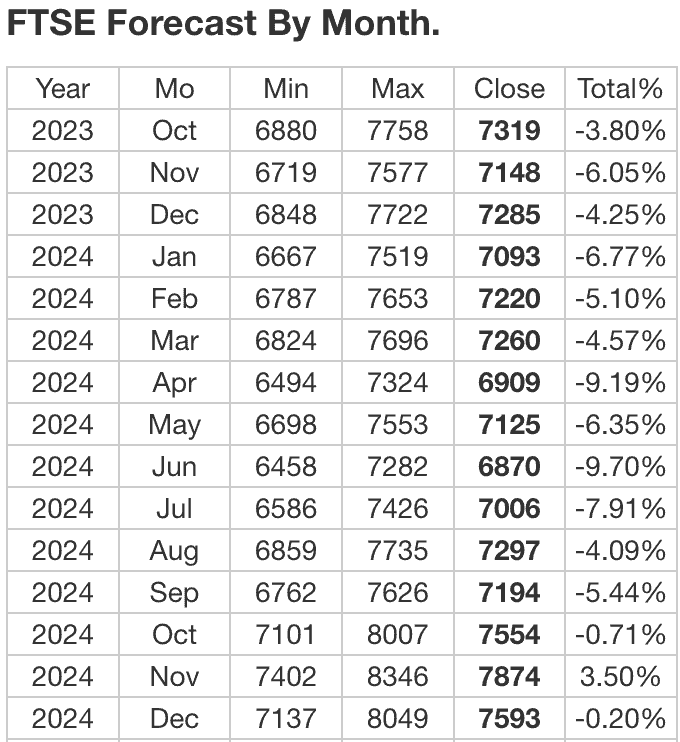
Source: EFA

Of course, this doesn’t paint the best picture of the index’s outlook. And in reality, it’s likely that the forecast will change regularly over the coming months.

Interest rates

Interest rates can have a big impact on markets, and often in ways investors don’t properly consider.

Higher interest rates, currently at 5.25%, can lead to increased borrowing costs for businesses and consumers, potentially reducing corporate profitability and slowing economic growth.

However, as rates moderate to 2%-3% over the medium term, the reduced borrowing costs may enhance profitability and stimulate economic activity, benefiting companies in the FTSE 100.

This is frequently noted by investors.

However, the second way is arguably more profound. With rates where they are today, investors have been turning to cash and debt for lower risk and often guaranteed returns.

Lower interest rates can make stocks more attractive relative to bonds, potentially driving investment back into shares, including those listed on the FTSE 100. As such, falling rates could push the index upwards.

Economics and geopolitics

Some of the sectors most heavily represented in the FTSE 100 include financial services, oil and gas, healthcare, consumer goods, and mining. This means that the index can be pulled in two directions by geopolitical events and economic data.

For example, the awful events in Gaza sent most stocks downwards, while energy and defence companies moved upwards on stronger oil.

Conflict in the Middle East is never good for markets in general, however. There are several ‘chokepoints’ for oil in the region, including the Persian Gulf and the Straits of Hormuz. Clearly there are fears the conflict could spread.

Looking forward, it’s impossible to forecast what may happen next. An end to conflict in Ukraine and an early conclusion to the conflict in Gaza would undoubtedly be positive for markets.

Such outcomes often reduce geopolitical risk, alleviate concerns about supply disruptions, and bolster investor confidence in global markets.

Nevertheless, it’s essential to remain vigilant and adaptable, as geopolitical developments can move swiftly, influencing market sentiment and investment decisions.

So, while the FTSE 100 isn’t forecast to hit 8,000 for a while, a changing geopolitical environment could speed up this process.


James Fox has no position in any of the shares mentioned. The Motley Fool UK has no position in any of the shares mentioned. Views expressed on the companies mentioned in this article are those of the writer and therefore may differ from the official recommendations we make in our subscription services such as Share Advisor, Hidden Winners and Pro. Here at The Motley Fool we believe that considering a diverse range of insights makes us better investors.

More on Investing Articles

Friends and sisters exploring the outdoors together in Cornwall. They are standing with their arms around each other at the coast.
Investing Articles

£503 buys 14 shares in this FTSE 250 stock that returned 23.9% annually for the last 15 years

This FTSE 250 stock has averaged a huge return for 15 years. At today's price, £503 buys 14 shares. But…

Read more »

Black woman using loudspeaker to be heard
Investing Articles

£1,000 buys 25 shares in this FTSE 100 stock that’s returned 29.2% annually for the last 10 years

This FTSE 100 mining stock has returned close to 30% a year for a decade. At 3,995p, £1,000 buys 25…

Read more »

Female student sitting at the steps and using laptop
Investing Articles

Down 47%, is this growth stock finally worth buying in May?

With a £288m order book and a hidden pipeline of defence and nuclear contracts, is this growth stock now too…

Read more »

House models and one with REIT - standing for real estate investment trust - written on it.
Investing Articles

2 REITs yielding 7%+ to consider for passive income in 2026

A REIT backed by the NHS and another backed by Tesco and Sainsbury's with both yielding 7%+. Here's why I'm…

Read more »

Woman riding her old fashioned bicycle along the Beach Esplanade at Aberdeen, Scotland.
Investing Articles

Just 97 shares of this UK dividend stock generate £238 in passive income

A 5.7% yield, £238 in passive income from just 97 shares, and one of the most divisive dividend stocks on…

Read more »

ISA coins
Investing Articles

£10,000 in an ISA generates a second income of…

The London Stock Exchange is home to some of the world's most generous dividends. But how big a second income…

Read more »

Shot of a senior man drinking coffee and looking thoughtfully out of a window
Investing Articles

Expert recommendations: 2 top income stocks yielding 7%+!

With yields of 7.2% and 7.8% respectively, these two income stocks are catching the eyes of institutional analysts. Should investors…

Read more »

Illustration of flames over a black background
Investing Articles

3 top income-focused stocks to buy in May 2026, according to experts

Looking for a stock to buy for income in May 2026? Experts have flagged these three UK dividend shares as…

Read more »





