


We have some exciting news to share! The Motley Fool UK has now become The Twelfth Magpie -- an independent, UK-owned company, led by our long-serving UK management team — Mark Rogers, Chris Nials and Heather Adlington. In practical terms, it’s the same team you know, now fully focused on serving our UK readers and members.

Just as importantly, our approach remains unchanged: long-term, jargon-free, and on your side. This site is our new home, and there will be extra tweaks made across the coming few days as we settle in. So if anything looks a little off, please bear with us!

The content of this article was relevant at the time of publishing. Circumstances change continuously and caution should therefore be exercised when relying upon any content contained within this article.

Are FTSE 100 banks oversold?

FTSE 100 banks, notably Barclays and Lloyds, suffered over the past week. Dr James Fox highlights why this could represent a buying opportunity.

| More on:
Young Caucasian man making doubtful face at camera

Image source: Getty Images

You’re reading a free article with opinions that may differ from The Motley Fool’s Premium Investing Services. Become a Motley Fool member today to get instant access to our top analyst recommendations, in-depth research, investing resources, and more. Learn More.

FTSE 100 banks have experienced a challenging week. Barclays (LSE:BARC) fell as much as 8% on Tuesday (24 October), while on Wednesday, Lloyds (LSE:LLOY) dipped to 38p a share after its results. Interestingly both stocks beat earnings expectations.

Here’s why I believe they’re both oversold.

XXX

Net interest margins

Barclays and Lloyds fell primarily on concerns that net interest margins (NIMs) are falling. Lloyds’s NIM for the last quarter came in at 3.08% while Barclays revised its annualised NIM to 3.05%-3.1%, down from 3.15%-3.2%.

However, it’s worthwhile putting this data into context. The current NIMs we’re seeing are far above the average seen over the past two decades in the UK, as the below chart shows.
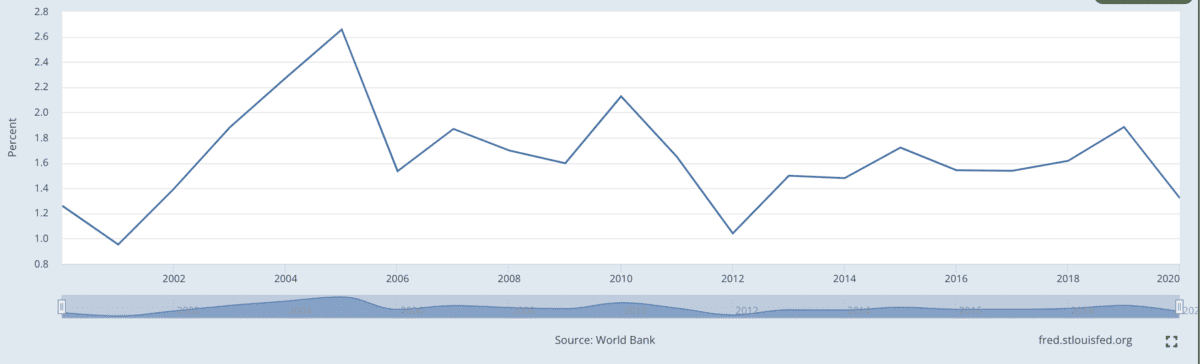
Source: World Bank — Net interest margins in the UK 2000-2020

As we can see, the current NIMs of the two banks in question are significantly above the long-run average for the UK.

Valuations

These are the two cheapest FTSE 100 banks by several metrics. They’re also considerably cheaper than their US counterparts.

For example, while Barclays and Lloyds trade at 4.2 and 4.9 times TTM (trailing 12 months) earnings, JP Morgan and Bank of America trade at 8.4 and 7.1 times, respectively.

It’s a similar story on a forward basis too. Barclays and Lloyds trade at 4.8 and 5.5 times forward earnings while JP Morgan and Bank of America trade at 8.5 and 7.5 times forward earnings.

While investors tend to have a more positive outlook on the US economy and US banks, it’s not straightforward. For one, Barclays earns around a quarter of its revenues in the US.

However, looking at metrics including the return on equity (RoE), we can see some patterns emerging, connecting business performance with stock valuation.

RoE at Barclays and Lloyds is 9.5% and 12.6%, respectively, while at JP Morgan and Bank of America it’s 16.9% and 10.9%.

The net interest margin, in percentage form, shows a similar story. Barclays and Lloyds have NIM percentages ratios of 27.3% and 32.2% while JP Morgan and Bank of America ratios come in at 36% and 31.5%.

As a final comparison to their US peers, we can see that Barclays and Lloyds trade at 0.5 and 0.67 times book value while JP Morgan and Bank of America trade at 1.41 and 0.78 times, respectively.

Forecasting

While investors and analysts focused on NIM forecasts in the last tranche of results, for about a year, investors were more concerned about impairment charges amid growing defaults.

However, it does appear that the worst-case scenario — one in which there would be a host of credit defaults — has been avoided.

Of course, there’s still a threat that a hard landing would cause untold damaged to house prices, and job losses would mean a slew of credit losses.

But right now, we’re not seeing that. Lloyds actually said its customers were dealing well with higher interest rates — the caveat being the average Lloyds mortgage customer earns £75,000.

With interest rates remaining elevated, but likely to moderate in the medium term, coupled with more resilient borrowers, I think there are reasons to be positive.

But more specifically, I think there’s very little reasoning for the discounts afforded to Barclays and Lloyds. Both these stocks remain core parts of my portfolio.


Bank of America is an advertising partner of The Ascent, a Motley Fool company. JPMorgan Chase is an advertising partner of The Ascent, a Motley Fool company. James Fox has positions in Barclays Plc and Lloyds Banking Group Plc. The Motley Fool UK has recommended Barclays Plc and Lloyds Banking Group Plc. Views expressed on the companies mentioned in this article are those of the writer and therefore may differ from the official recommendations we make in our subscription services such as Share Advisor, Hidden Winners and Pro. Here at The Motley Fool we believe that considering a diverse range of insights makes us better investors.

More on Investing Articles

Friends and sisters exploring the outdoors together in Cornwall. They are standing with their arms around each other at the coast.
Investing Articles

£503 buys 14 shares in this FTSE 250 stock that returned 23.9% annually for the last 15 years

This FTSE 250 stock has averaged a huge return for 15 years. At today's price, £503 buys 14 shares. But…

Read more »

Black woman using loudspeaker to be heard
Investing Articles

£1,000 buys 25 shares in this FTSE 100 stock that’s returned 29.2% annually for the last 10 years

This FTSE 100 mining stock has returned close to 30% a year for a decade. At 3,995p, £1,000 buys 25…

Read more »

Female student sitting at the steps and using laptop
Investing Articles

Down 47%, is this growth stock finally worth buying in May?

With a £288m order book and a hidden pipeline of defence and nuclear contracts, is this growth stock now too…

Read more »

House models and one with REIT - standing for real estate investment trust - written on it.
Investing Articles

2 REITs yielding 7%+ to consider for passive income in 2026

A REIT backed by the NHS and another backed by Tesco and Sainsbury's with both yielding 7%+. Here's why I'm…

Read more »

Woman riding her old fashioned bicycle along the Beach Esplanade at Aberdeen, Scotland.
Investing Articles

Just 97 shares of this UK dividend stock generate £238 in passive income

A 5.7% yield, £238 in passive income from just 97 shares, and one of the most divisive dividend stocks on…

Read more »

ISA coins
Investing Articles

£10,000 in an ISA generates a second income of…

The London Stock Exchange is home to some of the world's most generous dividends. But how big a second income…

Read more »

Shot of a senior man drinking coffee and looking thoughtfully out of a window
Investing Articles

Expert recommendations: 2 top income stocks yielding 7%+!

With yields of 7.2% and 7.8% respectively, these two income stocks are catching the eyes of institutional analysts. Should investors…

Read more »

Illustration of flames over a black background
Investing Articles

3 top income-focused stocks to buy in May 2026, according to experts

Looking for a stock to buy for income in May 2026? Experts have flagged these three UK dividend shares as…

Read more »





