


We have some exciting news to share! The Motley Fool UK has now become The Twelfth Magpie -- an independent, UK-owned company, led by our long-serving UK management team — Mark Rogers, Chris Nials and Heather Adlington. In practical terms, it’s the same team you know, now fully focused on serving our UK readers and members.

Just as importantly, our approach remains unchanged: long-term, jargon-free, and on your side. This site is our new home, and there will be extra tweaks made across the coming few days as we settle in. So if anything looks a little off, please bear with us!

The content of this article was relevant at the time of publishing. Circumstances change continuously and caution should therefore be exercised when relying upon any content contained within this article.

How I pick shares to try and beat the FTSE 100

A FTSE 100 tracker fund is not the best place to invest for long-term price increases. Our writer tells us how he picks individual companies instead.

Businesswoman calculating finances in an office

Image source: Getty Images

You’re reading a free article with opinions that may differ from The Motley Fool’s Premium Investing Services. Become a Motley Fool member today to get instant access to our top analyst recommendations, in-depth research, investing resources, and more. Learn More.

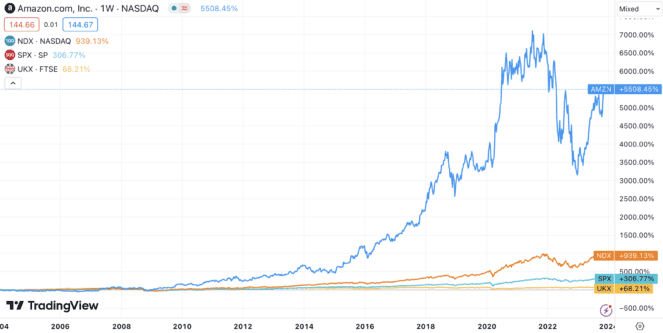
I think it’s tempting to buy a FTSE 100 index fund, after all, that’s an easy route into investing. But the 20-year FTSE 100 average annual return is 5%, and that’s not very competitive.

To illustrate this, let’s look at the share price increases of the FTSE 100 versus the S&P 500, the Nasdaq 100 and Amazon shares:
XXX
Source: TradingView

That’s three OK index funds versus soaraway Amazon with the Footsie at the bottom. This is why I pick individual companies to invest in.

How I choose

When looking for a new company, I rarely start with the financials.

Instead, I look at the products and services I use day in and day out. I’m never surprised when the companies I use religiously also have monumentally strong financial statements.

About half of my portfolio is built up of companies that I use. There are others I don’t use — Ferrari, for example. While I wish I could, but it might be some time yet!

So how do I find and decide on the companies I have no first-hand experience of? Well, one way is through stock-screeners. These handy tools filter financial data and list only the companies that meet particular criteria.

What I look for

I’m typically hunting down value opportunities. But I also want the companies that are selling cheaply to be vigorous growers. So, I’ll set parameters that include but aren’t limited to:

  1. 10-year average annual revenue growth of 30% or more
  2. Over five years, a price down 30% or more

This is a very simplified version of the power of screening data. I often use many more inputs than this. Yet, with just these two simple parameters, what I can uncover is amazing.

It’s also essential that I make sure I use a reputable screener. One with good reviews, including endorsements from major financial institutions, is best, as I want the data to be accurate.

I found four companies that could have been included in the FTSE 100, S&P 500, or Nasdaq 100 that met my two criteria listed above. These were JD.com, Paycom, Etsy and SolarEdge Technologies.

That’s down from around 600 companies (the Nasdaq 100 and S&P 500 cross over a lot).

Well, I might say that’s a slightly easier dataset to analyse.

How I analyse

But hold on, just because a company’s revenue growth is good and the share price is down doesn’t make it a good investment.

This is where deeper financial analysis comes in. I often think of reading financial statements like playing chess because attention to detail is everything. I also have to know how each component of these statements coincides with actual operations and consider broader economic factors.

The key things I look for first are how much profit is being generated as reported on the income statement and debt on the balance sheet.

Beyond that, I’m digging into areas of weakness, significantly poor ratios, and discounted cash flow analyses. I compare these metrics to companies in the same industry.

The bottom line

While this is a hypothetical screening for shares, and I’m not buying these companies, this captures the essence of how I work in the real world.

Investing isn’t easy. If it were, everybody would be rich. I believe it takes time, patience, discipline, intelligence and strategy. But after a while, results do show.


John Mackey, former CEO of Whole Foods Market, an Amazon subsidiary, is a member of The Motley Fool’s board of directors. Oliver Rodzianko has positions in Amazon. The Motley Fool UK has recommended Amazon. Views expressed on the companies mentioned in this article are those of the writer and therefore may differ from the official recommendations we make in our subscription services such as Share Advisor, Hidden Winners and Pro. Here at The Motley Fool we believe that considering a diverse range of insights makes us better investors.

More on Investing Articles

Friends and sisters exploring the outdoors together in Cornwall. They are standing with their arms around each other at the coast.
Investing Articles

£503 buys 14 shares in this FTSE 250 stock that returned 23.9% annually for the last 15 years

This FTSE 250 stock has averaged a huge return for 15 years. At today's price, £503 buys 14 shares. But…

Read more »

Black woman using loudspeaker to be heard
Investing Articles

£1,000 buys 25 shares in this FTSE 100 stock that’s returned 29.2% annually for the last 10 years

This FTSE 100 mining stock has returned close to 30% a year for a decade. At 3,995p, £1,000 buys 25…

Read more »

Female student sitting at the steps and using laptop
Investing Articles

Down 47%, is this growth stock finally worth buying in May?

With a £288m order book and a hidden pipeline of defence and nuclear contracts, is this growth stock now too…

Read more »

House models and one with REIT - standing for real estate investment trust - written on it.
Investing Articles

2 REITs yielding 7%+ to consider for passive income in 2026

A REIT backed by the NHS and another backed by Tesco and Sainsbury's with both yielding 7%+. Here's why I'm…

Read more »

Woman riding her old fashioned bicycle along the Beach Esplanade at Aberdeen, Scotland.
Investing Articles

Just 97 shares of this UK dividend stock generate £238 in passive income

A 5.7% yield, £238 in passive income from just 97 shares, and one of the most divisive dividend stocks on…

Read more »

ISA coins
Investing Articles

£10,000 in an ISA generates a second income of…

The London Stock Exchange is home to some of the world's most generous dividends. But how big a second income…

Read more »

Shot of a senior man drinking coffee and looking thoughtfully out of a window
Investing Articles

Expert recommendations: 2 top income stocks yielding 7%+!

With yields of 7.2% and 7.8% respectively, these two income stocks are catching the eyes of institutional analysts. Should investors…

Read more »

Illustration of flames over a black background
Investing Articles

3 top income-focused stocks to buy in May 2026, according to experts

Looking for a stock to buy for income in May 2026? Experts have flagged these three UK dividend shares as…

Read more »





