


We have some exciting news to share! The Motley Fool UK has now become The Twelfth Magpie -- an independent, UK-owned company, led by our long-serving UK management team — Mark Rogers, Chris Nials and Heather Adlington. In practical terms, it’s the same team you know, now fully focused on serving our UK readers and members.

Just as importantly, our approach remains unchanged: long-term, jargon-free, and on your side. This site is our new home, and there will be extra tweaks made across the coming few days as we settle in. So if anything looks a little off, please bear with us!

The content of this article was relevant at the time of publishing. Circumstances change continuously and caution should therefore be exercised when relying upon any content contained within this article.

If I’d invested £5,000 in Aviva shares 7 months ago, how much would I have now?

Aviva shares have enjoyed significant growth in the past seven months but this Fool got in late. Has he missed out on the best returns?

| More on:
Aviva logo on glass meeting room door

Image source: Aviva plc

You’re reading a free article with opinions that may differ from The Motley Fool’s Premium Investing Services. Become a Motley Fool member today to get instant access to our top analyst recommendations, in-depth research, investing resources, and more. Learn More.

Key Points

  • Up 33% in the past six months
  • Slightly high P/E ratio
  • Sufficient debt coverage

I only recently bought Aviva (LSE:AV.) shares because I was slow to the party. As a result, I may have missed out on the best returns. 

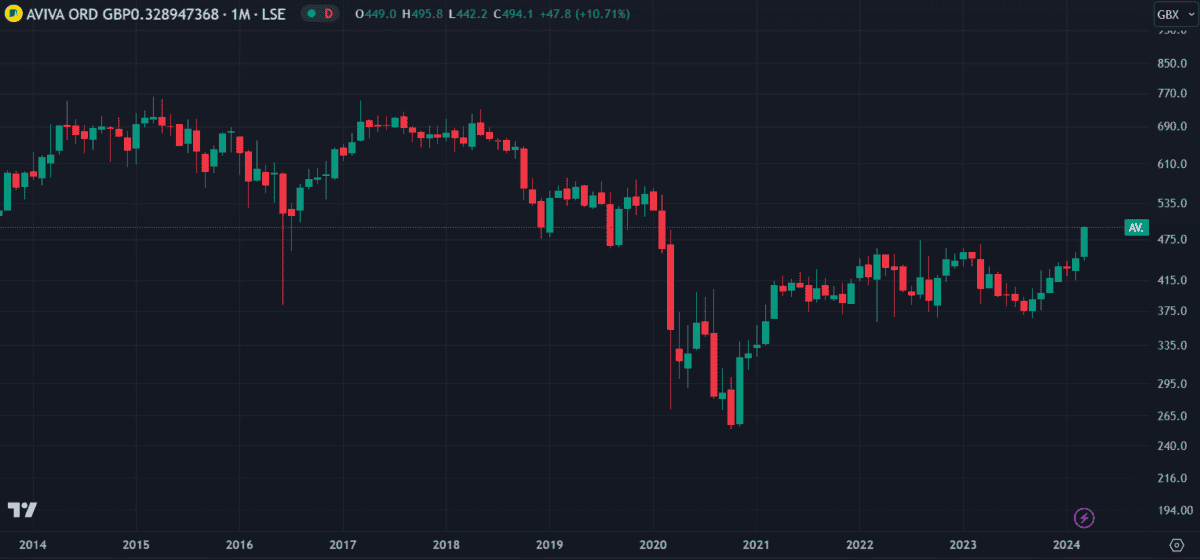
The shares have been up and down for the past four years and dipped quite a bit throughout 2023. Because of this, I was initially put off and didn’t circle back until it was too late. The price took off this month after Aviva announced its 2023 full-year (FY) results. They revealed a 9% increase in operating profit, a £300m share buyback program and an 8% rise in dividends.

XXX

The share price is already up 17.9% since then.

But the last few months saw even better returns. Since hitting a low of 369p on 8 September, the price has recovered 33% – an impressive climb in just under seven months.

If I’d invested £5,000 back then I’d already have secured myself a decent £1,650 in returns. That’s not bad for only six months. Had I instead bought the shares of Aviva competitor Prudential, I’d be £600 out of pocket!

So with Aviva now at a four-year high, what does the future hold?
aviva shares
Created on TradingView.com

Calculating value

Using a discounted cash flow (DCF) model, analysts estimate Aviva to be undervalued by 34%. This doesn’t necessarily mean the share price will increase by 34%, simply that the price seems low compared to earnings. 

A DCF model determines value by dividing future cash flow forecasts by a company’s weighted average cost of capital (WACC) and subtracting debt. While it can provide a relatively good idea of value, it relies heavily on the accuracy of future cash flow forecasts. If external factors or unexpected events alter cash flow, then the calculations must be revisited. 
aviva pe ratio
Created on TradingView.com

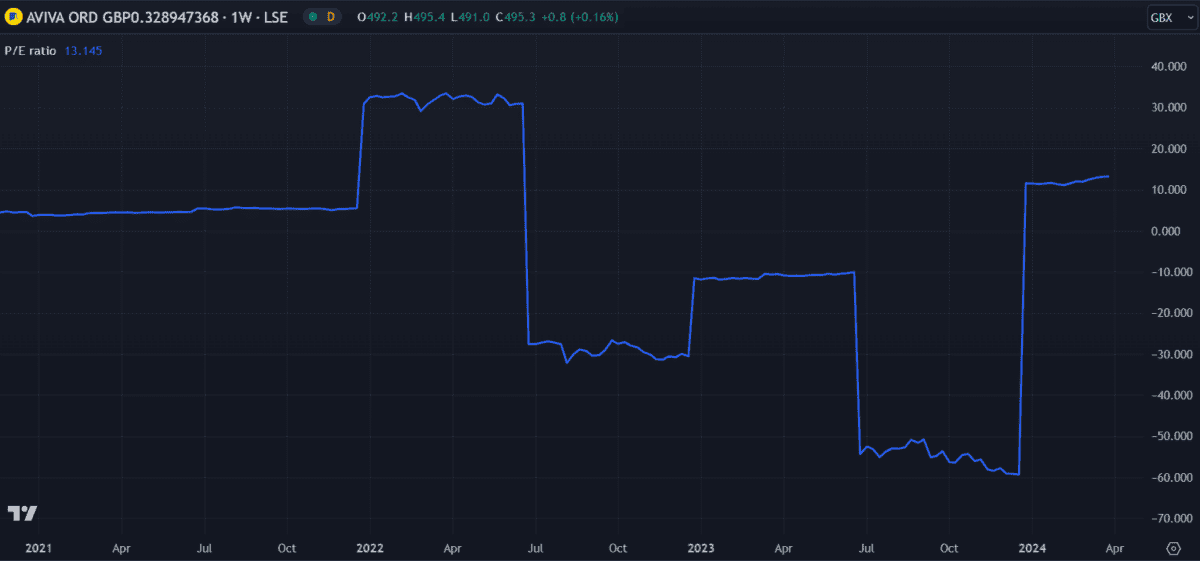
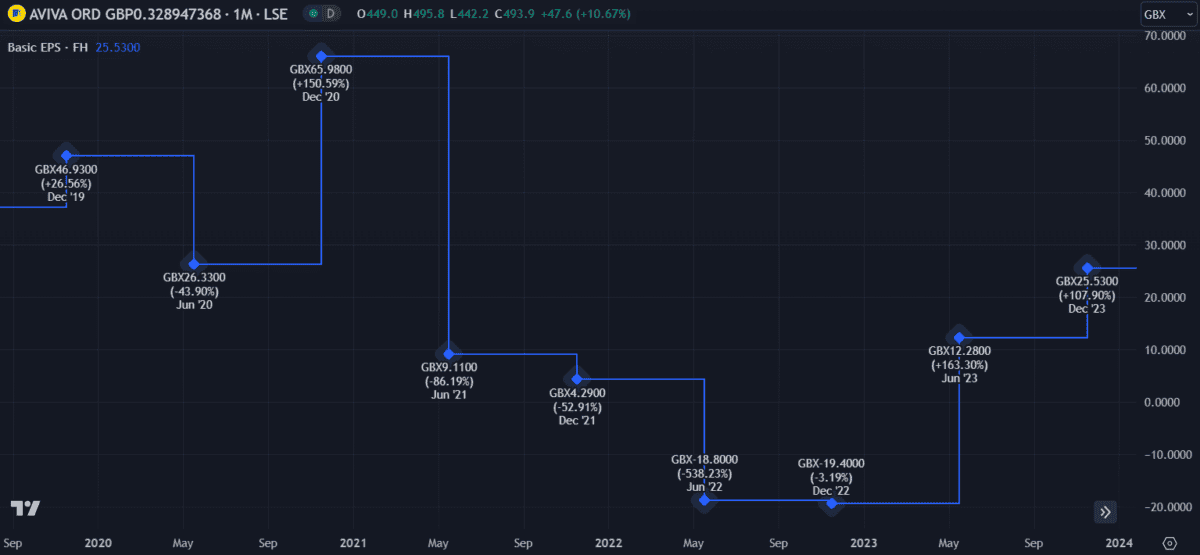
The price-to-earnings (P/E) ratio is another metric used to evaluate a company. To get a P/E ratio, divide the share price by the company’s earnings per share (EPS). EPS is calculated by dividing net income by outstanding shares. With a trailing P/E ratio of 13, Aviva is lower than Prudential (15.8) and Admiral Group (25), but higher than the industry average of 10.8.

This indicates that Aviva shares could be slightly expensive compared to others in the same industry.
aviva earnings per share
Created on TradingView.com

Balance sheet

Evaluating growth potential is one thing but it’s all for nothing if the company goes bankrupt. By checking the balance sheet we can evaluate the company’s financial position.

Debt is key here.

Using debt responsibility can spell the difference between success and failure. Companies that don’t use any debt may fail to compete with others, while companies that don’t manage debt properly could default on loans and go bankrupt.
aviva debt to equity
Created at TradingView

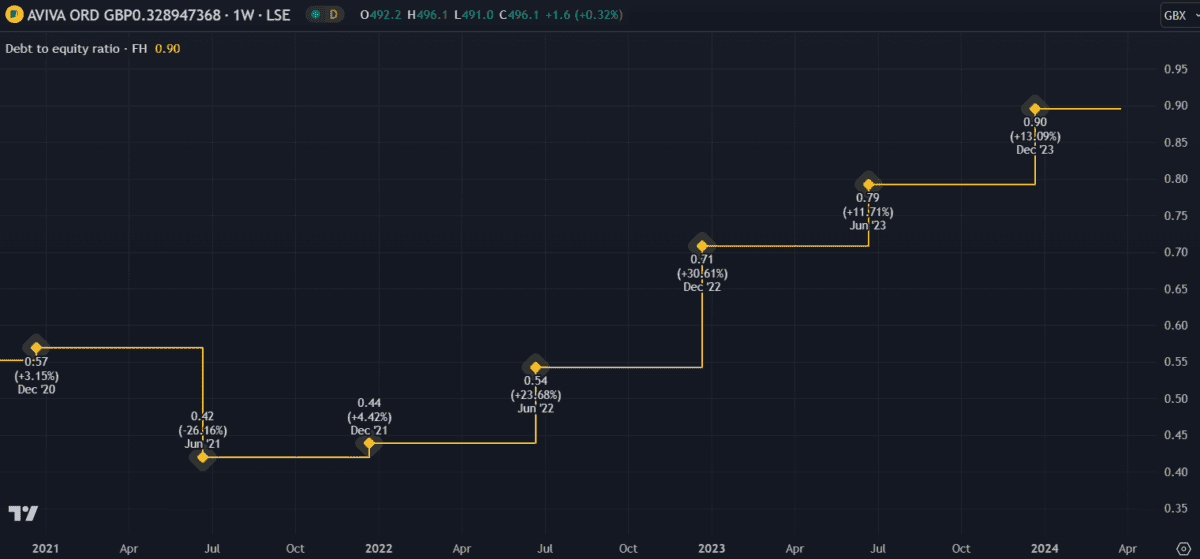
Aviva’s debt-to-equity (D/E) ratio has been steadily increasing over the past few years. Now at 0.9, it’s dangerously close to a factor of one – which would mean it’s not fully covered by shareholder equity. However, in Aviva’s case, the company has sufficient cash and operating income to cover its debt, leaving it with an interest coverage ratio of 6.7 times.

Overall, I think Aviva is in a good position but I don’t expect the share price to make significant gains from here. I will hold my shares for now but, sadly, I think I missed the best price entry point.


Mark Hartley has positions in Aviva Plc. The Motley Fool UK has recommended Admiral Group Plc and Prudential Plc. Views expressed on the companies mentioned in this article are those of the writer and therefore may differ from the official recommendations we make in our subscription services such as Share Advisor, Hidden Winners and Pro. Here at The Motley Fool we believe that considering a diverse range of insights makes us better investors.

More on Investing Articles

Friends and sisters exploring the outdoors together in Cornwall. They are standing with their arms around each other at the coast.
Investing Articles

£503 buys 14 shares in this FTSE 250 stock that returned 23.9% annually for the last 15 years

This FTSE 250 stock has averaged a huge return for 15 years. At today's price, £503 buys 14 shares. But…

Read more »

Black woman using loudspeaker to be heard
Investing Articles

£1,000 buys 25 shares in this FTSE 100 stock that’s returned 29.2% annually for the last 10 years

This FTSE 100 mining stock has returned close to 30% a year for a decade. At 3,995p, £1,000 buys 25…

Read more »

Female student sitting at the steps and using laptop
Investing Articles

Down 47%, is this growth stock finally worth buying in May?

With a £288m order book and a hidden pipeline of defence and nuclear contracts, is this growth stock now too…

Read more »

House models and one with REIT - standing for real estate investment trust - written on it.
Investing Articles

2 REITs yielding 7%+ to consider for passive income in 2026

A REIT backed by the NHS and another backed by Tesco and Sainsbury's with both yielding 7%+. Here's why I'm…

Read more »

Woman riding her old fashioned bicycle along the Beach Esplanade at Aberdeen, Scotland.
Investing Articles

Just 97 shares of this UK dividend stock generate £238 in passive income

A 5.7% yield, £238 in passive income from just 97 shares, and one of the most divisive dividend stocks on…

Read more »

ISA coins
Investing Articles

£10,000 in an ISA generates a second income of…

The London Stock Exchange is home to some of the world's most generous dividends. But how big a second income…

Read more »

Shot of a senior man drinking coffee and looking thoughtfully out of a window
Investing Articles

Expert recommendations: 2 top income stocks yielding 7%+!

With yields of 7.2% and 7.8% respectively, these two income stocks are catching the eyes of institutional analysts. Should investors…

Read more »

Illustration of flames over a black background
Investing Articles

3 top income-focused stocks to buy in May 2026, according to experts

Looking for a stock to buy for income in May 2026? Experts have flagged these three UK dividend shares as…

Read more »





