

We have some exciting news to share! The Motley Fool UK has now become The Twelfth Magpie -- an independent, UK-owned company, led by our long-serving UK management team — Mark Rogers, Chris Nials and Heather Adlington. In practical terms, it’s the same team you know, now fully focused on serving our UK readers and members.

Just as importantly, our approach remains unchanged: long-term, jargon-free, and on your side. This site is our new home, and there will be extra tweaks made across the coming few days as we settle in. So if anything looks a little off, please bear with us!

The content of this article was relevant at the time of publishing. Circumstances change continuously and caution should therefore be exercised when relying upon any content contained within this article.

1 simple Vanguard ETF could turn £500 per month into £54,159 in annual passive income

Ben McPoland explores how investing just a few hundred quid in an ETF can lead to a substantial passive income stream down the road.

| More on:
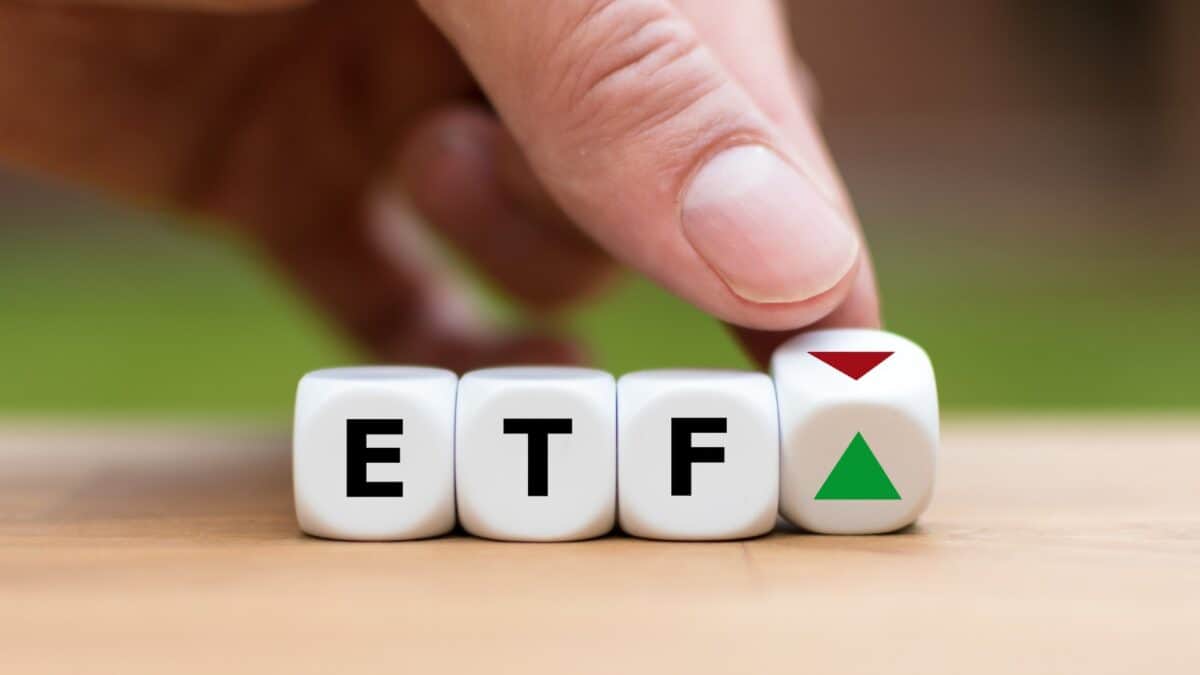
Hand is turning a dice and changes the direction of an arrow symbolizing that the value of an ETF (Exchange Traded Fund) is going up (or vice versa)

Image source: Getty Images

You’re reading a free article with opinions that may differ from The Motley Fool’s Premium Investing Services. Become a Motley Fool member today to get instant access to our top analyst recommendations, in-depth research, investing resources, and more. Learn More.

Investing for passive income doesn’t have to be hard. A single investment can carry on building wealth for life without one needing to lift a finger.

The good news is that the ability to earn a growing dividend income is well within reach for the vast majority of savers.

XXX

Indeed, I can build a £54,159 dividend stream just by consistently investing £500 a month in a simple Vanguard exchange-traded fund (ETF). Here’s how.

The simple investment

The Vanguard FTSE 100 UCITS ETF (LSE:VUKE) tracks the FTSE 100‘s returns. So not only does it go up or down when the index does, but it also dishes out dividends to shareholders.

As at 31 March, the 10 biggest holdings were:

Stock% of fund
Shell 8.60%
AstraZeneca 7.95%
HSBC 5.96%
Unilever 4.97%
BP 4.17%
GSK 3.46%
RELX 3.27%
Diageo 3.26%
Rio Tinto 2.75%
Glencore 2.66%

All these stocks pay dividends. Some of their yields are quite modest (that of data analytics firm RELX is 1.78%), while others are much meatier (HSBC yields 7.52%).

Collectively though, Footsie payouts add up and give the ETF a dividend yield of 3.84%.

This is unlike the US, where indexes are dominated by tech giants like Alphabet (nee Google) and Amazon that have never paid dividends. The average yield of the S&P 500 is a paltry 1.31%.

Dividend diversification

While dividends aren’t guaranteed, investors can benefit from broad exposure to the FTSE 100. Broad exposure reduces the impact of individual companies or whole sectors cutting their payouts.

For example, UK housebuilders have been taking the axe to their dividends over the past year due to higher interest rates and a slowdown in the property market. Offsetting this, however, have been banks, which have hiked their own payouts after benefitting from higher interest income.

Another key strength of the UK blue-chip index is that it is truly global. In fact, over 80% of the sales of FTSE 100 companies now come from outside the UK, according to London Stock Exchange Group.

This diversification is an important feature of the ETF. Another is low fees, with the ongoing charge just 0.09%.

Investing £500 per month

Over the last 10 years, the ETF has produced a cumulative return of 75% (share price gains and dividends).

Now, this is perhaps one criticism I’d have here. It tracks the FTSE 100, which has long underperformed other major global indexes on a share price return basis. This underperformance could continue.

However, for the purposes of solid and dependable income, no other index comes close.

So let’s take that 7.5% a year as our average return. If I put in £500 every month and reinvested my dividends, here’s how the portfolio value could build up.

Period (years)Portfolio valueAnnual dividend income (reinvested)
1 £6,206£238
5 £36,048£1,384
10 £87,800£3,371
15 £162,097£6,224
20 £268,759£10,320
25 £421,887£16,200
30 £641,722£24,642
35 £957,324£36,761
40 £1,410,410£54,159

So, if I consistently invested into this ETF for 40 years, I could end up with annual passive income worth just over £54,000 (excluding any platform fees).

In other words, I could stop reinvesting dividends and start spending them! Or simply enjoy the nest egg I’d built up.

Of course, this is based on the fund’s current 3.84% yield, which in reality will fluctuate throughout this time. And inflation will mean £54k won’t have the same purchasing power in four decades as it does now.

Nevertheless, this Vanguard ETF is arguably the easiest option for building a sizeable future passive income stream. It practically takes no effort.


Suzanne Frey, an executive at Alphabet, is a member of The Motley Fool’s board of directors. HSBC Holdings is an advertising partner of The Ascent, a Motley Fool company. John Mackey, former CEO of Whole Foods Market, an Amazon subsidiary, is a member of The Motley Fool’s board of directors. Ben McPoland has positions in Alphabet, AstraZeneca Plc, Diageo Plc, Glencore Plc, HSBC Holdings, and London Stock Exchange Group Plc. The Motley Fool UK has recommended Alphabet, Amazon, AstraZeneca Plc, Diageo Plc, GSK, HSBC Holdings, RELX, and Unilever Plc. Views expressed on the companies mentioned in this article are those of the writer and therefore may differ from the official recommendations we make in our subscription services such as Share Advisor, Hidden Winners and Pro. Here at The Motley Fool we believe that considering a diverse range of insights makes us better investors.

More on Investing Articles

Friends and sisters exploring the outdoors together in Cornwall. They are standing with their arms around each other at the coast.
Investing Articles

£503 buys 14 shares in this FTSE 250 stock that returned 23.9% annually for the last 15 years

This FTSE 250 stock has averaged a huge return for 15 years. At today's price, £503 buys 14 shares. But…

Read more »

Black woman using loudspeaker to be heard
Investing Articles

£1,000 buys 25 shares in this FTSE 100 stock that’s returned 29.2% annually for the last 10 years

This FTSE 100 mining stock has returned close to 30% a year for a decade. At 3,995p, £1,000 buys 25…

Read more »

Female student sitting at the steps and using laptop
Investing Articles

Down 47%, is this growth stock finally worth buying in May?

With a £288m order book and a hidden pipeline of defence and nuclear contracts, is this growth stock now too…

Read more »

House models and one with REIT - standing for real estate investment trust - written on it.
Investing Articles

2 REITs yielding 7%+ to consider for passive income in 2026

A REIT backed by the NHS and another backed by Tesco and Sainsbury's with both yielding 7%+. Here's why I'm…

Read more »

Woman riding her old fashioned bicycle along the Beach Esplanade at Aberdeen, Scotland.
Investing Articles

Just 97 shares of this UK dividend stock generate £238 in passive income

A 5.7% yield, £238 in passive income from just 97 shares, and one of the most divisive dividend stocks on…

Read more »

ISA coins
Investing Articles

£10,000 in an ISA generates a second income of…

The London Stock Exchange is home to some of the world's most generous dividends. But how big a second income…

Read more »

Shot of a senior man drinking coffee and looking thoughtfully out of a window
Investing Articles

Expert recommendations: 2 top income stocks yielding 7%+!

With yields of 7.2% and 7.8% respectively, these two income stocks are catching the eyes of institutional analysts. Should investors…

Read more »

Illustration of flames over a black background
Investing Articles

3 top income-focused stocks to buy in May 2026, according to experts

Looking for a stock to buy for income in May 2026? Experts have flagged these three UK dividend shares as…

Read more »





