


We have some exciting news to share! The Motley Fool UK has now become The Twelfth Magpie -- an independent, UK-owned company, led by our long-serving UK management team — Mark Rogers, Chris Nials and Heather Adlington. In practical terms, it’s the same team you know, now fully focused on serving our UK readers and members.

Just as importantly, our approach remains unchanged: long-term, jargon-free, and on your side. This site is our new home, and there will be extra tweaks made across the coming few days as we settle in. So if anything looks a little off, please bear with us!

The content of this article was relevant at the time of publishing. Circumstances change continuously and caution should therefore be exercised when relying upon any content contained within this article.

£20,000 stashed away? Here’s how I’d invest and aim for £20,000 of passive income

Millions of us want a passive income, but sometimes we just need to trust the process and commit to regular savings. Dr James Fox explains his strategy.

| More on:
The Ocean Village Marina neighborhood of Southampton on the Channel coast in southern England, UK.

Image source: Getty Images

You’re reading a free article with opinions that may differ from The Motley Fool’s Premium Investing Services. Become a Motley Fool member today to get instant access to our top analyst recommendations, in-depth research, investing resources, and more. Learn More.

Passive income is the holy grail for many of us. It’s something that could give us the opportunity to take more time off work and spend more time with our families. It’s also something that could simply help us pay bills and get by in life.

Regardless of our reasons, passive income can be achieved by investing in stocks and shares. Compared with the passive income ‘hacks’ I see pushed on social media, investing allows us to achieve our goals in a relatively low-risk environment.

XXX

So, what if I had £20,000 stashed aside? While that might sound like a good chunk of money, could I invest that and turn it into £20,000 of annual passive income? Let’s take a look.

It pays to be boring

It’s only come to my attention recently that my proclivity to put money aside and spend very little on myself is a little boring to some. However, it’s the basis of a strategy that has served many successful investors well.

So, let’s imagine I decide to invest all of this £20,000 into stocks and shares through an ISA — an ISA is simply a wrapper that protects our investment from tax and is available on all major investment brokerages.

Please note that tax treatment depends on the individual circumstances of each client and may be subject to change in future. The content in this article is provided for information purposes only. It is not intended to be, neither does it constitute, any form of tax advice. Readers are responsible for carrying out their own due diligence and for obtaining professional advice before making any investment decisions.

I could then look to build a portfolio using my £20,000 as starting capital and by making small monthly contributions.

Sound investments

Many novice investors are drawn in by the prospects of big returns on volatile stocks. But that frequently leads to losses.

However, when we make investment decisions based on strong fundamentals, quantitative analysis, and macroeconomic data, we stand a much better chance of growing our portfolios.

Novice investors may look to make high single-digit returns every year, while more experienced investors may aim for double-digit returns.
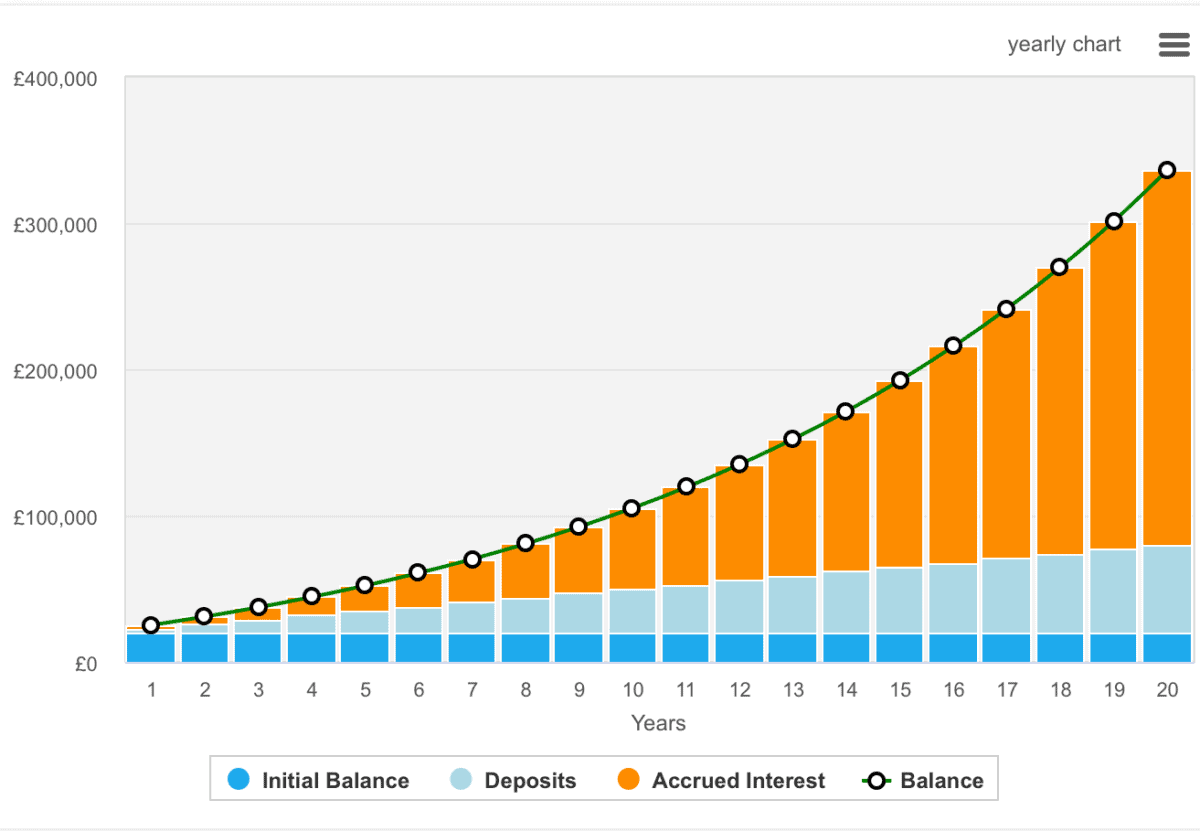
Created at thecalculatorsite.com

The above example shows how £20,000 could grow if I achieved 10% annualised growth and contributed at additional £250 monthly from my salary.

In short, in less than 20 years, my portfolio would grow by more than 10 times. And towards the end of this period, I’d suggest that by investing in high-yielding dividend stocks, I could earn more than £20,000 annually in passive income.

Where to invest

Investors with more time on their hands might like to pick all of their own investments. And this can be particularly time consuming as diversification is always important.

However, for those of us seeking a slightly more hands off approach, a fund or ETF, such as the iShares US Technology ETF (NYSEMKT:IYW), might be a good place to start.

The fund invests in some of the biggest US companies in the tech space, and it’s traded like any other stock, meaning we can buy more or sell at any time.

US tech stocks have certainly seen a lot of attention over the past 12 months, and they’re becoming more expensive given growth expectations. This presents some degree of risk, especially with a major event like the US election just round the corner.

However, let’s think about the long run. US tech has outperformed its global peers decade after decade, and these mega-cap companies like Meta and Nvidia are in pole position to dominate the artificial intelligence revolution.

Very few people bet against US tech and win.

Randi Zuckerberg, a former director of market development and spokeswoman for Facebook and sister to Meta Platforms CEO Mark Zuckerberg, is a member of The Motley Fool's board of directors. James Fox has positions in Meta Platforms and Nvidia. The Motley Fool UK has recommended Meta Platforms and Nvidia. Views expressed on the companies mentioned in this article are those of the writer and therefore may differ from the official recommendations we make in our subscription services such as Share Advisor, Hidden Winners and Pro. Here at The Motley Fool we believe that considering a diverse range of insights makes us better investors.

More on Investing Articles

Friends and sisters exploring the outdoors together in Cornwall. They are standing with their arms around each other at the coast.
Investing Articles

£503 buys 14 shares in this FTSE 250 stock that returned 23.9% annually for the last 15 years

This FTSE 250 stock has averaged a huge return for 15 years. At today's price, £503 buys 14 shares. But…

Read more »

Black woman using loudspeaker to be heard
Investing Articles

£1,000 buys 25 shares in this FTSE 100 stock that’s returned 29.2% annually for the last 10 years

This FTSE 100 mining stock has returned close to 30% a year for a decade. At 3,995p, £1,000 buys 25…

Read more »

Female student sitting at the steps and using laptop
Investing Articles

Down 47%, is this growth stock finally worth buying in May?

With a £288m order book and a hidden pipeline of defence and nuclear contracts, is this growth stock now too…

Read more »

House models and one with REIT - standing for real estate investment trust - written on it.
Investing Articles

2 REITs yielding 7%+ to consider for passive income in 2026

A REIT backed by the NHS and another backed by Tesco and Sainsbury's with both yielding 7%+. Here's why I'm…

Read more »

Woman riding her old fashioned bicycle along the Beach Esplanade at Aberdeen, Scotland.
Investing Articles

Just 97 shares of this UK dividend stock generate £238 in passive income

A 5.7% yield, £238 in passive income from just 97 shares, and one of the most divisive dividend stocks on…

Read more »

ISA coins
Investing Articles

£10,000 in an ISA generates a second income of…

The London Stock Exchange is home to some of the world's most generous dividends. But how big a second income…

Read more »

Shot of a senior man drinking coffee and looking thoughtfully out of a window
Investing Articles

Expert recommendations: 2 top income stocks yielding 7%+!

With yields of 7.2% and 7.8% respectively, these two income stocks are catching the eyes of institutional analysts. Should investors…

Read more »

Illustration of flames over a black background
Investing Articles

3 top income-focused stocks to buy in May 2026, according to experts

Looking for a stock to buy for income in May 2026? Experts have flagged these three UK dividend shares as…

Read more »






