


We have some exciting news to share! The Motley Fool UK has now become The Twelfth Magpie -- an independent, UK-owned company, led by our long-serving UK management team — Mark Rogers, Chris Nials and Heather Adlington. In practical terms, it’s the same team you know, now fully focused on serving our UK readers and members.

Just as importantly, our approach remains unchanged: long-term, jargon-free, and on your side. This site is our new home, and there will be extra tweaks made across the coming few days as we settle in. So if anything looks a little off, please bear with us!

The content of this article was relevant at the time of publishing. Circumstances change continuously and caution should therefore be exercised when relying upon any content contained within this article.

£3k in a savings account? It could be earning more passive income elsewhere

While pondering the falling interest rates on savings accounts, our writer considers how a portfolio of reliable stocks could earn more passive income.

| More on:
Lady taking a bottle of Hellmann's Real Mayonnaise from a supermarket shelf

Image source: Unilever plc

You’re reading a free article with opinions that may differ from The Motley Fool’s Premium Investing Services. Become a Motley Fool member today to get instant access to our top analyst recommendations, in-depth research, investing resources, and more. Learn More.

Falling interest rates reduce the passive income that people earn from their savings accounts. Many accounts that once held a steady rate above 5% are now falling as low as 3%.

These days, holding a sum of around £3,000 in savings won’t return much. For instance, in 20 years, a 3% rate would only grow to around £5,462. 
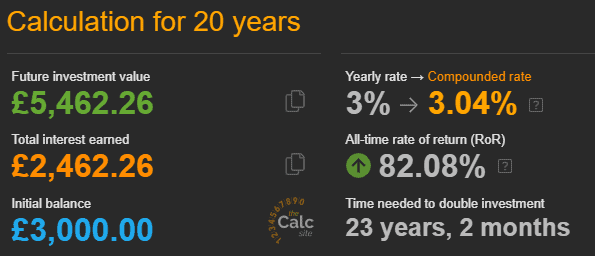
XXX
passive income from interest
Created on the TheCalculatorSite.com

When factoring in inflation at the Bank of England’s 2% target, it equates to very little. While many appreciate the safety and security that savings accounts offer, some might consider looking for faster ways to grow that money.

Is there a (relatively) safe way to aim for a more meaningful return?

Risk vs return

Many stocks on the FTSE 100 have historically delivered annualised returns upwards of 10% a year. In fact, some have delivered even more (but with higher returns come higher risk).

What’s more, many of these stocks pay annual dividends upwards of 5%. That means investors have a chance of beating their savings account even if the stock price doesn’t grow at all.

But the risk of losses is concerning. Money stagnating in a savings account isn’t ideal but losing it all is worse. That is the core reason why many people never invest — the market is confusing and even a small risk seems too high.

Consider defensive stocks

While no investment is without risk, some are considered to be low risk. These are typically companies in high-demand industries. Think energy, retail and pharmaceuticals.

They are usually industry leaders, with limited competition and a history of reliable performance. Note, ‘reliable’. Not exceptional, not mind-blowing. Just slow, steady and stable.

Such stocks are often referred to as defensive stocks, as their performance is resistant to wider market fluctuations.

Consider the multinational consumer goods company Unilever (LSE: ULVR). Between 2014 and 2024, it achieved annualised growth of 5.7% a year. And that’s before dividends, which currently yield 3%.

Sure, it doesn’t hold a candle to parabolic growth stocks like Nvidia. But where will it be in 10 years? Who knows.

Selling essential brands like Dove, Ben & Jerry’s, Hellmann’s and Vaseline, Unilever’s well-positioned to continue growing indefinitely. 

But that doesn’t guarantee growth. It could still lose market share to competitors or suffer losses due to supply chain disruptions. Anything from environmental disasters to currency fluctuations can hurt profits. 

And if it passes these costs on to the consumer, it risks losing customers to low-priced alternatives.

Still, with products used by 2.5bn people daily in 190 countries around the world, its market position is very well-established.

Path to passive income

£3,000 would buy around 65 Unilever shares. Assuming current averages held, in 20 years they could grow to be worth almost £16,000 (with dividends reinvested). I don’t know any savings account that could achieve that.

National Grid’s another defensive stock offering similar reliability and growth. As the main gas and electricity provider in the UK, it enjoys consistent demand. Growth is slow but it has a 5.7% dividend yield and a long track record of consistent payments.

It could achieve similar results to Unilever over 20 years.

I plan to drip-feed my savings into these shares and similar defensive stocks until retirement. By compounding the gains, I hope to achieve a reliable passive income stream.


Mark Hartley has positions in National Grid Plc and Unilever. The Motley Fool UK has recommended National Grid Plc, Nvidia, and Unilever. Views expressed on the companies mentioned in this article are those of the writer and therefore may differ from the official recommendations we make in our subscription services such as Share Advisor, Hidden Winners and Pro. Here at The Motley Fool we believe that considering a diverse range of insights makes us better investors.

More on Investing Articles

Friends and sisters exploring the outdoors together in Cornwall. They are standing with their arms around each other at the coast.
Investing Articles

£503 buys 14 shares in this FTSE 250 stock that returned 23.9% annually for the last 15 years

This FTSE 250 stock has averaged a huge return for 15 years. At today's price, £503 buys 14 shares. But…

Read more »

Black woman using loudspeaker to be heard
Investing Articles

£1,000 buys 25 shares in this FTSE 100 stock that’s returned 29.2% annually for the last 10 years

This FTSE 100 mining stock has returned close to 30% a year for a decade. At 3,995p, £1,000 buys 25…

Read more »

Female student sitting at the steps and using laptop
Investing Articles

Down 47%, is this growth stock finally worth buying in May?

With a £288m order book and a hidden pipeline of defence and nuclear contracts, is this growth stock now too…

Read more »

House models and one with REIT - standing for real estate investment trust - written on it.
Investing Articles

2 REITs yielding 7%+ to consider for passive income in 2026

A REIT backed by the NHS and another backed by Tesco and Sainsbury's with both yielding 7%+. Here's why I'm…

Read more »

Woman riding her old fashioned bicycle along the Beach Esplanade at Aberdeen, Scotland.
Investing Articles

Just 97 shares of this UK dividend stock generate £238 in passive income

A 5.7% yield, £238 in passive income from just 97 shares, and one of the most divisive dividend stocks on…

Read more »

ISA coins
Investing Articles

£10,000 in an ISA generates a second income of…

The London Stock Exchange is home to some of the world's most generous dividends. But how big a second income…

Read more »

Shot of a senior man drinking coffee and looking thoughtfully out of a window
Investing Articles

Expert recommendations: 2 top income stocks yielding 7%+!

With yields of 7.2% and 7.8% respectively, these two income stocks are catching the eyes of institutional analysts. Should investors…

Read more »

Illustration of flames over a black background
Investing Articles

3 top income-focused stocks to buy in May 2026, according to experts

Looking for a stock to buy for income in May 2026? Experts have flagged these three UK dividend shares as…

Read more »





