


We have some exciting news to share! The Motley Fool UK has now become The Twelfth Magpie -- an independent, UK-owned company, led by our long-serving UK management team — Mark Rogers, Chris Nials and Heather Adlington. In practical terms, it’s the same team you know, now fully focused on serving our UK readers and members.

Just as importantly, our approach remains unchanged: long-term, jargon-free, and on your side. This site is our new home, and there will be extra tweaks made across the coming few days as we settle in. So if anything looks a little off, please bear with us!

The content of this article was relevant at the time of publishing. Circumstances change continuously and caution should therefore be exercised when relying upon any content contained within this article.

£20k in a high-interest savings account? It could be earning more passive income in stocks

Millions of us want a passive income, but a high-interest savings account might not be the best way to do it. Dr James Fox explains how to invest for an income.

| More on:
Three generation family are playing football together in a field. There are two boys, their father and their grandfather.

Image source: Getty Images

You’re reading a free article with opinions that may differ from The Motley Fool’s Premium Investing Services. Become a Motley Fool member today to get instant access to our top analyst recommendations, in-depth research, investing resources, and more. Learn More.

Interest rates are falling, and this means that those of us with money in savings accounts will start to receive less passive income. In fact, with interest rates set to fall to around 3.5% in 2026, savers will likely only receive a modest premium to the targeted rate of inflation.

Just take a look at this illustration. £20,000 in a savings account with a 3% yield generates a very limited return. Assuming a long-term average inflation rate of 2%, the net gain would be a mere 1% per year.
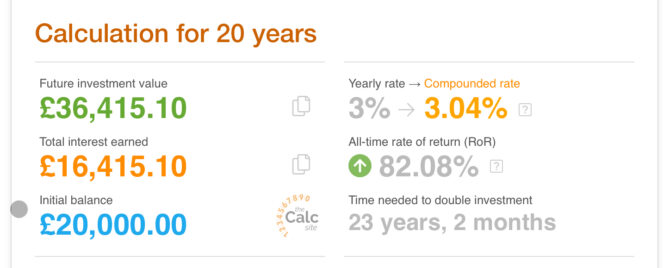
XXX
Source: thecalculatorsite.com

Why stocks

Investors might choose stocks for passive income over traditional savings due to the potential for higher returns and inflation protection. UK dividend stocks, particularly from established FTSE 100 companies, often provide regular payouts exceeding the low interest rates offered by savings accounts.

While savings rates can struggle to keep pace with inflation, dividend stocks can offer income growth and capital appreciation. For instance, sectors like utilities, healthcare, or consumer goods often deliver consistent dividends even during economic downturns.

Additionally, tax-efficient investment options like ISAs allow UK investors to shield dividend income from tax. Despite market volatility, long-term dividend investing offers a balance of steady income and the potential for greater financial growth than typical savings accounts.

Please note that tax treatment depends on the individual circumstances of each client and may be subject to change in future. The content in this article is provided for information purposes only. It is not intended to be, neither does it constitute, any form of tax advice. Readers are responsible for carrying out their own due diligence and for obtaining professional advice before making any investment decisions.

Choosing dividend aristocrats

Investors looking for a steady passive income that grows over time will likely want to focus on buying Dividend Aristocrats. These are companies that have continually paid and grown their dividend payments over time. Of course, past performance is not reflective of future performance, but a strong track record is always appreciated.

Investors may want to consider Legal & General (LSE:LGEN). The stock stands out as a compelling Dividend Aristocrat option for investors seeking steady passive income growth, with its remarkable track record of dividend consistency, having maintained or increased its payout every year since 2010. This commitment to shareholder returns has earned Legal & General a place in the prestigious S&P UK High Yield Dividend Aristocrats Index.

There are several reasons why passive income investors pick Legal & General. One is the underlying strength of the business, with a strong solvency ratio of 223%. What’s more, Legal & General continues to offer modest earnings growth. CEO António Simões expects mid-single-digit growth year on year, indicating a stable outlook.

Looking ahead, the firm’s financial targets are encouraging. The company aims for a 6%-9% compound annual growth rate in core operating earnings per share from 2024 to 2027, with an operating return on equity of over 20%. Additionally, it anticipates generating £5bn-£6bn in cumulative Solvency II operational surplus across 2025, 2026, and 2027.

However, investors are clearly most attracted by the headline dividend yield, which could reach an impressive 9.36% in the coming year. The company’s board has announced plans to grow the dividend per share by 5% for the full year 2024, followed by 2% annual growth thereafter.

Unfortunately, investing doesn’t come without its risks. While insurers are known for strong free cash flows, Legal & General’s dividend payout appears to exceed free cash flows, potentially presenting a threat to the sustainability of the dividend in the long run.

Nonetheless, that doesn’t mean the business can’t afford the dividends, and the earnings forecast suggests the payments will become more manageable over the medium term.


James Fox has positions in Legal & General Group Plc. The Motley Fool UK has no position in any of the shares mentioned. Views expressed on the companies mentioned in this article are those of the writer and therefore may differ from the official recommendations we make in our subscription services such as Share Advisor, Hidden Winners and Pro. Here at The Motley Fool we believe that considering a diverse range of insights makes us better investors.

More on Investing Articles

Friends and sisters exploring the outdoors together in Cornwall. They are standing with their arms around each other at the coast.
Investing Articles

£503 buys 14 shares in this FTSE 250 stock that returned 23.9% annually for the last 15 years

This FTSE 250 stock has averaged a huge return for 15 years. At today's price, £503 buys 14 shares. But…

Read more »

Black woman using loudspeaker to be heard
Investing Articles

£1,000 buys 25 shares in this FTSE 100 stock that’s returned 29.2% annually for the last 10 years

This FTSE 100 mining stock has returned close to 30% a year for a decade. At 3,995p, £1,000 buys 25…

Read more »

Female student sitting at the steps and using laptop
Investing Articles

Down 47%, is this growth stock finally worth buying in May?

With a £288m order book and a hidden pipeline of defence and nuclear contracts, is this growth stock now too…

Read more »

House models and one with REIT - standing for real estate investment trust - written on it.
Investing Articles

2 REITs yielding 7%+ to consider for passive income in 2026

A REIT backed by the NHS and another backed by Tesco and Sainsbury's with both yielding 7%+. Here's why I'm…

Read more »

Woman riding her old fashioned bicycle along the Beach Esplanade at Aberdeen, Scotland.
Investing Articles

Just 97 shares of this UK dividend stock generate £238 in passive income

A 5.7% yield, £238 in passive income from just 97 shares, and one of the most divisive dividend stocks on…

Read more »

ISA coins
Investing Articles

£10,000 in an ISA generates a second income of…

The London Stock Exchange is home to some of the world's most generous dividends. But how big a second income…

Read more »

Shot of a senior man drinking coffee and looking thoughtfully out of a window
Investing Articles

Expert recommendations: 2 top income stocks yielding 7%+!

With yields of 7.2% and 7.8% respectively, these two income stocks are catching the eyes of institutional analysts. Should investors…

Read more »

Illustration of flames over a black background
Investing Articles

3 top income-focused stocks to buy in May 2026, according to experts

Looking for a stock to buy for income in May 2026? Experts have flagged these three UK dividend shares as…

Read more »





