


We have some exciting news to share! The Motley Fool UK has now become The Twelfth Magpie -- an independent, UK-owned company, led by our long-serving UK management team — Mark Rogers, Chris Nials and Heather Adlington. In practical terms, it’s the same team you know, now fully focused on serving our UK readers and members.

Just as importantly, our approach remains unchanged: long-term, jargon-free, and on your side. This site is our new home, and there will be extra tweaks made across the coming few days as we settle in. So if anything looks a little off, please bear with us!

The content of this article was relevant at the time of publishing. Circumstances change continuously and caution should therefore be exercised when relying upon any content contained within this article.

Why isn’t everyone aiming for £37m in stocks and shares?

It’s never too early to start investing in stocks and shares through a SIPP or ISA. Dr James Fox explains how multi-millionaire status can be achieved.

| More on:
Young Black man sat in front of laptop while wearing headphones

Image source: Getty Images

You’re reading a free article with opinions that may differ from The Motley Fool’s Premium Investing Services. Become a Motley Fool member today to get instant access to our top analyst recommendations, in-depth research, investing resources, and more. Learn More.

My one-year-old daughter has a Junior ISA and a SIPP (Self-Invested Personal Pension). These are accounts and tax wrappers that allow us to invest in stocks and shares and leverage the power of compounding for long-term growth. But what about this £37m figure? Well, the maths tells us that it’s possible.

In fact, this is a calculation I’ve run for my daughter’s SIPP:

XXX
  • A total of £320 in monthly contributions, consisting of £240 from my own funds and £80 from HRMC.
  • I’ve accounted for this figure increasing by 3% annually, assuming a rising threshold.
  • A 12% annualised growth rate, which is about the rate of growth I think I can achieve for her. Other investors may wish to take a slightly lower figure.
  • As of 2028, the minimum age to withdraw from a SIPP is 57 years. So, I’ve accounted for 57 years of investing and reinvesting.

Adding all this together, we come to the figure of £37m. As we can see from the graphic below, most of the growth is coming towards the end of the period. That’s compounding. Compounding really comes into its own when we invest for the very long run. I appreciate this requires a very long-term perspective. But I’m surprised more people don’t do this.
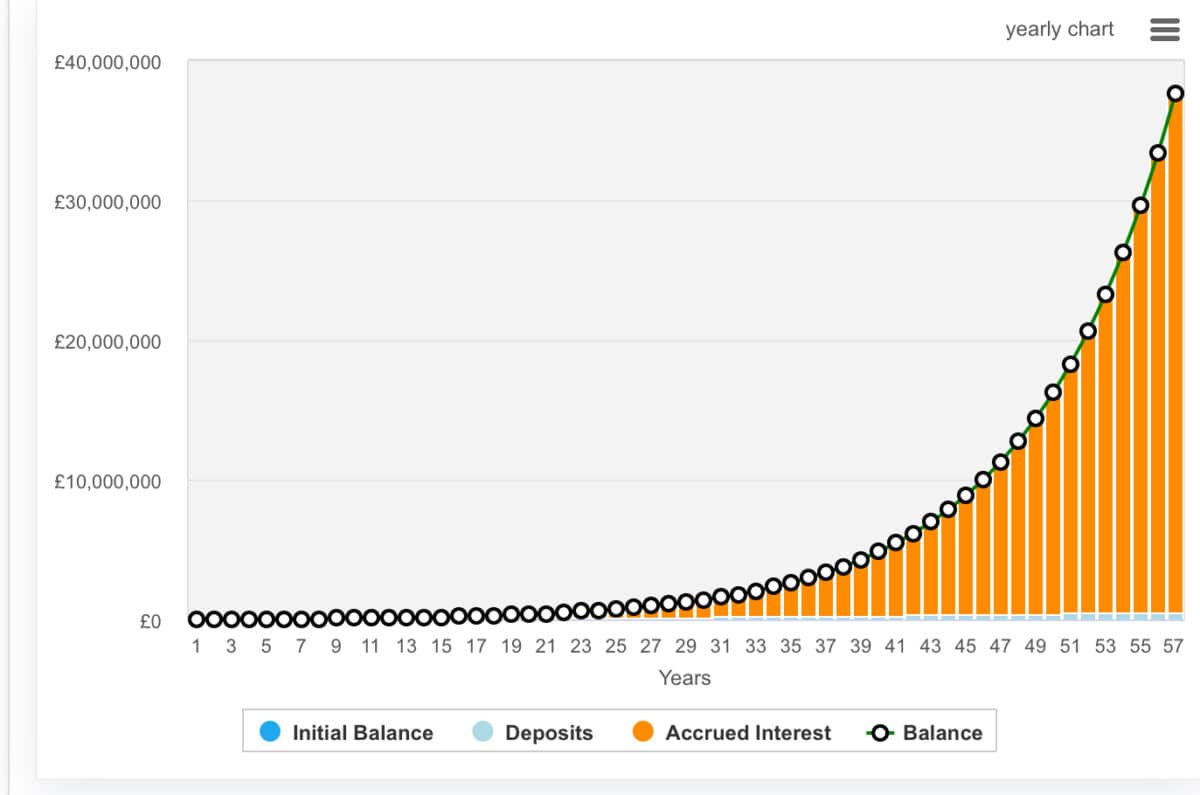
Created at thecalculatorsite.com

Please note that tax treatment depends on the individual circumstances of each client and may be subject to change in future. The content in this article is provided for information purposes only. It is not intended to be, neither does it constitute, any form of tax advice. Readers are responsible for carrying out their own due diligence and for obtaining professional advice before making any investment decisions.

This is how Warren Buffett made it

This isn’t a new strategy. In fact, Warren Buffett‘s wealth is a testament to the power of compounding and time. At age 30, his net worth was $1m, growing to $25m by 39. By 56, he became a billionaire, and by 66, his wealth surged to $17bn. Remarkably, 99% of his wealth was accumulated after age 50, with $84.2bn earned post-50 and $81.5bn after 65. Today, he’s worth $160bn.

Buffett’s strategy of reinvesting profits and focusing on long-term investments allowed his wealth to snowball over decades. For example, his $1bn investment in Coca-Cola in 1988 grew to over $20bn through reinvested dividends. This exponential growth underscores the importance of starting early and letting compounding work over time.

Investing for long-term growth

With Buffett in mind, one stock to consider for long-term investing is his Berkshire Hathaway (NYSE:BRK.B) conglomerate.


Berkshire Hathaway, under Warren Buffett’s leadership, has consistently demonstrated its ability to deliver long-term growth through disciplined investing and compounding. From 1965 to 2023, the company achieved a compound annual growth rate (CAGR) of 19.8%, significantly outperforming the S&P 500’s 10.2% over the same period.  

Moreover, its diversified portfolio, spanning insurance, utilities, and railroads, provides stability and resilience across economic cycles. This is why it was one of the first investments in my daughter’s SIPP.

In 2024, Berkshire reported more positive results, supported by strong insurance operations and a $334bn cash reserve. This financial strength allows Berkshire to capitalise on market opportunities, such as its recent investments in Japanese trading houses.

However, risks include its reliance on Buffett’s leadership, with succession concerns looming. Additionally, its massive size may limit agility in volatile markets, although its cash position may suggest the opposite.

Despite these challenges, Berkshire’s proven track record, wide economic moat, and conservative capital allocation make it an enticing proposition for long-term investors. Analysts maintain a Buy rating, with a 12-month price target of $511, reflecting confidence in its continued growth.


James Fox has positions in Berkshire Hathaway. The Motley Fool UK has no position in any of the shares mentioned. Views expressed on the companies mentioned in this article are those of the writer and therefore may differ from the official recommendations we make in our subscription services such as Share Advisor, Hidden Winners and Pro. Here at The Motley Fool we believe that considering a diverse range of insights makes us better investors.

More on Investing Articles

Friends and sisters exploring the outdoors together in Cornwall. They are standing with their arms around each other at the coast.
Investing Articles

£503 buys 14 shares in this FTSE 250 stock that returned 23.9% annually for the last 15 years

This FTSE 250 stock has averaged a huge return for 15 years. At today's price, £503 buys 14 shares. But…

Read more »

Black woman using loudspeaker to be heard
Investing Articles

£1,000 buys 25 shares in this FTSE 100 stock that’s returned 29.2% annually for the last 10 years

This FTSE 100 mining stock has returned close to 30% a year for a decade. At 3,995p, £1,000 buys 25…

Read more »

Female student sitting at the steps and using laptop
Investing Articles

Down 47%, is this growth stock finally worth buying in May?

With a £288m order book and a hidden pipeline of defence and nuclear contracts, is this growth stock now too…

Read more »

House models and one with REIT - standing for real estate investment trust - written on it.
Investing Articles

2 REITs yielding 7%+ to consider for passive income in 2026

A REIT backed by the NHS and another backed by Tesco and Sainsbury's with both yielding 7%+. Here's why I'm…

Read more »

Woman riding her old fashioned bicycle along the Beach Esplanade at Aberdeen, Scotland.
Investing Articles

Just 97 shares of this UK dividend stock generate £238 in passive income

A 5.7% yield, £238 in passive income from just 97 shares, and one of the most divisive dividend stocks on…

Read more »

ISA coins
Investing Articles

£10,000 in an ISA generates a second income of…

The London Stock Exchange is home to some of the world's most generous dividends. But how big a second income…

Read more »

Shot of a senior man drinking coffee and looking thoughtfully out of a window
Investing Articles

Expert recommendations: 2 top income stocks yielding 7%+!

With yields of 7.2% and 7.8% respectively, these two income stocks are catching the eyes of institutional analysts. Should investors…

Read more »

Illustration of flames over a black background
Investing Articles

3 top income-focused stocks to buy in May 2026, according to experts

Looking for a stock to buy for income in May 2026? Experts have flagged these three UK dividend shares as…

Read more »





