


We have some exciting news to share! The Motley Fool UK has now become The Twelfth Magpie -- an independent, UK-owned company, led by our long-serving UK management team — Mark Rogers, Chris Nials and Heather Adlington. In practical terms, it’s the same team you know, now fully focused on serving our UK readers and members.

Just as importantly, our approach remains unchanged: long-term, jargon-free, and on your side. This site is our new home, and there will be extra tweaks made across the coming few days as we settle in. So if anything looks a little off, please bear with us!

The content of this article was relevant at the time of publishing. Circumstances change continuously and caution should therefore be exercised when relying upon any content contained within this article.

Here’s how a £25k ISA could be the start of a £25k second income

It’s simpler than it sounds. Dr James Fox explains how he’d try to achieve a life-changing second income from a Stocks and Shares ISA.

| More on:
Shot of an young mixed-race woman using her cellphone while out cycling through the city

Image source: Getty Images

You’re reading a free article with opinions that may differ from The Motley Fool’s Premium Investing Services. Become a Motley Fool member today to get instant access to our top analyst recommendations, in-depth research, investing resources, and more. Learn More.

Millions of Britons invest for a second income. The reality, of course, is that many of us won’t achieve our goals unless we’re really committed. In the UK, a £25,000 portfolio is actually above average. But it isn’t enough to generate a life-changing passive income.

Instead, investors may want to consider what they’re targeting and run the maths on how they can get there. So, let’s explore how an investor could turn a £25,000 portfolio into a £25,000 annual second income.

XXX

Transforming the portfolio

A £25,000 second income could be achieved with a £500,000 portfolio and a 5% yield. Of course, the question we’re all asking ourselves is how do we turn a £25,000 portfolio into one worth half a million.

The simple answer is that it takes time and consistency. A rule of thumb is that a portfolio will double in value every seven years if it grows at 10% annually. And using that maths we can see that it wouldn’t take 21 years to reach £200k and then 28 years to reach £400k.

This is where the consistency part comes in. Making regular contributions can make the world of difference. Using the exact same calculation as before, but adding in £250 of monthly contributions, would see the figure rise to £840k after 28 years. That’s more than double. And it would only take 23 years to reach that £500k target. The magic is the compounding.

The caveat here is that some investors won’t be able to achieve double-digit growth. In fact, many novice investors lose money, particularly when they chase high returns without a solid understanding of risk management, valuation, or market cycles.

Emotional decision-making, overconfidence, and a lack of discipline often lead to poor timing. This includes buying into hype near market tops and selling in panic during downturns.
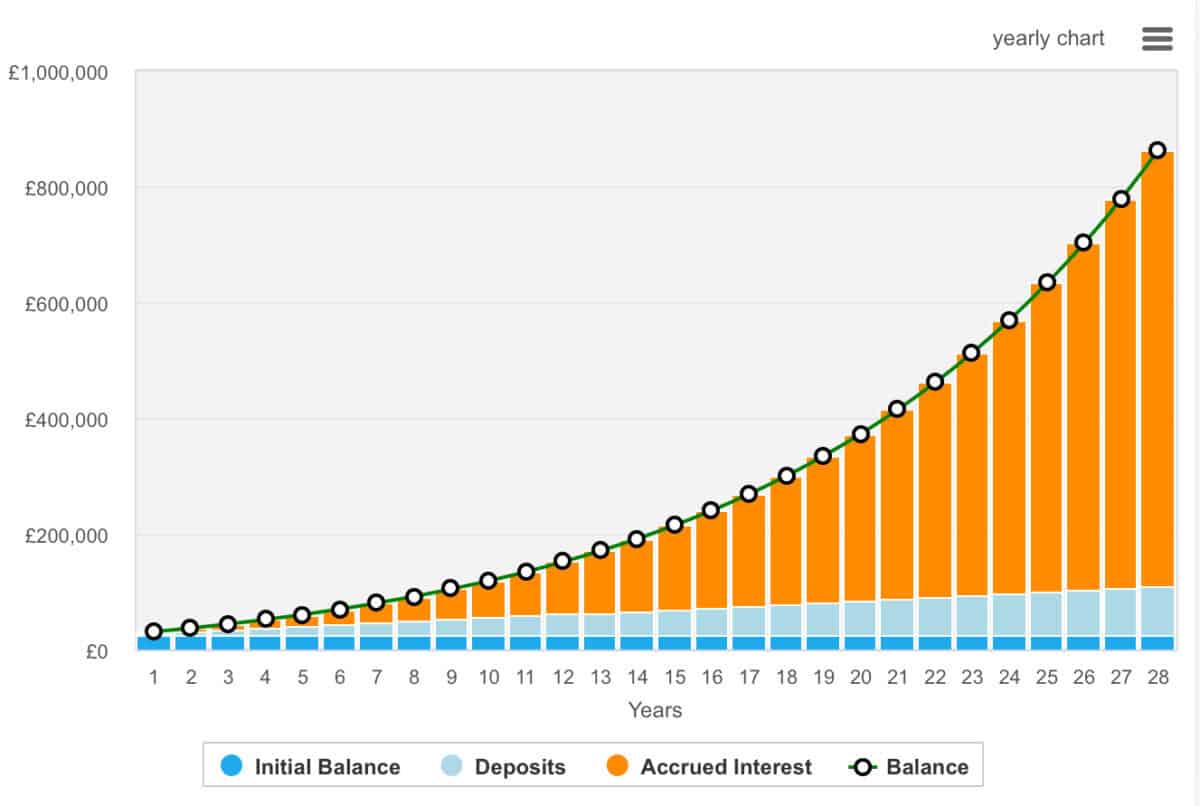
Created at thecalculatorsite.com

I’ve said this before…

I have a fairly high conviction approach to investing, and one stock that I repeatedly talk about is Scottish Mortgage Investment Trust (LSE:SMT). The investment trust offers a rare combination of diversification and high-conviction growth investing, focusing on some of the world’s most innovative and disruptive companies — both public and private.


Its managers, Tom Slater and Lawrence Burns, seek out businesses capable of transforming industries, often backing them at an early stage. This includes household names like Amazon and Nvidia, as well as private giants such as SpaceX and Bytedance.

A key feature of Scottish Mortgage is its use of gearing — borrowing money to invest further. Gearing can amplify returns in rising markets. But it also increases losses when markets fall, making the trust more volatile than many peers. This is particularly relevant given the trust’s concentrated exposure to high-growth sectors like technology and healthcare, which can be sensitive to shifts in market sentiment, interest rates, and economic cycles.

The trust’s adventurous portfolio and gearing mean it is best suited for investors with a high risk tolerance and a long-term perspective. And while it has delivered strong long-term returns, recent years have seen periods of significant underperformance. Personally, it’s a stock I continue to top up on.


John Mackey, former CEO of Whole Foods Market, an Amazon subsidiary, is a member of The Motley Fool’s board of directors. James Fox has positions in Nvidia and Scottish Mortgage Investment Trust Plc. The Motley Fool UK has recommended Amazon and Nvidia. Views expressed on the companies mentioned in this article are those of the writer and therefore may differ from the official recommendations we make in our subscription services such as Share Advisor, Hidden Winners and Pro. Here at The Motley Fool we believe that considering a diverse range of insights makes us better investors.

More on Investing Articles

Friends and sisters exploring the outdoors together in Cornwall. They are standing with their arms around each other at the coast.
Investing Articles

£503 buys 14 shares in this FTSE 250 stock that returned 23.9% annually for the last 15 years

This FTSE 250 stock has averaged a huge return for 15 years. At today's price, £503 buys 14 shares. But…

Read more »

Black woman using loudspeaker to be heard
Investing Articles

£1,000 buys 25 shares in this FTSE 100 stock that’s returned 29.2% annually for the last 10 years

This FTSE 100 mining stock has returned close to 30% a year for a decade. At 3,995p, £1,000 buys 25…

Read more »

Female student sitting at the steps and using laptop
Investing Articles

Down 47%, is this growth stock finally worth buying in May?

With a £288m order book and a hidden pipeline of defence and nuclear contracts, is this growth stock now too…

Read more »

House models and one with REIT - standing for real estate investment trust - written on it.
Investing Articles

2 REITs yielding 7%+ to consider for passive income in 2026

A REIT backed by the NHS and another backed by Tesco and Sainsbury's with both yielding 7%+. Here's why I'm…

Read more »

Woman riding her old fashioned bicycle along the Beach Esplanade at Aberdeen, Scotland.
Investing Articles

Just 97 shares of this UK dividend stock generate £238 in passive income

A 5.7% yield, £238 in passive income from just 97 shares, and one of the most divisive dividend stocks on…

Read more »

ISA coins
Investing Articles

£10,000 in an ISA generates a second income of…

The London Stock Exchange is home to some of the world's most generous dividends. But how big a second income…

Read more »

Shot of a senior man drinking coffee and looking thoughtfully out of a window
Investing Articles

Expert recommendations: 2 top income stocks yielding 7%+!

With yields of 7.2% and 7.8% respectively, these two income stocks are catching the eyes of institutional analysts. Should investors…

Read more »

Illustration of flames over a black background
Investing Articles

3 top income-focused stocks to buy in May 2026, according to experts

Looking for a stock to buy for income in May 2026? Experts have flagged these three UK dividend shares as…

Read more »





