


We have some exciting news to share! The Motley Fool UK has now become The Twelfth Magpie -- an independent, UK-owned company, led by our long-serving UK management team — Mark Rogers, Chris Nials and Heather Adlington. In practical terms, it’s the same team you know, now fully focused on serving our UK readers and members.

Just as importantly, our approach remains unchanged: long-term, jargon-free, and on your side. This site is our new home, and there will be extra tweaks made across the coming few days as we settle in. So if anything looks a little off, please bear with us!

The content of this article was relevant at the time of publishing. Circumstances change continuously and caution should therefore be exercised when relying upon any content contained within this article.

As the FTSE 100 recovers from US trade war losses, here are the winners and losers

Our writer considers the prospects of one UK share that has suffered recently, while other FTSE 100 stocks have enjoyed notable gains.

| More on:
Business man pointing at 'Sell' sign

Image source: Getty Images

You’re reading a free article with opinions that may differ from The Motley Fool’s Premium Investing Services. Become a Motley Fool member today to get instant access to our top analyst recommendations, in-depth research, investing resources, and more. Learn More.

The FTSE 100‘s back where it was before the US administration announced a 10% trade tariff on UK goods. When the shocking news hit in early April, the index fell almost 1,000 points in a few days.

Now back to around 8,500 points, it’s near the same level it was in mid-March. The variation in performance of stocks over this period is a good indication of how different industries are affected by tariffs.

XXX

FTSE 100 stock performance

In this instance, there are clear sector-specific winners and losers. Travel-related stocks were among the hardest hit by tariffs, while tobacco stocks, which experienced minimal losses at the time, have since suffered worse losses.

International Consolidated Airlines Group fell sharply when the tariffs were announced, but is now up almost 16% since before the announcement. The FTSE 250 stock Carnival Cruises suffered similar losses but has enjoyed even greater gains since. The most likely explanation for this is falling fuel prices — the largest expense these two companies face.

Meanwhile, tobacco giants Imperial Brands and British American Tobacco (LSE: BATS) are both down by 2%-3% since mid-March.
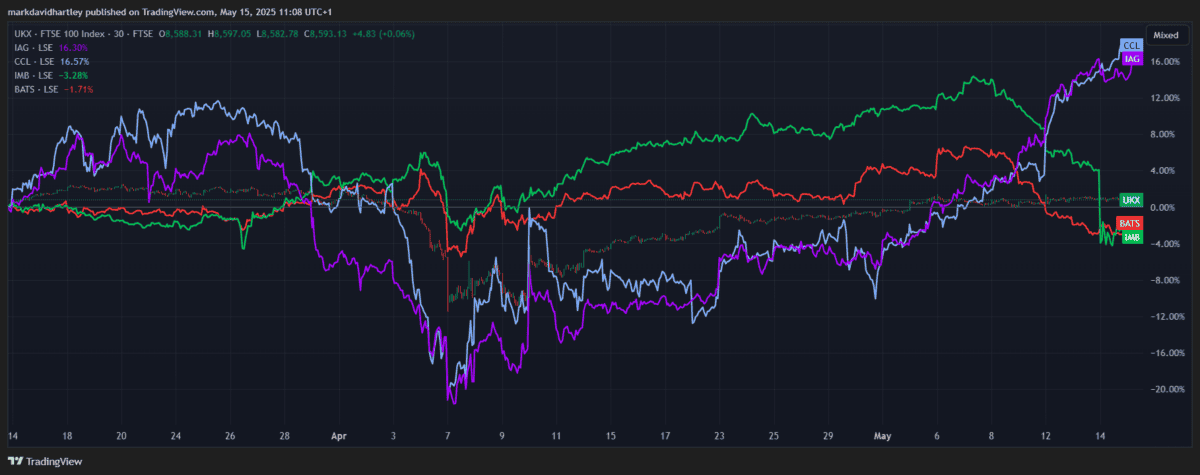
FTSE 100 price comparisons
Created on TradingView.com

So why’s tobacco suffering now, and how is it related to tariffs? I decided to find out.

Trade war tensions

The most likely factor contributing to the recent drop in tobacco stock prices is the announcement of tariff reductions between the US and China. The two countries agreed to lower reciprocal tariffs by 115% for 90 days, aiming to de-escalate ongoing trade tensions. While this led to a net positive gain in most global markets, defensive industries like tobacco took a hit.

Why? The environment provides an opportunity for risk-hardy investors to exploit the resulting price fluctuations. Subsequently, many are shifting funds out of stable defensive stocks to take advantage of those more sensitive to tariff changes.

And it’s not just tobacco — other popular defensive stocks such as Unilever, Reckitt and AstraZeneca also suffered minor losses this week.

Those benefiting most from the changes are sectors including technology and consumer goods that are more directly impacted by trade policies.

An opportunity?

British American Tobacco’s falling share price might look attractive to value investors — but does it have long-term potential?

The company’s been grappling with several operational challenges recently, which gives reason for pause. In its latest annual report, it outlined expectations of lower first-half profits, attributed to macroeconomic pressures and the rise of illegal vapor products in the US. Besides this, its venture into the vapor market has faced additional setbacks. Legal challenges have been a key issue, along with increased competition from disposable products in Europe and patent disputes in the US. 

These problems have raised concerns about the company’s ability to successfully transition to next-gen product categories.

But with a consistently high yield and one of the best dividend track records on the FTSE 100, it still offers significant value. Currently, with a yield around 8%, dividends have grown at an average annual rate of 5%, with no cuts or reductions in decades.

That’s why it remains one of the top-earning dividend stocks in my passive income portfolio. There are certainly challenges ahead, but for income-focused investors, I think it’s still one worth considering.


Mark Hartley has positions in AstraZeneca Plc, British American Tobacco P.l.c., Reckitt Benckiser Group Plc, and Unilever. The Motley Fool UK has recommended AstraZeneca Plc, British American Tobacco P.l.c., Reckitt Benckiser Group Plc, and Unilever. Views expressed on the companies mentioned in this article are those of the writer and therefore may differ from the official recommendations we make in our subscription services such as Share Advisor, Hidden Winners and Pro. Here at The Motley Fool we believe that considering a diverse range of insights makes us better investors.

More on Investing Articles

Friends and sisters exploring the outdoors together in Cornwall. They are standing with their arms around each other at the coast.
Investing Articles

£503 buys 14 shares in this FTSE 250 stock that returned 23.9% annually for the last 15 years

This FTSE 250 stock has averaged a huge return for 15 years. At today's price, £503 buys 14 shares. But…

Read more »

Black woman using loudspeaker to be heard
Investing Articles

£1,000 buys 25 shares in this FTSE 100 stock that’s returned 29.2% annually for the last 10 years

This FTSE 100 mining stock has returned close to 30% a year for a decade. At 3,995p, £1,000 buys 25…

Read more »

Female student sitting at the steps and using laptop
Investing Articles

Down 47%, is this growth stock finally worth buying in May?

With a £288m order book and a hidden pipeline of defence and nuclear contracts, is this growth stock now too…

Read more »

House models and one with REIT - standing for real estate investment trust - written on it.
Investing Articles

2 REITs yielding 7%+ to consider for passive income in 2026

A REIT backed by the NHS and another backed by Tesco and Sainsbury's with both yielding 7%+. Here's why I'm…

Read more »

Woman riding her old fashioned bicycle along the Beach Esplanade at Aberdeen, Scotland.
Investing Articles

Just 97 shares of this UK dividend stock generate £238 in passive income

A 5.7% yield, £238 in passive income from just 97 shares, and one of the most divisive dividend stocks on…

Read more »

ISA coins
Investing Articles

£10,000 in an ISA generates a second income of…

The London Stock Exchange is home to some of the world's most generous dividends. But how big a second income…

Read more »

Shot of a senior man drinking coffee and looking thoughtfully out of a window
Investing Articles

Expert recommendations: 2 top income stocks yielding 7%+!

With yields of 7.2% and 7.8% respectively, these two income stocks are catching the eyes of institutional analysts. Should investors…

Read more »

Illustration of flames over a black background
Investing Articles

3 top income-focused stocks to buy in May 2026, according to experts

Looking for a stock to buy for income in May 2026? Experts have flagged these three UK dividend shares as…

Read more »





