

We have some exciting news to share! The Motley Fool UK has now become The Twelfth Magpie -- an independent, UK-owned company, led by our long-serving UK management team — Mark Rogers, Chris Nials and Heather Adlington. In practical terms, it’s the same team you know, now fully focused on serving our UK readers and members.

Just as importantly, our approach remains unchanged: long-term, jargon-free, and on your side. This site is our new home, and there will be extra tweaks made across the coming few days as we settle in. So if anything looks a little off, please bear with us!

The content of this article was relevant at the time of publishing. Circumstances change continuously and caution should therefore be exercised when relying upon any content contained within this article.

Down 15% from its year high, is Shell’s share price too cheap for me to pass up?

Shell’s share price has simply tracked the trading pattern of the benchmark oil price in recent months, but I think there’s a lot more value in it than that.

| More on:
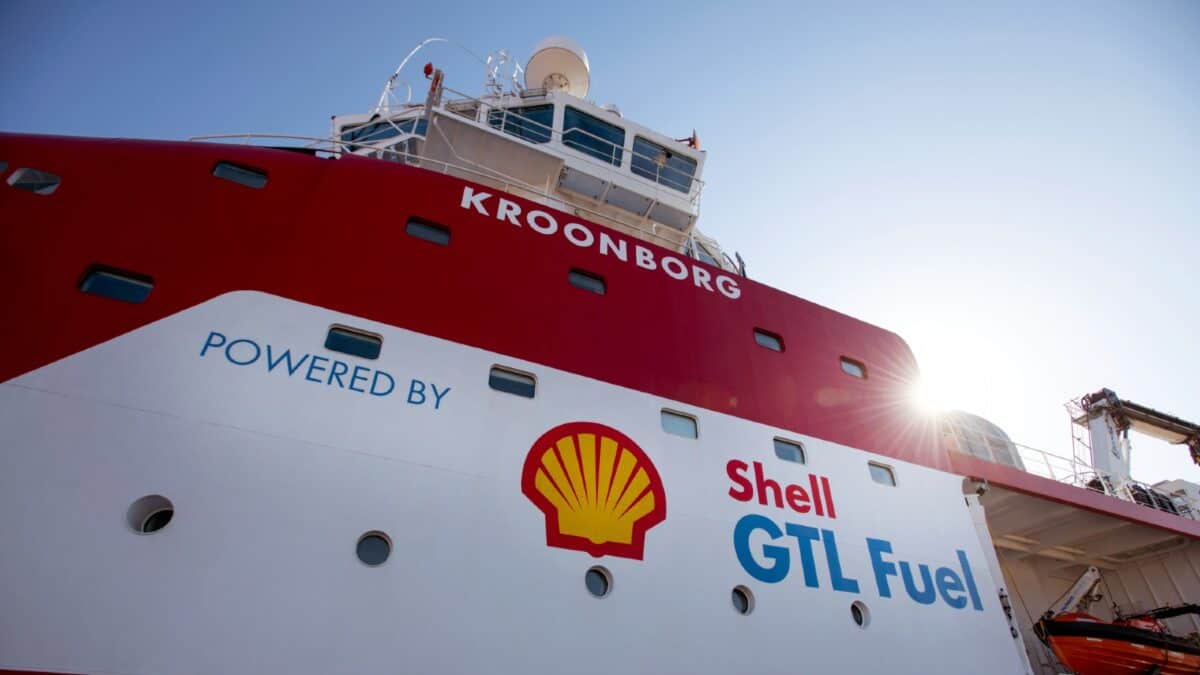
Side of boat fuelled by gas to liquids, advertising Shell GTL Fuel

Image source: Olaf Kraak via Shell plc

You’re reading a free article with opinions that may differ from The Motley Fool’s Premium Investing Services. Become a Motley Fool member today to get instant access to our top analyst recommendations, in-depth research, investing resources, and more. Learn More.

Shell’s (LSE: SHEL) share price is down 15% from its 5 July 12-month high of £29.10. Comparing its share price chart with that of the Brent oil price benchmark shows a near-identical trading pattern.

In basic terms, this implies that the UK oil giant has no additional value over and above the oil price. That is, no additional value from its high-value petrochemical products, green energy products, trading operations or anything else.

XXX

Handily though, the value of the likely future cash flows from all of Shell’s operations can be seen via discounted cash flow analysis.

It pinpoints the price any firm’s share price should be, based on future cash flow forecasts for the underlying business.

This allows me to get a clear picture of the difference between Shell’s share price and its share value. The two are not the same and it is in this difference that big, consistent profits are made over time, in my experience.

This comprises very senior trading and sales positions at investment banks and 35 years as a private investor.

So, what’s the valuation?

Using other analysts’ figures and my own, the DCF for Shell shows it is 62% undervalued at its current price of £24.79.

Therefore, the ‘fair value’ of the shares is £65.24.

A comparison of the firm’s key stock measures against those of its competitors lends further weight to this view.

Its 0.7 price-to-sales ratio is very undervalued against its competitors’ average of 1.9. Indeed, it is bottom of the group that comprises Chevron at 1.2, ExxonMobil at 1.3, ConocoPhillips at 1.9, and Saudi Aramco at 3.4. And it is apposite to note that this ratio includes all sales made by the company, not just of oil.

It is also very undervalued at a price-to-book ratio of 1.1 compared to the 2.3 average of its peers.

How does the business look?

I think a risk to Shell is any reversion to a more aggressive energy transition plan due to government pressure.

These included a target of reducing its net carbon intensity by a minimum 20% by 2030 compared to 2016 levels. It has since lowered this target to a minimum of 15%. 

It also featured a 45% net carbon reduction target for 2035, which was subsequently scrapped.

Like its CEO, Wael Swan, I believe its earlier targets exacerbated the valuation gap between it and its still fossil-fuel-focused competitors.

Instead, Shell plans to keep oil production at 1.4m bpd until 2030. And it intends to expand its liquefied natural gas business, based on forecasts that demand will increase 50%+ by 2040.

Overall, consensus analysts’ estimates are that the firm’s earnings will increase 10.4% a year to end-2027.

Will I buy more of the stock?

It is earnings growth that ultimately drives a firm’s share price higher over the long run. Given the very undervalued starting point for such a rise, I cannot pass up the opportunity to buy more of the shares and will do so very soon.

An additional benefit of doing so is the healthy dividend yield of 4.3% currently. This compares to the 3.5% average yield of the FTSE 100 at present.

That said, analysts project that Shell’s yield will rise to 4.5% next year and to 4.7% in 2027.

Simon Watkins has positions in Shell Plc. The Motley Fool UK has no position in any of the shares mentioned. Views expressed on the companies mentioned in this article are those of the writer and therefore may differ from the official recommendations we make in our subscription services such as Share Advisor, Hidden Winners and Pro. Here at The Motley Fool we believe that considering a diverse range of insights makes us better investors.

More on Investing Articles

Friends and sisters exploring the outdoors together in Cornwall. They are standing with their arms around each other at the coast.
Investing Articles

£503 buys 14 shares in this FTSE 250 stock that returned 23.9% annually for the last 15 years

This FTSE 250 stock has averaged a huge return for 15 years. At today's price, £503 buys 14 shares. But…

Read more »

Black woman using loudspeaker to be heard
Investing Articles

£1,000 buys 25 shares in this FTSE 100 stock that’s returned 29.2% annually for the last 10 years

This FTSE 100 mining stock has returned close to 30% a year for a decade. At 3,995p, £1,000 buys 25…

Read more »

Female student sitting at the steps and using laptop
Investing Articles

Down 47%, is this growth stock finally worth buying in May?

With a £288m order book and a hidden pipeline of defence and nuclear contracts, is this growth stock now too…

Read more »

House models and one with REIT - standing for real estate investment trust - written on it.
Investing Articles

2 REITs yielding 7%+ to consider for passive income in 2026

A REIT backed by the NHS and another backed by Tesco and Sainsbury's with both yielding 7%+. Here's why I'm…

Read more »

Woman riding her old fashioned bicycle along the Beach Esplanade at Aberdeen, Scotland.
Investing Articles

Just 97 shares of this UK dividend stock generate £238 in passive income

A 5.7% yield, £238 in passive income from just 97 shares, and one of the most divisive dividend stocks on…

Read more »

ISA coins
Investing Articles

£10,000 in an ISA generates a second income of…

The London Stock Exchange is home to some of the world's most generous dividends. But how big a second income…

Read more »

Shot of a senior man drinking coffee and looking thoughtfully out of a window
Investing Articles

Expert recommendations: 2 top income stocks yielding 7%+!

With yields of 7.2% and 7.8% respectively, these two income stocks are catching the eyes of institutional analysts. Should investors…

Read more »

Illustration of flames over a black background
Investing Articles

3 top income-focused stocks to buy in May 2026, according to experts

Looking for a stock to buy for income in May 2026? Experts have flagged these three UK dividend shares as…

Read more »






