


We have some exciting news to share! The Motley Fool UK has now become The Twelfth Magpie -- an independent, UK-owned company, led by our long-serving UK management team — Mark Rogers, Chris Nials and Heather Adlington. In practical terms, it’s the same team you know, now fully focused on serving our UK readers and members.

Just as importantly, our approach remains unchanged: long-term, jargon-free, and on your side. This site is our new home, and there will be extra tweaks made across the coming few days as we settle in. So if anything looks a little off, please bear with us!

The content of this article was relevant at the time of publishing. Circumstances change continuously and caution should therefore be exercised when relying upon any content contained within this article.

How much do you need in a SIPP to target a £1,000 monthly passive income?

Discover how a regular monthly contribution of roughly £250 could create a substantial Self-Invested Personal Pension (SIPP).

| More on:
Shot of a senior man drinking coffee and looking thoughtfully out of a window

Image source: Getty Images

You’re reading a free article with opinions that may differ from The Motley Fool’s Premium Investing Services. Become a Motley Fool member today to get instant access to our top analyst recommendations, in-depth research, investing resources, and more. Learn More.

With shelter from capital income and dividend taxes, the Self-Invested Personal Pension (SIPP) can be a real game changer for targeting a long-term passive income.

In this respect, it has similarities to the Stocks and Shares ISA. However, this financial product has an added bonus: tax relief, which is paid at the following rates:

XXX
  • 20% for basic-rate taxpayers
  • 40% for higher-rate taxpayers
  • 45% for additional-rate taxpayers

These tax savings and tax relief give share investors an incredible advantage to build wealth. With more capital to invest, individuals can speed up the compounding process and grow their wealth faster over time. An added bonus is that 25% of the SIPP can eventually be withdrawn free of tax.

Please note that tax treatment depends on the individual circumstances of each client and may be subject to change in future. The content in this article is provided for information purposes only. It is not intended to be, neither does it constitute, any form of tax advice. Readers are responsible for carrying out their own due diligence and for obtaining professional advice before making any investment decisions.

Put simply, this means someone who invests less than £250 a month could realistically aim for a £2,000 monthly second income by the time they retire.

Targeting a £400k pension

A popular passive income strategy with SIPP users is to invest in dividend-paying shares.

An investor going down this route would need a pension pot of £400k for an income of £2k a month. That’s assuming they invest in 6%-yielding dividend shares. Higher-yielding stocks are commonly available that could reduce the needed pot size. But these shares can be riskier due to issues like sector concentration, lower growth potential, and balance sheet instability.

Share investors have many options available to them to target this £400,000 portfolio. I personally like the idea of investing in a wide range of global shares, which provides large-range growth and income opportunities. At the same time, this diversified approach also lets me spread risk.

By holding a basket of shares that replicates the MSCI World Index, an individual could target that £400k SIPP with a monthly investment of just under £250 (£246) over 25 years. That figure includes tax relief, too.

This calculation is based on the index’s 10-year average annual return of 11.2%.
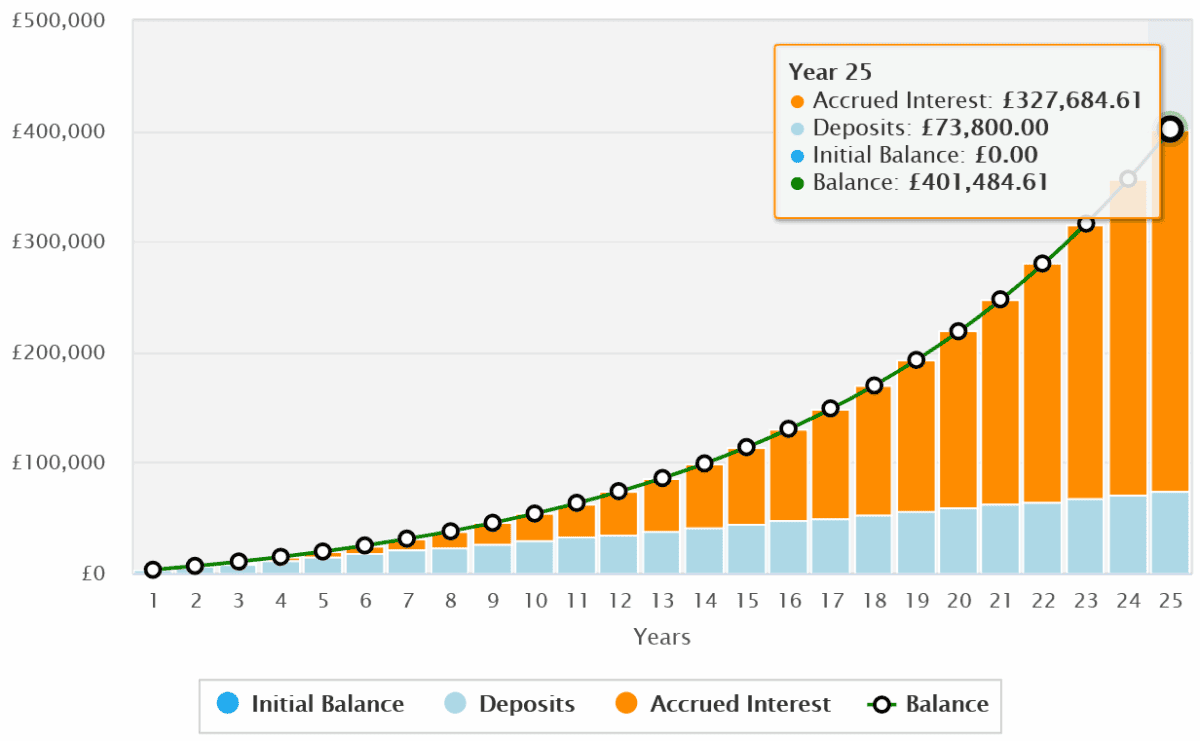
Turning £246 a month in a SIPP into a £400k portfolio
Source: thecalculatorsite.com

Using global funds for a SIPP income

The MSCI World Index consists of 1,322 different companies. Clearly, adding this number of shares into a SIPP would require considerable effort and cost. Many of these shares would be unavailable to personal pension investors too. So this approach is clearly off limits.

Happily, though, investors can target the index with the help of an exchange-traded fund (ETF). The iShares Core MSCI World Index (LSE:IWDG) — launched in 2017 — is one such investment vehicle.

Tracking errors are common with ETFs, reflecting small gaps between the fund’s performance and that of the underlying index. These reflect items like dealing charges, trade timings, and dividend reinvestment.

However, well-managed funds substantially reduce (if not entirely eliminate) the threat of wide divergences. This iShares one has a three-year tracking error of just 1.42%, according to Morningstar.

While well diversified by sector and country, I like the fund’s high weighting of technology stocks (26.7% of the whole portfolio). Shares like Nvidia and Microsoft have significant growth potential as the digital economy rapidly expands.

Past performance isn’t a guarantee of future returns. But I feel SIPP investors seeking a large income should seriously consider global share ETFs like this one.


Royston Wild has no position in any of the shares mentioned. The Motley Fool UK has recommended Microsoft and Nvidia. Views expressed on the companies mentioned in this article are those of the writer and therefore may differ from the official recommendations we make in our subscription services such as Share Advisor, Hidden Winners and Pro. Here at The Motley Fool we believe that considering a diverse range of insights makes us better investors.

More on Investing Articles

Friends and sisters exploring the outdoors together in Cornwall. They are standing with their arms around each other at the coast.
Investing Articles

£503 buys 14 shares in this FTSE 250 stock that returned 23.9% annually for the last 15 years

This FTSE 250 stock has averaged a huge return for 15 years. At today's price, £503 buys 14 shares. But…

Read more »

Black woman using loudspeaker to be heard
Investing Articles

£1,000 buys 25 shares in this FTSE 100 stock that’s returned 29.2% annually for the last 10 years

This FTSE 100 mining stock has returned close to 30% a year for a decade. At 3,995p, £1,000 buys 25…

Read more »

Female student sitting at the steps and using laptop
Investing Articles

Down 47%, is this growth stock finally worth buying in May?

With a £288m order book and a hidden pipeline of defence and nuclear contracts, is this growth stock now too…

Read more »

House models and one with REIT - standing for real estate investment trust - written on it.
Investing Articles

2 REITs yielding 7%+ to consider for passive income in 2026

A REIT backed by the NHS and another backed by Tesco and Sainsbury's with both yielding 7%+. Here's why I'm…

Read more »

Woman riding her old fashioned bicycle along the Beach Esplanade at Aberdeen, Scotland.
Investing Articles

Just 97 shares of this UK dividend stock generate £238 in passive income

A 5.7% yield, £238 in passive income from just 97 shares, and one of the most divisive dividend stocks on…

Read more »

ISA coins
Investing Articles

£10,000 in an ISA generates a second income of…

The London Stock Exchange is home to some of the world's most generous dividends. But how big a second income…

Read more »

Shot of a senior man drinking coffee and looking thoughtfully out of a window
Investing Articles

Expert recommendations: 2 top income stocks yielding 7%+!

With yields of 7.2% and 7.8% respectively, these two income stocks are catching the eyes of institutional analysts. Should investors…

Read more »

Illustration of flames over a black background
Investing Articles

3 top income-focused stocks to buy in May 2026, according to experts

Looking for a stock to buy for income in May 2026? Experts have flagged these three UK dividend shares as…

Read more »





