


We have some exciting news to share! The Motley Fool UK has now become The Twelfth Magpie -- an independent, UK-owned company, led by our long-serving UK management team — Mark Rogers, Chris Nials and Heather Adlington. In practical terms, it’s the same team you know, now fully focused on serving our UK readers and members.

Just as importantly, our approach remains unchanged: long-term, jargon-free, and on your side. This site is our new home, and there will be extra tweaks made across the coming few days as we settle in. So if anything looks a little off, please bear with us!

The content of this article was relevant at the time of publishing. Circumstances change continuously and caution should therefore be exercised when relying upon any content contained within this article.

How much money do I to put into need in an ISA for £1,000 in passive income each month?

The Stocks and Shares ISA is an incredible vehicle for Britons to build wealth and take an income from their investments. Not enough of us use it.

| More on:
Close-up image depicting a woman in her 70s taking British bank notes from her colourful leather wallet.

Image source: Getty Images

You’re reading a free article with opinions that may differ from The Motley Fool’s Premium Investing Services. Become a Motley Fool member today to get instant access to our top analyst recommendations, in-depth research, investing resources, and more. Learn More.

The Stocks and Shares ISA allows Britons to contribute up to £20,000 each year into a tax-free investment portfolio. In terms of wealth creation in the UK, there’s nothing quite like it.

To generate £1,000 in passive income each month (£12,000 per year) from a Stocks and Shares ISA, an investor would need a portfolio of around £240,000 yielding 5% annually.

XXX

That’s a substantial sum, but the beauty of compounding means it doesn’t have to be built overnight.

For instance, investing £400 a month into a diversified ISA returning an average of 8% per year could grow to roughly £235,000 after 20 years.

Each year, the returns themselves start earning returns — that’s compounding in action. Early contributions have decades to grow, while later ones benefit from an ever-larger base.

The key is consistency and time in the market, not timing it. Even modest, regular investments can snowball into a meaningful passive income stream, particularly when sheltered from tax within an ISA.
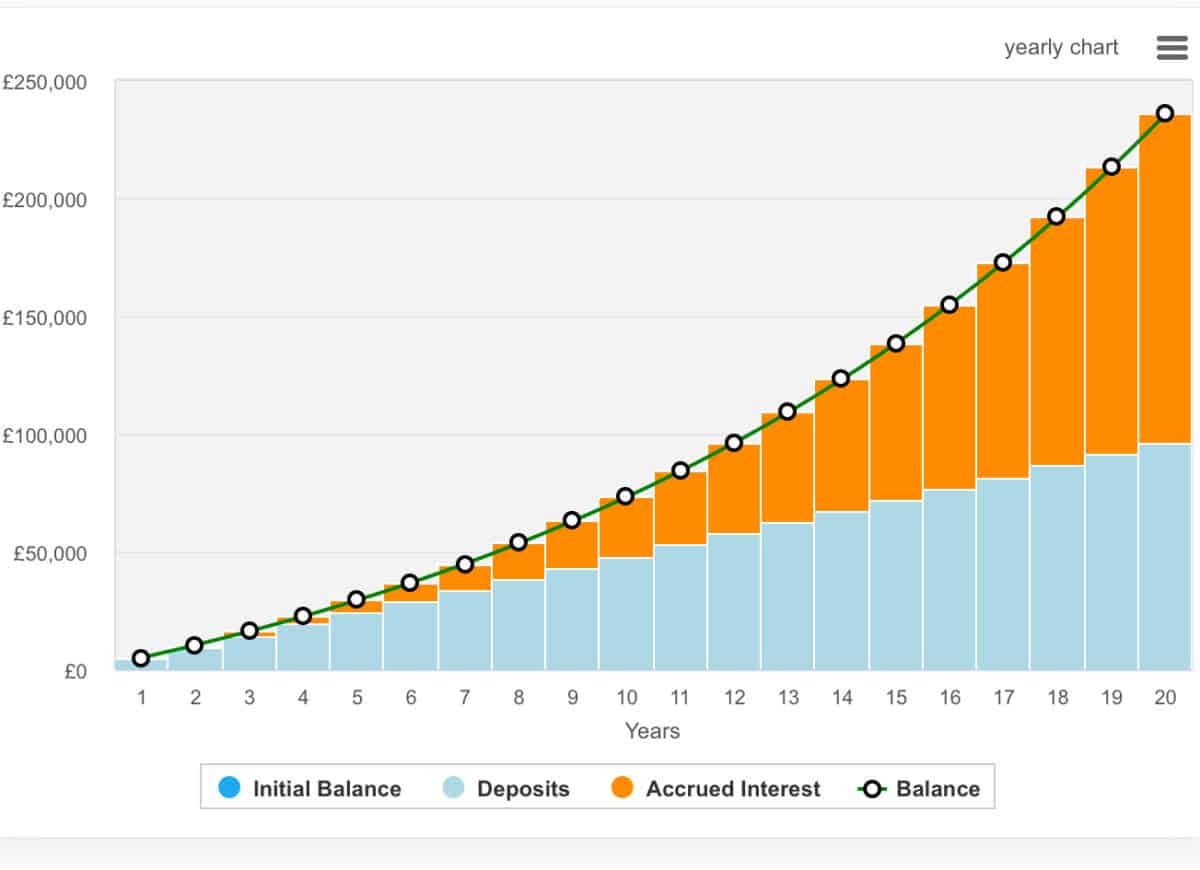
Created at thecalculatorsite.com

Please note that tax treatment depends on the individual circumstances of each client and may be subject to change in future. The content in this article is provided for information purposes only. It is not intended to be, neither does it constitute, any form of tax advice. Readers are responsible for carrying out their own due diligence and for obtaining professional advice before making any investment decisions.

Where to invest?

Ok, so we’ve explored how this could be achieved in theory, but the next part is know what to do to get there. After opening a Stocks and Shares ISA with a brokerage, investors need to choose which stocks to buy with their hard-earned cash.

The options — depending on the brokerage — are typically vast. There’s everything from funds and trusts to stocks and bonds.

Funds and investment trusts pool money from many investors to buy a diversified mix of assets, managed by professionals aiming to generate steady returns.

They’re often seen as an easier way to spread risk without picking individual shares. Stocks, on the other hand, represent ownership in specific companies — higher risk, but with the potential for higher long-term gains.

Bonds are essentially loans to governments or corporations that pay fixed interest, offering stability and predictable income.

Personally, as a more experienced investor, my portfolio is geared towards a wide range of stocks. A data-driven approach helps me achieve returns that are typically far in excess those of an index-tracking fund.

A current favourite

My only investment in the month of October has been the London Stock Exchange Group (LSE:LSEG). According to analyst consensus, the London Stock Exchange Group is currently viewed as the most undervalued company on the FTSE 100.


Forecasts suggest a 42% discount to fair value. However, such estimates must be treated with caution as analyst coverage can vary in quality. So, why is it so undervalued?

The London Stock Exchange Group has a wide economic moat and high margin operations, especially in data and analytics. It also offers double-digit earnings growth while trading at a little over 20 times forward earnings.

However, no stock is perfect. Risks remain. Competition in data and analytics is fierce, and the transition away from legacy products could dent recurring revenues.

Still, for long-term investors, these risks may be balanced by the firm’s diversified, high-margin operations. I certainly believe it’s a stock worth considering.


James Fox has positions in London Stock Exchange Group. The Motley Fool UK has no position in any of the shares mentioned. Views expressed on the companies mentioned in this article are those of the writer and therefore may differ from the official recommendations we make in our subscription services such as Share Advisor, Hidden Winners and Pro. Here at The Motley Fool we believe that considering a diverse range of insights makes us better investors.

More on Investing Articles

Friends and sisters exploring the outdoors together in Cornwall. They are standing with their arms around each other at the coast.
Investing Articles

£503 buys 14 shares in this FTSE 250 stock that returned 23.9% annually for the last 15 years

This FTSE 250 stock has averaged a huge return for 15 years. At today's price, £503 buys 14 shares. But…

Read more »

Black woman using loudspeaker to be heard
Investing Articles

£1,000 buys 25 shares in this FTSE 100 stock that’s returned 29.2% annually for the last 10 years

This FTSE 100 mining stock has returned close to 30% a year for a decade. At 3,995p, £1,000 buys 25…

Read more »

Female student sitting at the steps and using laptop
Investing Articles

Down 47%, is this growth stock finally worth buying in May?

With a £288m order book and a hidden pipeline of defence and nuclear contracts, is this growth stock now too…

Read more »

House models and one with REIT - standing for real estate investment trust - written on it.
Investing Articles

2 REITs yielding 7%+ to consider for passive income in 2026

A REIT backed by the NHS and another backed by Tesco and Sainsbury's with both yielding 7%+. Here's why I'm…

Read more »

Woman riding her old fashioned bicycle along the Beach Esplanade at Aberdeen, Scotland.
Investing Articles

Just 97 shares of this UK dividend stock generate £238 in passive income

A 5.7% yield, £238 in passive income from just 97 shares, and one of the most divisive dividend stocks on…

Read more »

ISA coins
Investing Articles

£10,000 in an ISA generates a second income of…

The London Stock Exchange is home to some of the world's most generous dividends. But how big a second income…

Read more »

Shot of a senior man drinking coffee and looking thoughtfully out of a window
Investing Articles

Expert recommendations: 2 top income stocks yielding 7%+!

With yields of 7.2% and 7.8% respectively, these two income stocks are catching the eyes of institutional analysts. Should investors…

Read more »

Illustration of flames over a black background
Investing Articles

3 top income-focused stocks to buy in May 2026, according to experts

Looking for a stock to buy for income in May 2026? Experts have flagged these three UK dividend shares as…

Read more »





