


We have some exciting news to share! The Motley Fool UK has now become The Twelfth Magpie -- an independent, UK-owned company, led by our long-serving UK management team — Mark Rogers, Chris Nials and Heather Adlington. In practical terms, it’s the same team you know, now fully focused on serving our UK readers and members.

Just as importantly, our approach remains unchanged: long-term, jargon-free, and on your side. This site is our new home, and there will be extra tweaks made across the coming few days as we settle in. So if anything looks a little off, please bear with us!

The content of this article was relevant at the time of publishing. Circumstances change continuously and caution should therefore be exercised when relying upon any content contained within this article.

2 low-risk, high-yield FTSE 100 shares to consider for 2026

Investors aiming for long-term passive income should focus on dividend reliability. Our writer identifies two FTSE 100 stocks to consider.

| More on:
Chalkboard representation of risk versus reward on a pair of scales

Image source: Getty Images

You’re reading a free article with opinions that may differ from The Motley Fool’s Premium Investing Services. Become a Motley Fool member today to get instant access to our top analyst recommendations, in-depth research, investing resources, and more. Learn More.

Building a passive income portfolio in the UK doesn’t just require a bucketload of patience and dedication (although they help). Equally as important is a portfolio made of the right FTSE 100 shares.

But what are the ‘right’ shares?

XXX

Well, in all honesty, there’s no definitive list of correct shares for such an endeavour. And the fact that the goal posts are constantly changing doesn’t help. Fluctuating interest rates, political instability and foreign tariffs all play a part in where share prices go daily.

That’s why the ideal shares are those that keep a steady head even when times get tough. If your investment outlook is 10 to 20 years (and it should be), then you need shares that will survive the journey.

With that in mind, I’ve identified two dividend shares on the FTSE 100 that have a super-reliable history. Whether preparing for retirement or saving up for a house, I think both are well worth considering.

Unilever

Despite a typically moderate yield, Unilever (LSE: ULVR) is popular for passive income because of its exceptional dividend track record. Spanning nearly a century, it’s paid dividends consistently since 1929, with almost 20 years of uninterrupted growth before Covid.

That alone is impressive — but the real attraction is its resilience to market downturns. Even during the most severe economic downturns (the Great Depression, World War II, the 2008 Financial Crisis, and Covid), Unilever maintained its dividend payments.

The reason for this is the company’s recession-resistant business model. Selling essential goods like food, personal care, and household products means its revenues flow regardless of economic conditions.

It’s worth noting, there’s a risk of unexpected currency fluctuations affecting dividend payments, as Unilever reports in both sterling and euros. Furthermore, its global diversification means returns are at risk from political instability, currency crises and economic volatility.

Still, history has shown it’s one of the most stable of FTSE 100 dividend stocks.

Severn Trent

When thinking of a good utility stock for income, many people turn to National Grid. But while the nation’s core energy grid operator is a great option, Severn Trent (LSE: SVT) actually has a better dividend track record.

What’s more, it’s also performed slightly better over the past 20 years.
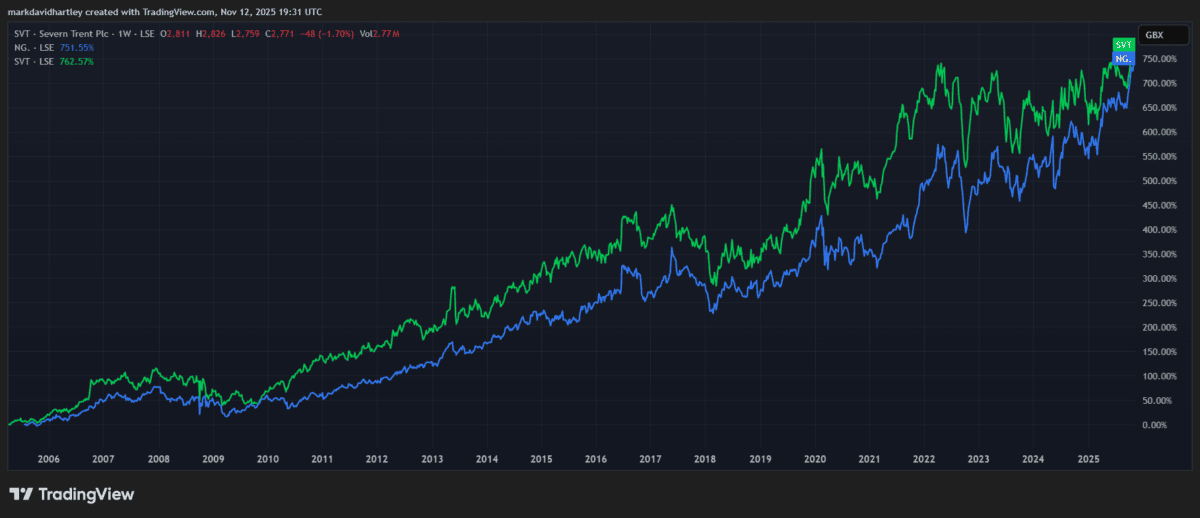
Created on TradingView.com

Similar to National Grid, Severn Trent is a regulated utility company serving approximately 4.7m households and businesses across the Midlands and Wales. As a regulated monopoly, the company benefits from predictable, inflation-linked revenue streams with minimal competition.

While nowhere near Unilever’s record, in its 20-year-long history, it’s done surprisingly well. Despite two minor dividend reductions in the past 20 years, overall, dividends have grown at an average rate of 3.53% per year. For example, the company increased dividends from 81p in 2016 to £1.19 in 2024 — approximately 47% growth over eight years.

Another bonus of regulation adds provisions for inflation indexation, ensuring dividend payments keep pace with rising costs. And the essential need for water means revenue remains stable regardless of economic conditions.

But there is one elephant in the room that can’t be ignored: £8.65bn in debt. At that level, even a regulated business is at risk of defaulting — or at least cutting dividends.

Still, with a long-term view, I expect debt will come under control and the company will continue delivering stable income to shareholders.


Mark Hartley has positions in National Grid Plc and Unilever. The Motley Fool UK has recommended National Grid Plc and Unilever. Views expressed on the companies mentioned in this article are those of the writer and therefore may differ from the official recommendations we make in our subscription services such as Share Advisor, Hidden Winners and Pro. Here at The Motley Fool we believe that considering a diverse range of insights makes us better investors.

More on Investing Articles

Friends and sisters exploring the outdoors together in Cornwall. They are standing with their arms around each other at the coast.
Investing Articles

£503 buys 14 shares in this FTSE 250 stock that returned 23.9% annually for the last 15 years

This FTSE 250 stock has averaged a huge return for 15 years. At today's price, £503 buys 14 shares. But…

Read more »

Black woman using loudspeaker to be heard
Investing Articles

£1,000 buys 25 shares in this FTSE 100 stock that’s returned 29.2% annually for the last 10 years

This FTSE 100 mining stock has returned close to 30% a year for a decade. At 3,995p, £1,000 buys 25…

Read more »

Female student sitting at the steps and using laptop
Investing Articles

Down 47%, is this growth stock finally worth buying in May?

With a £288m order book and a hidden pipeline of defence and nuclear contracts, is this growth stock now too…

Read more »

House models and one with REIT - standing for real estate investment trust - written on it.
Investing Articles

2 REITs yielding 7%+ to consider for passive income in 2026

A REIT backed by the NHS and another backed by Tesco and Sainsbury's with both yielding 7%+. Here's why I'm…

Read more »

Woman riding her old fashioned bicycle along the Beach Esplanade at Aberdeen, Scotland.
Investing Articles

Just 97 shares of this UK dividend stock generate £238 in passive income

A 5.7% yield, £238 in passive income from just 97 shares, and one of the most divisive dividend stocks on…

Read more »

ISA coins
Investing Articles

£10,000 in an ISA generates a second income of…

The London Stock Exchange is home to some of the world's most generous dividends. But how big a second income…

Read more »

Shot of a senior man drinking coffee and looking thoughtfully out of a window
Investing Articles

Expert recommendations: 2 top income stocks yielding 7%+!

With yields of 7.2% and 7.8% respectively, these two income stocks are catching the eyes of institutional analysts. Should investors…

Read more »

Illustration of flames over a black background
Investing Articles

3 top income-focused stocks to buy in May 2026, according to experts

Looking for a stock to buy for income in May 2026? Experts have flagged these three UK dividend shares as…

Read more »





