


We have some exciting news to share! The Motley Fool UK has now become The Twelfth Magpie -- an independent, UK-owned company, led by our long-serving UK management team — Mark Rogers, Chris Nials and Heather Adlington. In practical terms, it’s the same team you know, now fully focused on serving our UK readers and members.

Just as importantly, our approach remains unchanged: long-term, jargon-free, and on your side. This site is our new home, and there will be extra tweaks made across the coming few days as we settle in. So if anything looks a little off, please bear with us!

The content of this article was relevant at the time of publishing. Circumstances change continuously and caution should therefore be exercised when relying upon any content contained within this article.

£10,000 invested in Lloyds shares 5 years ago is now worth £24,600! What’s next?

Lloyds’ shares have surged over the past five years with most of that growth coming in the past 24 months. Dr James Fox explores the next phase.

| More on:
Woman riding her old fashioned bicycle along the Beach Esplanade at Aberdeen, Scotland.

Image source: Getty Images

You’re reading a free article with opinions that may differ from The Motley Fool’s Premium Investing Services. Become a Motley Fool member today to get instant access to our top analyst recommendations, in-depth research, investing resources, and more. Learn More.

Lloyds‘ shares (LSE:LLOY) have quietly delivered a far stronger return than many expected. As a result, a £10,000 investment five years ago now standing at roughly £24,600.

That outperformance reflects a combination of resilient earnings, tighter cost discipline and, crucially, an overly pessimistic set of base-case assumptions that surrounded the bank earlier in the cycle.

XXX

Markets spent years pricing in heavy credit impairments as the UK entered successive periods of economic uncertainty. Yet actual defaults remained far lower than the models suggested. This was supported by stable employment, a resilient UK consumer, and households deleveraging more than anticipated.


At the same time, the FTSE 100 company has benefitted from a prolonged period of elevated interest rates. Forecasts once implied that net interest margins would collapse quickly after the initial spike in rates. However, the decline proved far more gradual.

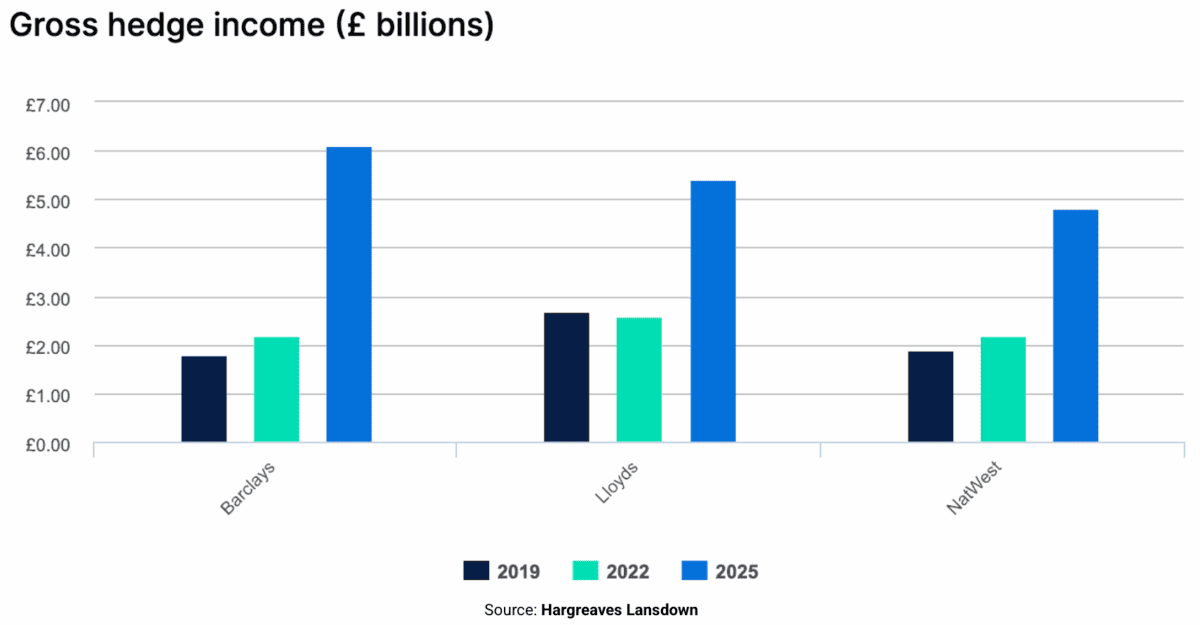
One factor behind that has been hedging. Banks have been replacing lower-yielding hedges (buying things like govt debt) with new contracts struck at materially higher rates. That supported net interest income even as headline rates eased from their peak.

Below is a two-year-old forecast from Hargreaves Lansdown. I’ve used it several times in the past and it’s proven to be very relevant. In Q3 2025, the hedging strategy contributed £1.4bn.
Management has also used that breathing space to clean up the balance sheet, maintain robust capital buffers, and keep shareholder distributions flowing. For example, the bank’s CET1 ratio — a core measure of a bank’s financial strength and stability — is 13.8%. That’s substantially above the minimum requirement.

Combined with steady progress in reducing operating costs and expanding fee-generating activity, the bank has consistently beaten the modest expectations set for it.

The result is strong earnings and a re-rating — in other words investors are happy to the bank trading with a more expensive valuation.

Where now?

Predicting exactly what’s going to happen next is challenging, especially in the week containing the Chancellor’s Budget.

First thing to consider is that banks reflect the health of the UK economy. Sadly, I’m becoming increasingly pessimistic. Financial analyst John Choong’s truly excellent Interpretiv research and newsletter points to a £38bn government blackhole that’s going to require more taxes and spending cuts.

And if inflation does come down as the UK economy cools further, then more interest rate cuts should be on the cards. That might be good for mortgage holders like me, but it will have an impact on net interest income.

These are definitely risk factors for Lloyds, especially if the impacts are more severe than the current base-case scenario. It’s also trading at 12 times forward earnings — the most expensive it’s been in years.

However, it’s proven to be a resilient institution in recent years, capable of generating outsized returns from the UK lending sector. I still think it’s worth considering for the long run, but other options may be cheaper.


James Fox has positions in Lloyds Banking Group Plc. The Motley Fool UK has recommended Lloyds Banking Group Plc. Views expressed on the companies mentioned in this article are those of the writer and therefore may differ from the official recommendations we make in our subscription services such as Share Advisor, Hidden Winners and Pro. Here at The Motley Fool we believe that considering a diverse range of insights makes us better investors.

More on Investing Articles

Friends and sisters exploring the outdoors together in Cornwall. They are standing with their arms around each other at the coast.
Investing Articles

£503 buys 14 shares in this FTSE 250 stock that returned 23.9% annually for the last 15 years

This FTSE 250 stock has averaged a huge return for 15 years. At today's price, £503 buys 14 shares. But…

Read more »

Black woman using loudspeaker to be heard
Investing Articles

£1,000 buys 25 shares in this FTSE 100 stock that’s returned 29.2% annually for the last 10 years

This FTSE 100 mining stock has returned close to 30% a year for a decade. At 3,995p, £1,000 buys 25…

Read more »

Female student sitting at the steps and using laptop
Investing Articles

Down 47%, is this growth stock finally worth buying in May?

With a £288m order book and a hidden pipeline of defence and nuclear contracts, is this growth stock now too…

Read more »

House models and one with REIT - standing for real estate investment trust - written on it.
Investing Articles

2 REITs yielding 7%+ to consider for passive income in 2026

A REIT backed by the NHS and another backed by Tesco and Sainsbury's with both yielding 7%+. Here's why I'm…

Read more »

Woman riding her old fashioned bicycle along the Beach Esplanade at Aberdeen, Scotland.
Investing Articles

Just 97 shares of this UK dividend stock generate £238 in passive income

A 5.7% yield, £238 in passive income from just 97 shares, and one of the most divisive dividend stocks on…

Read more »

ISA coins
Investing Articles

£10,000 in an ISA generates a second income of…

The London Stock Exchange is home to some of the world's most generous dividends. But how big a second income…

Read more »

Shot of a senior man drinking coffee and looking thoughtfully out of a window
Investing Articles

Expert recommendations: 2 top income stocks yielding 7%+!

With yields of 7.2% and 7.8% respectively, these two income stocks are catching the eyes of institutional analysts. Should investors…

Read more »

Illustration of flames over a black background
Investing Articles

3 top income-focused stocks to buy in May 2026, according to experts

Looking for a stock to buy for income in May 2026? Experts have flagged these three UK dividend shares as…

Read more »





