

We have some exciting news to share! The Motley Fool UK has now become The Twelfth Magpie -- an independent, UK-owned company, led by our long-serving UK management team — Mark Rogers, Chris Nials and Heather Adlington. In practical terms, it’s the same team you know, now fully focused on serving our UK readers and members.

Just as importantly, our approach remains unchanged: long-term, jargon-free, and on your side. This site is our new home, and there will be extra tweaks made across the coming few days as we settle in. So if anything looks a little off, please bear with us!

The content of this article was relevant at the time of publishing. Circumstances change continuously and caution should therefore be exercised when relying upon any content contained within this article.

Just over £2 now, BT’s share price hasn’t caught up with reality yet — so where should it be trading?

BT’s share price still reflects an outdated story, but the company’s cash-flow shift suggests the market may be missing a major re-rating opportunity.

| More on:
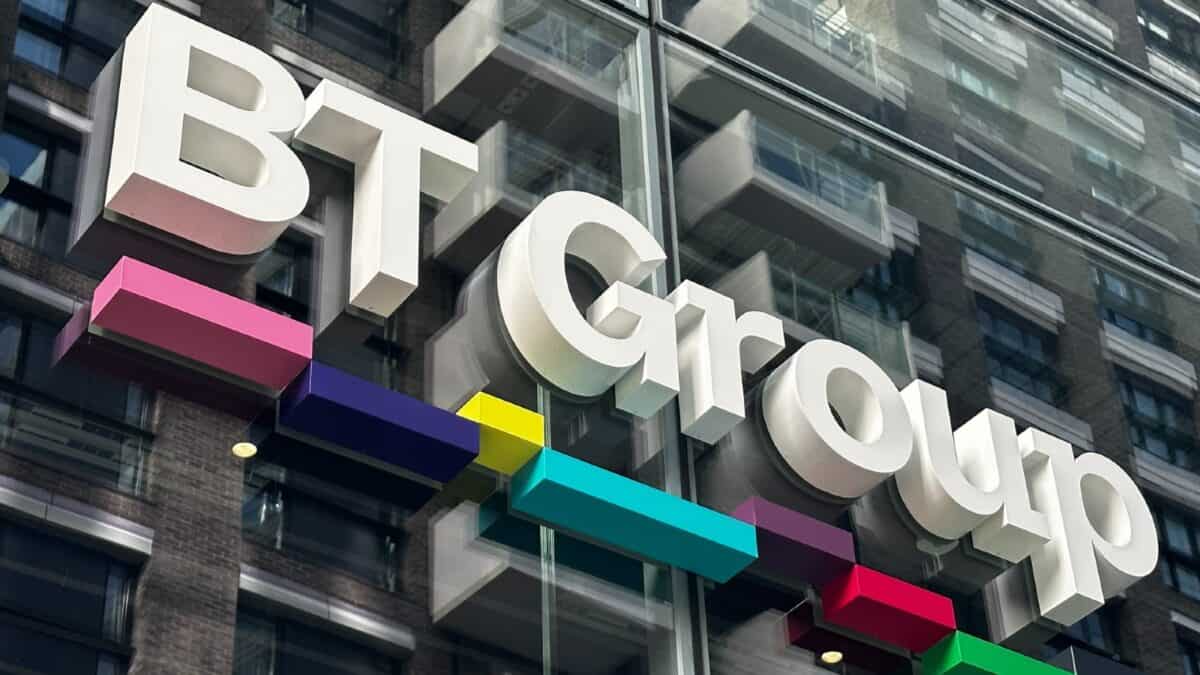
Exterior of BT Group head office - One Braham, London

Image source: BT Group plc

You’re reading a free article with opinions that may differ from The Motley Fool’s Premium Investing Services. Become a Motley Fool member today to get instant access to our top analyst recommendations, in-depth research, investing resources, and more. Learn More.

BT’s (LSE: BT.A) share price continues to reflect the old story of a slow, utility-like operator. This is despite the business now being deep into a transition that is reshaping its fundamentals.

Peak capex appears to be behind it, and the benefits of its fibre-first strategy are becoming more evident. This means BT is shifting from an investment-heavy phase into one with stronger earnings visibility and improving cash generation.

XXX

That gap between improving fundamentals and stagnant valuation leaves BT looking a bargain to me at this stage of its transition.

So, how high can the shares go?

Strong earnings growth ahead

The key driver for any firm’s share price over the long run is sustained growth in earnings (‘profits’). A risk for BT is the intense competition in the telecoms sector that may squeeze its margins. However, consensus analysts’ forecasts are that its earnings will grow by 15% a year to end-2028 at minimum.

This looks conservative to me, given its recent run of results. The full-year 2025 numbers showed profit after tax soared 23% year on year to £1.054bn. This highlights how BT’s improving cost base and rising fibre economics are now feeding through more visibly to the bottom line.

Normalised free cash flow jumped 25% to £1.598bn, which is a major driver of long‑term value in its own right. This was driven by higher EBITDA and a materially lower working‑capital outflow.

Meanwhile, Openreach — BT’s fast-expanding full‑fibre network — delivered 5% EBITDA growth to £4.029bn. This reflected rising Fibre to the Premises penetration and strong cost control.

Indeed, BT’s ongoing cost-cutting and simplification programme will be another important earnings driver ahead. The firm has already delivered £3bn in cost savings — a full year ahead of plan. And it is now targeting a further £3bn of savings by 2029. This will boost EBITDA even in periods when revenue has dipped.

Together, these shifts underline a business whose fundamentals are improving in line with its transition plan.

So what are the shares really worth?

In my experience as a former investment bank trader, discounted cash flow (DCF) analysis is the optimal way to ascertain a share’s true worth.

It estimates a company’s ‘fair value’ by projecting its future cash flows and then ‘discounting’ them back to today.

Some analysts’ DCF modelling is more bearish than mine, depending on the inputs used. However, based on my DCF assumptions — including an 8.6% discount rate — BT is 51% undervalued at its current £2.06 price.

Therefore, its fair value could secretly be close to £4.20 a share — more than double its price today.

And because asset prices typically gravitate towards their fair value in the long run, it suggests a potentially terrific buying opportunity to consider if the DCF assumptions prove accurate.

My investment view

The old market narrative for BT simply no longer fits the new numbers, in my view.

With the business now moving into a more profitable, cash-generative phase, my valuation work suggests the shares sit well below their intrinsic worth.

On that basis, I will add to my position very soon. And I think BT merits far more attention from value-minded investors than it is currently getting.


Simon Watkins has positions in Bt Group Plc. The Motley Fool UK has no position in any of the shares mentioned. Views expressed on the companies mentioned in this article are those of the writer and therefore may differ from the official recommendations we make in our subscription services such as Share Advisor, Hidden Winners and Pro. Here at The Motley Fool we believe that considering a diverse range of insights makes us better investors.

More on Investing Articles

Friends and sisters exploring the outdoors together in Cornwall. They are standing with their arms around each other at the coast.
Investing Articles

£503 buys 14 shares in this FTSE 250 stock that returned 23.9% annually for the last 15 years

This FTSE 250 stock has averaged a huge return for 15 years. At today's price, £503 buys 14 shares. But…

Read more »

Black woman using loudspeaker to be heard
Investing Articles

£1,000 buys 25 shares in this FTSE 100 stock that’s returned 29.2% annually for the last 10 years

This FTSE 100 mining stock has returned close to 30% a year for a decade. At 3,995p, £1,000 buys 25…

Read more »

Female student sitting at the steps and using laptop
Investing Articles

Down 47%, is this growth stock finally worth buying in May?

With a £288m order book and a hidden pipeline of defence and nuclear contracts, is this growth stock now too…

Read more »

House models and one with REIT - standing for real estate investment trust - written on it.
Investing Articles

2 REITs yielding 7%+ to consider for passive income in 2026

A REIT backed by the NHS and another backed by Tesco and Sainsbury's with both yielding 7%+. Here's why I'm…

Read more »

Woman riding her old fashioned bicycle along the Beach Esplanade at Aberdeen, Scotland.
Investing Articles

Just 97 shares of this UK dividend stock generate £238 in passive income

A 5.7% yield, £238 in passive income from just 97 shares, and one of the most divisive dividend stocks on…

Read more »

ISA coins
Investing Articles

£10,000 in an ISA generates a second income of…

The London Stock Exchange is home to some of the world's most generous dividends. But how big a second income…

Read more »

Shot of a senior man drinking coffee and looking thoughtfully out of a window
Investing Articles

Expert recommendations: 2 top income stocks yielding 7%+!

With yields of 7.2% and 7.8% respectively, these two income stocks are catching the eyes of institutional analysts. Should investors…

Read more »

Illustration of flames over a black background
Investing Articles

3 top income-focused stocks to buy in May 2026, according to experts

Looking for a stock to buy for income in May 2026? Experts have flagged these three UK dividend shares as…

Read more »





