


We have some exciting news to share! The Motley Fool UK has now become The Twelfth Magpie -- an independent, UK-owned company, led by our long-serving UK management team — Mark Rogers, Chris Nials and Heather Adlington. In practical terms, it’s the same team you know, now fully focused on serving our UK readers and members.

Just as importantly, our approach remains unchanged: long-term, jargon-free, and on your side. This site is our new home, and there will be extra tweaks made across the coming few days as we settle in. So if anything looks a little off, please bear with us!

The content of this article was relevant at the time of publishing. Circumstances change continuously and caution should therefore be exercised when relying upon any content contained within this article.

This critical stock market indicator’s flashing red! Should investors be worried?

As a key sign of market overvaluation starts declining, our writer weighs up the likelihood of a stock market crash in March – and how to prepare.

| More on:
British pound data

Image source: Getty Images

You’re reading a free article with opinions that may differ from The Motley Fool’s Premium Investing Services. Become a Motley Fool member today to get instant access to our top analyst recommendations, in-depth research, investing resources, and more. Learn More.

With the Middle East conflict sending oil prices soaring, the idea of a stock market crash is back on people’s minds. When you also see big‑name indicators flashing red, it is easy to wonder if a fall’s coming, already underway, or quietly cooling in the background.

One key measure analysts use to gauge market health, named after billionaire investor Warren Buffett, recently hit an all-time high, but has since begun retreating.

XXX

What could this mean for global markets?

What’s the Buffett Indicator?

The Buffett Indicator compares the value of the market against the economy, usually measured as market-cap divided by GDP. In simple terms, it asks: how expensive are shares overall compared to the real economy underneath them?

A reading above 100% means the market’s overvalued, ie: worth more than the economy produces in a year. Recently, the indicator’s eased from an all‑time high of 221.6% to around 216%. That’s still very high but looks like the beginning of a reversal.
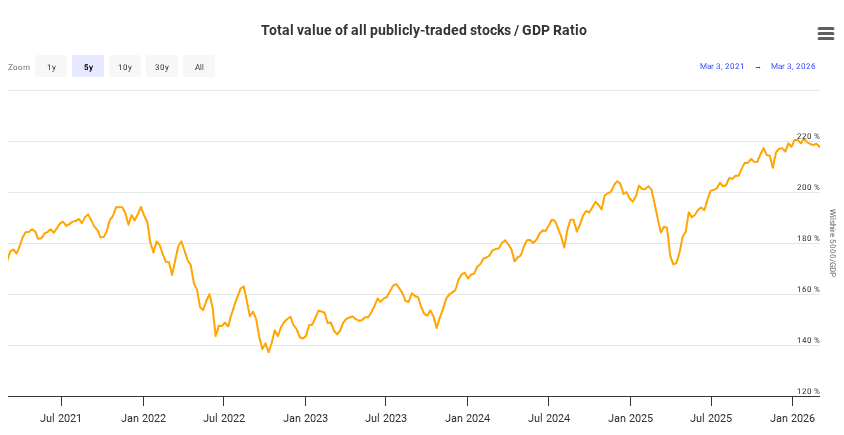
stock market value vs GDP
Screenshot from longtermtrends.com

The still-high reading alone doesn’t signal a crash but it could be the early signs of a shift in trajectory.

How UK investors can prepare

Rather than trying to guess the exact timing of a crash, UK investors can focus on being ready for a range of outcomes. A few practical steps can help, such as accumulating cash, trimming risky positions and titling towards defensive shares.

One classic defensive pick is National Grid (LSE: NG.), which owns and operates electricity and gas networks in the UK and parts of the US. The utility giant earns regulated returns for running critical energy infrastructure, so its revenues are better protected against day‑to‑day volatility.

Not only is it more stable in turbulent times but it’s got excellent income credentials. It’s paid uninterrupted dividends for 31 years, with a policy to grow the dividend broadly in line with inflation. That’s the sort of characteristics income investors like to see. 

The current payout ratio’s around 80% and cash generation’s strong, with cash flow covering the dividend roughly 3.6 times. 

Valuation-wise, it’s a bit high, trading on a forward price-to-earnings (P/E) of about 17. But its FY2025 results were impressive, with underlying profit up about 12%, helped by strong performance across UK and US networks and strategic investments.

Not without risk

A heavy debt load means stubborn interest rates could squeeze National Grid’s profits over time. The recent oil and gas supply shock has also had an impact. Higher energy prices and volatility have increased scrutiny of utilities and pushed governments and regulators to think harder about affordability and security of supply.

On the other hand, it has strengthened the case for investment in infrastructure to support renewables, which is exactly where it spends heavily. That sort of long‑term, regulated investment programme can help smooth results through economic ups and downs.

Playing it safe

When things get shaky, defensive shares offer a way to reduce risk without exiting the market entirely. As a provider of essential infrastructure with regulated earnings and a long history of paying dividends, National Grid’s one worth considering.

Steady cash flows combined with inflation‑linked income make it a sensible candidate as part of a diversified portfolio. But it’s not the only defensive share I’ve been looking at lately…


Mark Hartley has positions in National Grid Plc. The Motley Fool UK has recommended National Grid Plc. Views expressed on the companies mentioned in this article are those of the writer and therefore may differ from the official recommendations we make in our subscription services such as Share Advisor, Hidden Winners and Pro. Here at The Motley Fool we believe that considering a diverse range of insights makes us better investors.

More on Investing Articles

Friends and sisters exploring the outdoors together in Cornwall. They are standing with their arms around each other at the coast.
Investing Articles

£503 buys 14 shares in this FTSE 250 stock that returned 23.9% annually for the last 15 years

This FTSE 250 stock has averaged a huge return for 15 years. At today's price, £503 buys 14 shares. But…

Read more »

Black woman using loudspeaker to be heard
Investing Articles

£1,000 buys 25 shares in this FTSE 100 stock that’s returned 29.2% annually for the last 10 years

This FTSE 100 mining stock has returned close to 30% a year for a decade. At 3,995p, £1,000 buys 25…

Read more »

Female student sitting at the steps and using laptop
Investing Articles

Down 47%, is this growth stock finally worth buying in May?

With a £288m order book and a hidden pipeline of defence and nuclear contracts, is this growth stock now too…

Read more »

House models and one with REIT - standing for real estate investment trust - written on it.
Investing Articles

2 REITs yielding 7%+ to consider for passive income in 2026

A REIT backed by the NHS and another backed by Tesco and Sainsbury's with both yielding 7%+. Here's why I'm…

Read more »

Woman riding her old fashioned bicycle along the Beach Esplanade at Aberdeen, Scotland.
Investing Articles

Just 97 shares of this UK dividend stock generate £238 in passive income

A 5.7% yield, £238 in passive income from just 97 shares, and one of the most divisive dividend stocks on…

Read more »

ISA coins
Investing Articles

£10,000 in an ISA generates a second income of…

The London Stock Exchange is home to some of the world's most generous dividends. But how big a second income…

Read more »

Shot of a senior man drinking coffee and looking thoughtfully out of a window
Investing Articles

Expert recommendations: 2 top income stocks yielding 7%+!

With yields of 7.2% and 7.8% respectively, these two income stocks are catching the eyes of institutional analysts. Should investors…

Read more »

Illustration of flames over a black background
Investing Articles

3 top income-focused stocks to buy in May 2026, according to experts

Looking for a stock to buy for income in May 2026? Experts have flagged these three UK dividend shares as…

Read more »





