

We have some exciting news to share! The Motley Fool UK has now become The Twelfth Magpie -- an independent, UK-owned company, led by our long-serving UK management team — Mark Rogers, Chris Nials and Heather Adlington. In practical terms, it’s the same team you know, now fully focused on serving our UK readers and members.

Just as importantly, our approach remains unchanged: long-term, jargon-free, and on your side. This site is our new home, and there will be extra tweaks made across the coming few days as we settle in. So if anything looks a little off, please bear with us!

The content of this article was relevant at the time of publishing. Circumstances change continuously and caution should therefore be exercised when relying upon any content contained within this article.

Are shares in fintech firm Wise a buy?

Wise shares are now trading on the UK’s main market following its very successful direct listing. I won’t buy just yet, but I will keep an eye on the Wise share price.

| More on:

You’re reading a free article with opinions that may differ from The Motley Fool’s Premium Investing Services. Become a Motley Fool member today to get instant access to our top analyst recommendations, in-depth research, investing resources, and more. Learn More.

Fintech stock Wise (LSE:WISE) hit the London Stock Exchange in a direct listing at a value of £8.8bn on 7 July 2021. A year ago, the company was valued between £3.6bn and £3.9bn. The Wise share price is currently sitting at 982p. With 994,589,856 ordinary shares at last count, Wise has a market cap of around £9.8bn today.

This has been a successful admission to the markets. And I can understand why: Wise is disrupting financial services, and unlike other tech stocks is not just bringing high revenue but also profits a decade after being founded. However, there are issues to address.

XXX

What is Wise?

Wise started in 2011 as TransferWise, offering low-cost international money transfers to everyday customers. Its goal was to make international money transfer cheaper, quicker, and more transparent than traditional banks. Wise is digitally native and does not offer cash services like, say, competitor Western Union, does.

The technology Wise uses to provide for international payments is fairly simple to understand schematically. Traditional banking would have someone routing money from their bank through a host of correspondent banks to an account on the other side of the world. Wise has built itself as a middleman between local payment services in multiple countries.
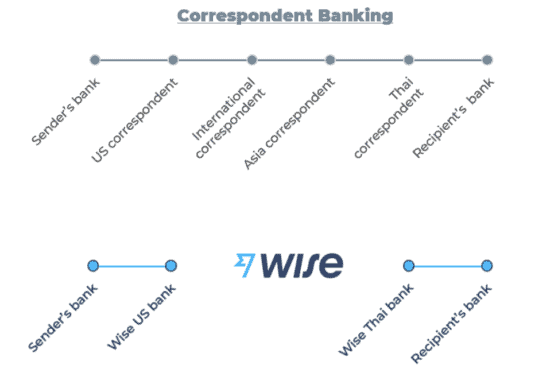
How Wise transfers money

Source: Wise Prospectus

Wise moves money by taking a client’s currency into its own account here and moving currency from its account to the client’s over there, at an agreed exchange rate. Removing the intermediaries and manual checking of correspondent banking is how Wise keeps costs and time down.

I do think Wise has a good business model. Pandemic aside, the world is becoming more mobile. That speaks to an increased demand for moving money between countries. Digital money is becoming the norm, obviating the need for Wise to have high street shops. And people everywhere are moving online. That means shopping around for money services is easier, and so long as Wise can stick to its value proposition, it should continue to attract clients.

Wise share price

The typical early Wise user was a fairly affluent tech-savvy European. It has since expanded globally and moved onto business customers. If now offers more sophisticated banking services like international payments and multi-currency accounts. This has kept revenue growth high.

Table 1: Wise condensed income statement 2019–2021

  2019 2020 2021
Revenue £177.9m £302.6m £421.0m
Gross profit £110.4m £188.1m £260.5m
Operating profit £12.2m £23.6m £44.9m
Profit for the year £10.3m £15.0m £30.9m
Diluted EPS 0.56p 0.80p 1.58p

Source: Wise Prospectus

Wise grew its revenues by 39% and doubled its profits over the 2021 fiscal year. Revenue growth is below the 70% seen in 2020 but operating and net profit margins are improving. But Wise shares are seemingly trading at 621 times earnings per share. That’s extremely high for a company with slowing revenue growth and established competitors.

Then there is the dual-class share structure, which gives the founders control but that kept Wise shares in the standard rather than premium, main market of the LSE. This locks Wise shares out of FTSE index inclusion and means losing long-term holders like index funds. However, a premium listing should be possible in five years, when the dual share class structure is due to expire.

I do like Wise shares, but I think its share price might be too rich for me at present. I will watch from the sidelines to see if anything changes.


James J. McCombie has no position in any of the shares mentioned. The Motley Fool UK has no position in any of the shares mentioned. Views expressed on the companies mentioned in this article are those of the writer and therefore may differ from the official recommendations we make in our subscription services such as Share Advisor, Hidden Winners and Pro. Here at The Motley Fool we believe that considering a diverse range of insights makes us better investors.

More on Investing Articles

Friends and sisters exploring the outdoors together in Cornwall. They are standing with their arms around each other at the coast.
Investing Articles

£503 buys 14 shares in this FTSE 250 stock that returned 23.9% annually for the last 15 years

This FTSE 250 stock has averaged a huge return for 15 years. At today's price, £503 buys 14 shares. But…

Read more »

Black woman using loudspeaker to be heard
Investing Articles

£1,000 buys 25 shares in this FTSE 100 stock that’s returned 29.2% annually for the last 10 years

This FTSE 100 mining stock has returned close to 30% a year for a decade. At 3,995p, £1,000 buys 25…

Read more »

Female student sitting at the steps and using laptop
Investing Articles

Down 47%, is this growth stock finally worth buying in May?

With a £288m order book and a hidden pipeline of defence and nuclear contracts, is this growth stock now too…

Read more »

House models and one with REIT - standing for real estate investment trust - written on it.
Investing Articles

2 REITs yielding 7%+ to consider for passive income in 2026

A REIT backed by the NHS and another backed by Tesco and Sainsbury's with both yielding 7%+. Here's why I'm…

Read more »

Woman riding her old fashioned bicycle along the Beach Esplanade at Aberdeen, Scotland.
Investing Articles

Just 97 shares of this UK dividend stock generate £238 in passive income

A 5.7% yield, £238 in passive income from just 97 shares, and one of the most divisive dividend stocks on…

Read more »

ISA coins
Investing Articles

£10,000 in an ISA generates a second income of…

The London Stock Exchange is home to some of the world's most generous dividends. But how big a second income…

Read more »

Shot of a senior man drinking coffee and looking thoughtfully out of a window
Investing Articles

Expert recommendations: 2 top income stocks yielding 7%+!

With yields of 7.2% and 7.8% respectively, these two income stocks are catching the eyes of institutional analysts. Should investors…

Read more »

Illustration of flames over a black background
Investing Articles

3 top income-focused stocks to buy in May 2026, according to experts

Looking for a stock to buy for income in May 2026? Experts have flagged these three UK dividend shares as…

Read more »





