
We have some exciting news to share! The Motley Fool UK has now become The Twelfth Magpie -- an independent, UK-owned company, led by our long-serving UK management team — Mark Rogers, Chris Nials and Heather Adlington. In practical terms, it’s the same team you know, now fully focused on serving our UK readers and members.

Just as importantly, our approach remains unchanged: long-term, jargon-free, and on your side. This site is our new home, and there will be extra tweaks made across the coming few days as we settle in. So if anything looks a little off, please bear with us!

The content of this article was relevant at the time of publishing. Circumstances change continuously and caution should therefore be exercised when relying upon any content contained within this article.

3 Warren Buffett tips on how to invest in banks

As one of the greatest investors to have ever lived, here’s Warren Buffett’s advice on how to invest in bank stocks.

Warren Buffett at a Berkshire Hathaway AGM

Image source: The Motley Fool

You’re reading a free article with opinions that may differ from The Motley Fool’s Premium Investing Services. Become a Motley Fool member today to get instant access to our top analyst recommendations, in-depth research, investing resources, and more. Learn More.

Investing in banks can expose investors to huge amounts of risks. The recent collapse of Silicon Valley Bank (SVB) serves as a stark reminder of how fragile these institutions can be. So, here are three of Warren Buffett’s best tips on how to pick the best bank stocks.

1. Demand a margin of safety

Banking is inherently a risky business. High street banks tend to loan out sizeable chunks of customer deposits and earn profits from the interest they get from those loans. This means that they’re almost always in a deficit.

XXX

Thus, if customers begin to withdraw their funds en masse, banks may find it difficult to find liquidity, leading to what many refer to as a liquidity crisis. This was what led to the failures of SVB and several of its regional competitors.

Nonetheless, these failures were partially a result of irresponsible capital allocation. As such, Warren Buffett’s advice on finding banks with a margin of safety is extremely important. The Oracle of Omaha believes that buying a stock is like buying a business, and doing due diligence is essential.

Therefore, it’s crucial to ensure that a company has ample liquidity and a robust set of financials to withstand an economic downturn or liquidity crisis. These can be evaluated through ratios such as CET1 (comparing a bank’s capital against its assets), liquidity coverage, and countercyclical ratios.

2. Look for economic moats

Most of Warren Buffett’s investments are in conglomerates with competitive advantages over their competitors. That’s because companies that can successfully fend off competitors have better odds of growing their intrinsic value over time. This same precedent can be applied to banks.

The fall of several regional banks in the US has resulted in a flight to quality. Consequently, the likes of JP Morgan and Bank of America have received tens of billions in customer deposits since SVB’s turmoil. This is what Warren Buffett would call en economic moat.

It’s for those reasons that UK banks stand out as the most attractive to me — their strength and reliability. This is because their lower-risk deposit base gives them a much bigger buffer to protect themselves from a liquidity crisis.
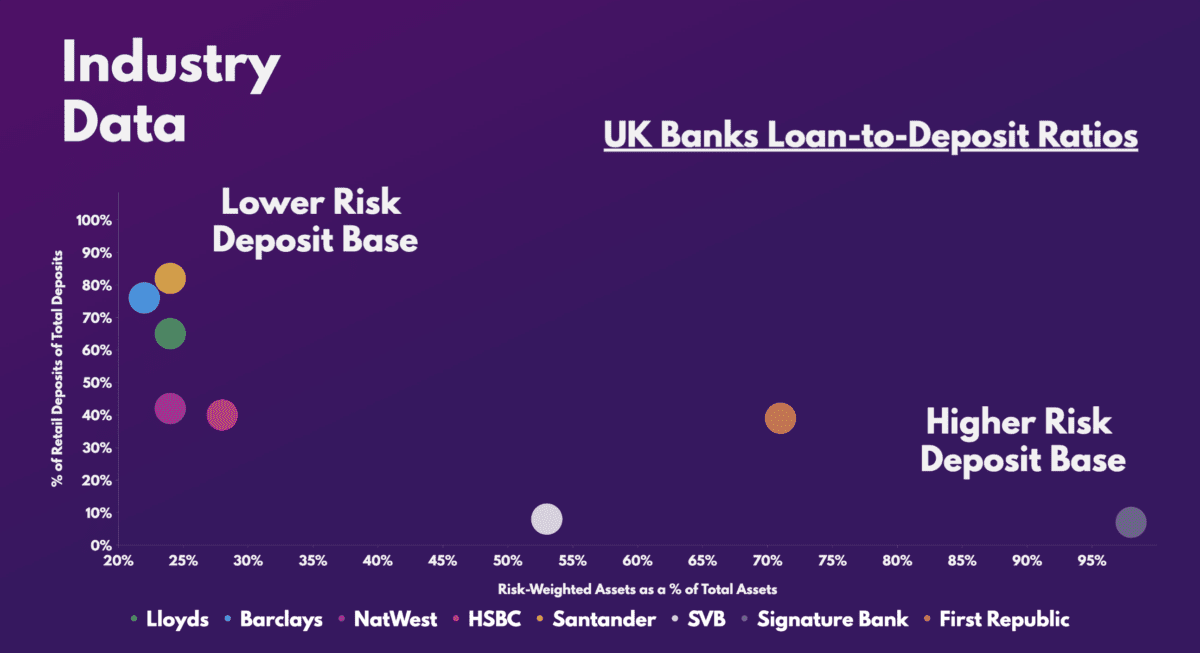
Warren Buffett - UK Banks Loan-to-Deposit Ratios.
Data sources: Lloyds, Barclays, NatWest, HSBC, Santander UK, SVB, Signature Bank, First Republic

This stems from the fact that the amount of risk-weighted assets they hold are much lower than their US counterparts. Moreover, the number of retail customers they have is significantly higher. Hence, the likelihood of a bank run is lower as the majority of their funds are insured by a regulatory body.

3. Focus on the long term

Another Warren Buffett tip is to focus on the returns a bank can make over the long term. In the context of bank stocks, they should generate high interest margins (the difference between income generated from interest-bearing assets and liabilities) and good returns on tangible equity (ROTE).

Nevertheless, there’s a fine line between striving for large returns and potentially plunging a business into the ground. Getting too greedy can result in bankers taking unnecessary risks, while being too conservative may result in low profits.

Thankfully though, UK banks sit between the two, which is why I’m invested in Lloyds. And given their cheap valuation multiples with a strong outlook for net interest income and ROTE for the years ahead, I may even start a position in Barclays.

MetricsLloydsBarclaysIndustry average
Price-to-book (P/B) ratio0.70.30.7
Price-to-earnings (P/E) ratio6.24.58.9
Forward price-to-earnings (FP/E) ratio6.64.75.7
Data source: Google Finance

SVB Financial provides credit and banking services to The Motley Fool. Bank of America is an advertising partner of The Ascent, a Motley Fool company. JPMorgan Chase is an advertising partner of The Ascent, a Motley Fool company. John Choong has positions in Lloyds Banking Group Plc. The Motley Fool UK has recommended Barclays Plc and Lloyds Banking Group Plc. Views expressed on the companies mentioned in this article are those of the writer and therefore may differ from the official recommendations we make in our subscription services such as Share Advisor, Hidden Winners and Pro. Here at The Motley Fool we believe that considering a diverse range of insights makes us better investors.

More on Value Shares

Portrait Of Senior Couple Climbing Hill On Hike Through Countryside In Lake District UK Together
Investing Articles

Expert picks: 2 top value stocks to buy and hold until 2036?

Stocks are near record highs, but these two value stocks are still trading at significant discounts. That's why experts believe…

Read more »

Close-up image depicting a woman in her 70s taking British bank notes from her colourful leather wallet.
Investing Articles

How much passive income could 333 Rolls-Royce shares pay out in 3 years?

Good things come in three’s, and this year Roll-Royce shares will see their third dividend increase. But what does the…

Read more »

Investing Articles

Is a summer stock market crash now inevitable?

Harvey Jones says that although we have escaped a stock market crash so far this year, recent volatility has thrown…

Read more »

Couple working from home while daughter watches video on smartphone with headphones on
Investing Articles

Hantavirus: why I’m not looking at the next stock market crash… yet

The hantavirus outbreak might not lead to a full-blown stock market crash. But increased vaccine research could be a boost…

Read more »

A beach at sunset where there is an inscription on the sand "Breathe Deeeply".
Investing Articles

How oil price volatility is impacting stock market sentiment — and how to prepare

As the Middle East crisis deepens, oil price shocks are sending ripples through global stock markets. Mark Hartley considers a…

Read more »

British pound data
Investing Articles

2 UK shares to consider avoiding as the FTSE 100 extends losses

As the FTSE 100 dips for the second time this year, Mark Hartley weighs up market sentiment and considers two…

Read more »

Investor looking at stock graph on a tablet with their finger hovering over the Buy button
Investing Articles

These white-hot FTSE 250 growth shares are on sale today!

Royston Wild loves a good bargain. Here he reveals two FTSE 250 shares that all savvy UK stock investors should…

Read more »

Aston Martin DBX - rear pic of trunk
Investing Articles

With the Aston Martin share price in pennies, is it in bargain territory?

With the Aston Martin share price at a fraction of what it once was, is it a bargain? Our writer…

Read more »