


We have some exciting news to share! The Motley Fool UK has now become The Twelfth Magpie -- an independent, UK-owned company, led by our long-serving UK management team — Mark Rogers, Chris Nials and Heather Adlington. In practical terms, it’s the same team you know, now fully focused on serving our UK readers and members.

Just as importantly, our approach remains unchanged: long-term, jargon-free, and on your side. This site is our new home, and there will be extra tweaks made across the coming few days as we settle in. So if anything looks a little off, please bear with us!

The content of this article was relevant at the time of publishing. Circumstances change continuously and caution should therefore be exercised when relying upon any content contained within this article.

Warren Buffett’s indicator tells me the UK stock market’s the cheapest it’s been for 15 years!

In 2001, Warren Buffett devised an indicator to assess whether a market is fairly valued. It tells me UK equities haven’t been this cheap for 15 years.

Warren Buffett at a Berkshire Hathaway AGM

Image source: The Motley Fool

You’re reading a free article with opinions that may differ from The Motley Fool’s Premium Investing Services. Become a Motley Fool member today to get instant access to our top analyst recommendations, in-depth research, investing resources, and more. Learn More.

Based on a similar idea to the price-to-earnings ratio, Warren Buffett’s indicator divides the market cap of a country’s stock market by its gross domestic product (GDP), and expresses the result as a percentage.

It’s intended to assess whether a particular market is under or overvalued. The American described it as “the best single measure of where valuations stand at any given moment“.

XXX

The chart below shows how the Buffett Indicator — as it become known — has fluctuated since 1999, when applied to the UK.
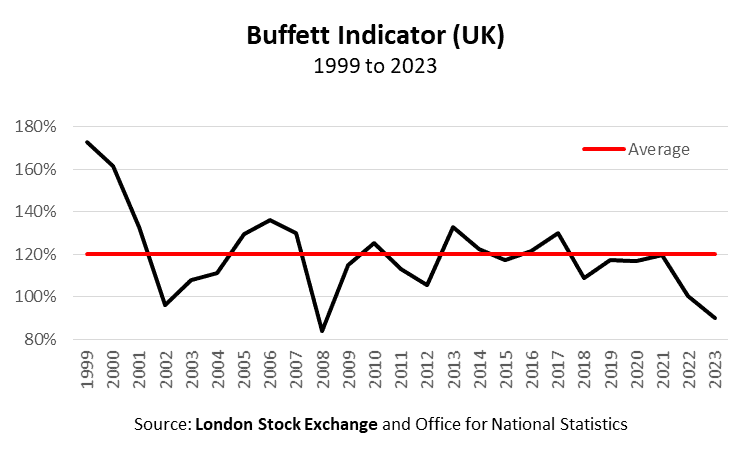
The average for the period is 120%.

It’s currently at 90%, and has only been lower in 2008, when the global financial crisis hit stock market valuations across the world.

If the measure holds true, domestic equities are at their cheapest for 15 years.

For comparison, the total market cap of all US listed companies was $43.3trn at the end of October 2023. And American GDP was $25.5trn in 2022.

The indicator for shares on the other side of the Atlantic is therefore 170%, although with its large number of tech companies — which generally attract better valuations — it’s always likely to be higher.

But if the UK stock market was valued the same as the US, it would be worth £2.1trn (90%) more.

Critics

But the indicator is far from perfect.

Market cap reflects worldwide earnings. But national income doesn’t include sales by subsidiaries of domestic companies in overseas markets.

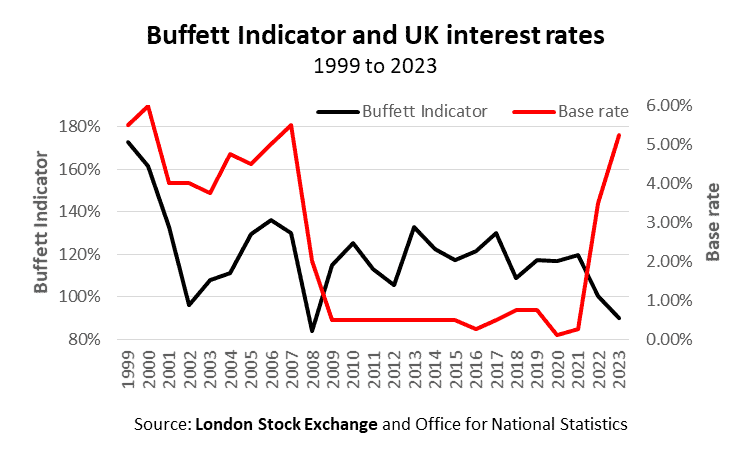
And it doesn’t take into account the impact of interest rates on share prices.

When rates are high, it’s possible to earn a better return on cash deposits and government bonds, with lower risk. Investors therefore tend to swap shares for these. This means there’s an inverse relationship between the stock market and interest rates.

This can be seen below — the Buffett Indicator has fallen over the past two years, which coincides with the Bank of England increasing the base rate 14 times.
Final thoughts

Whatever the merits of this valuation tool, I think UK equities are currently undervalued.

A number of stocks are currently trading close to their 52-week lows, despite reporting strong results over the past few months.

To illustrate this, five from the FTSE 100 are shown in the table below.

Stock52-week low (pence)52-week high (p)Current price (p)% above 52-week low
British American Tobacco2,4033,4532,5366
Lloyds Banking Group39544310
National Grid9181,2291,02512
Schroders35750740112
Legal and General20331122712
Source: Google Finance

Of course, just because a stock is near its 12-month low, doesn’t automatically mean it would make a great investment.

And I’m not necessarily saying I’d buy any of them — I’d need to do some further research before coming to this conclusion. But at first glance, these are quality companies generating strong earnings. And they are paying healthy dividends too.

I’m sure some of these valuations reflect the pessimism surrounding the prospects for the UK economy. The Office for Budget Responsibility says it’s going to be several years before GDP growth returns to its long-term trend rate.

But if I had some spare cash, I’d be looking at the UK stock market to pick up some bargains. As Warren Buffett advises: “Be fearful when others are greedy and be greedy when others are fearful“.


James Beard has positions in Lloyds Banking Group Plc and National Grid Plc. The Motley Fool UK has recommended British American Tobacco P.l.c., Lloyds Banking Group Plc, and Schroders Plc. Views expressed on the companies mentioned in this article are those of the writer and therefore may differ from the official recommendations we make in our subscription services such as Share Advisor, Hidden Winners and Pro. Here at The Motley Fool we believe that considering a diverse range of insights makes us better investors.

More on Investing Articles

Friends and sisters exploring the outdoors together in Cornwall. They are standing with their arms around each other at the coast.
Investing Articles

£503 buys 14 shares in this FTSE 250 stock that returned 23.9% annually for the last 15 years

This FTSE 250 stock has averaged a huge return for 15 years. At today's price, £503 buys 14 shares. But…

Read more »

Black woman using loudspeaker to be heard
Investing Articles

£1,000 buys 25 shares in this FTSE 100 stock that’s returned 29.2% annually for the last 10 years

This FTSE 100 mining stock has returned close to 30% a year for a decade. At 3,995p, £1,000 buys 25…

Read more »

Female student sitting at the steps and using laptop
Investing Articles

Down 47%, is this growth stock finally worth buying in May?

With a £288m order book and a hidden pipeline of defence and nuclear contracts, is this growth stock now too…

Read more »

House models and one with REIT - standing for real estate investment trust - written on it.
Investing Articles

2 REITs yielding 7%+ to consider for passive income in 2026

A REIT backed by the NHS and another backed by Tesco and Sainsbury's with both yielding 7%+. Here's why I'm…

Read more »

Woman riding her old fashioned bicycle along the Beach Esplanade at Aberdeen, Scotland.
Investing Articles

Just 97 shares of this UK dividend stock generate £238 in passive income

A 5.7% yield, £238 in passive income from just 97 shares, and one of the most divisive dividend stocks on…

Read more »

ISA coins
Investing Articles

£10,000 in an ISA generates a second income of…

The London Stock Exchange is home to some of the world's most generous dividends. But how big a second income…

Read more »

Shot of a senior man drinking coffee and looking thoughtfully out of a window
Investing Articles

Expert recommendations: 2 top income stocks yielding 7%+!

With yields of 7.2% and 7.8% respectively, these two income stocks are catching the eyes of institutional analysts. Should investors…

Read more »

Illustration of flames over a black background
Investing Articles

3 top income-focused stocks to buy in May 2026, according to experts

Looking for a stock to buy for income in May 2026? Experts have flagged these three UK dividend shares as…

Read more »





