


We have some exciting news to share! The Motley Fool UK has now become The Twelfth Magpie -- an independent, UK-owned company, led by our long-serving UK management team — Mark Rogers, Chris Nials and Heather Adlington. In practical terms, it’s the same team you know, now fully focused on serving our UK readers and members.

Just as importantly, our approach remains unchanged: long-term, jargon-free, and on your side. This site is our new home, and there will be extra tweaks made across the coming few days as we settle in. So if anything looks a little off, please bear with us!

The content of this article was relevant at the time of publishing. Circumstances change continuously and caution should therefore be exercised when relying upon any content contained within this article.

After the general election what might happen to the FTSE 100?

Our writer’s been looking at the manifestos of the three main political parties to try and understand how the general election might impact the FTSE 100.

| More on:
Bronze bull and bear figurines

Image source: Getty Images

You’re reading a free article with opinions that may differ from The Motley Fool’s Premium Investing Services. Become a Motley Fool member today to get instant access to our top analyst recommendations, in-depth research, investing resources, and more. Learn More.

Voters will go to the polls on 4 July to choose the country’s next government. Whatever the outcome, I think there are going to be some FTSE 100 winners and losers. 

Construction

All political parties appear to agree that there’s a shortage of housing in the UK.

XXX

The Labour Party is committed to building 1.5m new homes during the next Parliament. The Conservative Party is promising 1.6m. To trump both, the Liberal Democrats are aiming for 1.9m, including 150,000 social homes and 10 new garden cities.

There are four housebuilders on the index. All of them should benefit from this cross-party emphasis on getting Britain building.

Defence

The FTSE 100 has two defence contractors — BAE Systems and Rolls-Royce Holdings.

Both will be happy to learn that all three political parties are committed to spending 2.5% (currently 2%) of gross domestic product on the military.

The Conservatives have pledged to reach the target by 2030. In contrast To this, the Liberal Democrats state it’s their “ambition” but don’t provide a timescale.

Labour says it will undertake a Strategic Defence Review. Afterwards it “will set out the path” to spending 2.5%.

Other industries

If re-elected, Rishi Sunak is promising to deregulate the financial services sector. This should help the FTSE 100’s five banks, which account for 11.5% of the value of the index.

The Liberal Democrats promise to reverse “the Conservatives’ tax cuts for big banks”.

The party also want to impose a “proper” windfall tax on the “super-profits” of oil and gas producers. What this means is unclear.

Labour has pledged to increase the energy profits levy (windfall tax) on North Sea earnings by three percentage points.

BP and Shell will be disappointed. These two companies make up 12.9% of the index.

Asset sale

In its manifesto, the Conservatives have committed to a “retail sale” of the government’s remaining NatWest Group (LSE:NWG) shares. Based on the bank’s current share price, this could raise nearly £6bn.

The stock trades on a modest forward price-to-earnings ratio of 7.6.

And analysts are expecting it to pay a dividend of 16.72p a share in 2024. If correct, this implies a yield of 5.4%. Of course, dividends are never guaranteed. This is particularly true in the banking sector where earnings can be volatile.

Also, NatWest is heavily focused on the UK, which means if the domestic economy doesn’t grow as expected, it’s likely to have an adverse impact on its earnings and share price.

However, on paper the shares appear cheap. If I was in charge, I’d continue holding on to the stake for a little longer, in anticipation that it will increase in value.

A high-level view

All parties claim they will create the economic conditions necessary for the UK’s biggest companies to prosper.

History tells us (see the chart below) that global events — and longevity of service — have been the biggest factors in determining how the FTSE 100 has performed under each of the country’s Prime Ministers.
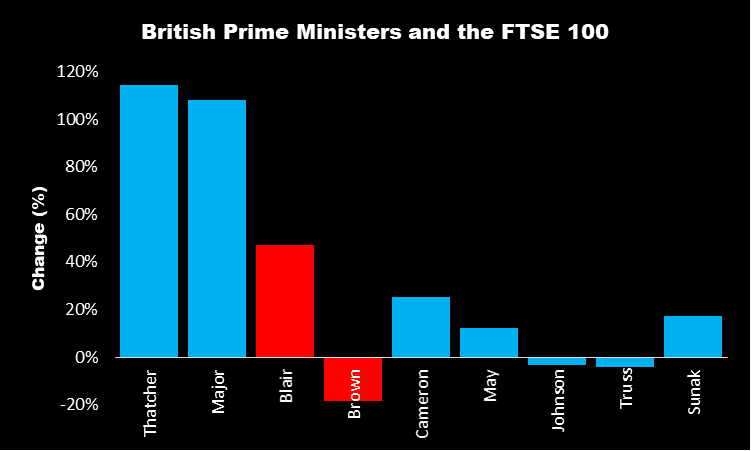
Source: author’s calculations

Gordon Brown had to deal with a financial crisis. And Boris Johnson oversaw a pandemic. Both were largely beyond their control.

In my opinion, I believe the FTSE 100 will continue largely unaffected, irrespective of which party wins the election.

Specific policy changes will create some winners and losers. But overall it’s likely to be business as usual.


James Beard has no position in any of the shares mentioned. The Motley Fool UK has recommended BAE Systems and Rolls-Royce Plc. Views expressed on the companies mentioned in this article are those of the writer and therefore may differ from the official recommendations we make in our subscription services such as Share Advisor, Hidden Winners and Pro. Here at The Motley Fool we believe that considering a diverse range of insights makes us better investors.

More on Investing Articles

Friends and sisters exploring the outdoors together in Cornwall. They are standing with their arms around each other at the coast.
Investing Articles

£503 buys 14 shares in this FTSE 250 stock that returned 23.9% annually for the last 15 years

This FTSE 250 stock has averaged a huge return for 15 years. At today's price, £503 buys 14 shares. But…

Read more »

Black woman using loudspeaker to be heard
Investing Articles

£1,000 buys 25 shares in this FTSE 100 stock that’s returned 29.2% annually for the last 10 years

This FTSE 100 mining stock has returned close to 30% a year for a decade. At 3,995p, £1,000 buys 25…

Read more »

Female student sitting at the steps and using laptop
Investing Articles

Down 47%, is this growth stock finally worth buying in May?

With a £288m order book and a hidden pipeline of defence and nuclear contracts, is this growth stock now too…

Read more »

House models and one with REIT - standing for real estate investment trust - written on it.
Investing Articles

2 REITs yielding 7%+ to consider for passive income in 2026

A REIT backed by the NHS and another backed by Tesco and Sainsbury's with both yielding 7%+. Here's why I'm…

Read more »

Woman riding her old fashioned bicycle along the Beach Esplanade at Aberdeen, Scotland.
Investing Articles

Just 97 shares of this UK dividend stock generate £238 in passive income

A 5.7% yield, £238 in passive income from just 97 shares, and one of the most divisive dividend stocks on…

Read more »

ISA coins
Investing Articles

£10,000 in an ISA generates a second income of…

The London Stock Exchange is home to some of the world's most generous dividends. But how big a second income…

Read more »

Shot of a senior man drinking coffee and looking thoughtfully out of a window
Investing Articles

Expert recommendations: 2 top income stocks yielding 7%+!

With yields of 7.2% and 7.8% respectively, these two income stocks are catching the eyes of institutional analysts. Should investors…

Read more »

Illustration of flames over a black background
Investing Articles

3 top income-focused stocks to buy in May 2026, according to experts

Looking for a stock to buy for income in May 2026? Experts have flagged these three UK dividend shares as…

Read more »





