


We have some exciting news to share! The Motley Fool UK has now become The Twelfth Magpie -- an independent, UK-owned company, led by our long-serving UK management team — Mark Rogers, Chris Nials and Heather Adlington. In practical terms, it’s the same team you know, now fully focused on serving our UK readers and members.

Just as importantly, our approach remains unchanged: long-term, jargon-free, and on your side. This site is our new home, and there will be extra tweaks made across the coming few days as we settle in. So if anything looks a little off, please bear with us!

The content of this article was relevant at the time of publishing. Circumstances change continuously and caution should therefore be exercised when relying upon any content contained within this article.

Can the move towards renewable energy push the SSE share price higher?

Everyone seems to be talking about green energy these days. Our writer considers how the SSE share price might respond to all this excitement.

| More on:
Light bulb with growing tree.

Image source: Getty Images

You’re reading a free article with opinions that may differ from The Motley Fool’s Premium Investing Services. Become a Motley Fool member today to get instant access to our top analyst recommendations, in-depth research, investing resources, and more. Learn More.

The SSE (LSE:SSE) share price has significantly outperformed the FTSE 100 over the past five years. Since October 2019, it’s risen by 46%, compared to 15% for the index as a whole.

Given that the company is a developer, builder and operator of electricity infrastructure assets this impressive performance isn’t surprising to me. In difficult times — remember, there’s been Brexit, a pandemic and rampant inflation during this period — risk-averse investors generally switch to defensive stocks, such as those operating in the regulated energy sector.

XXX

The transition to net zero

SSE likes to parade its green credentials.

In its annual report for the year ended 31 March 2024 (FY24), the word ‘renewable’ appears 556 times. And during that year, the company generated 11.2TwH of electricity using wind and hydro power. For context, it’s estimated that the UK’s annual consumption is currently 300TwH.

However, we‘re always being told that renewable energy is going to help drive down prices. Surely it doesn’t make sense to invest in a sector where the return on capital is expected to fall?

But as the chart below shows, since 2010, UK electricity prices have risen steadily even though an increasingly bigger proportion of the country’s energy requirements have been coming from renewable sources.
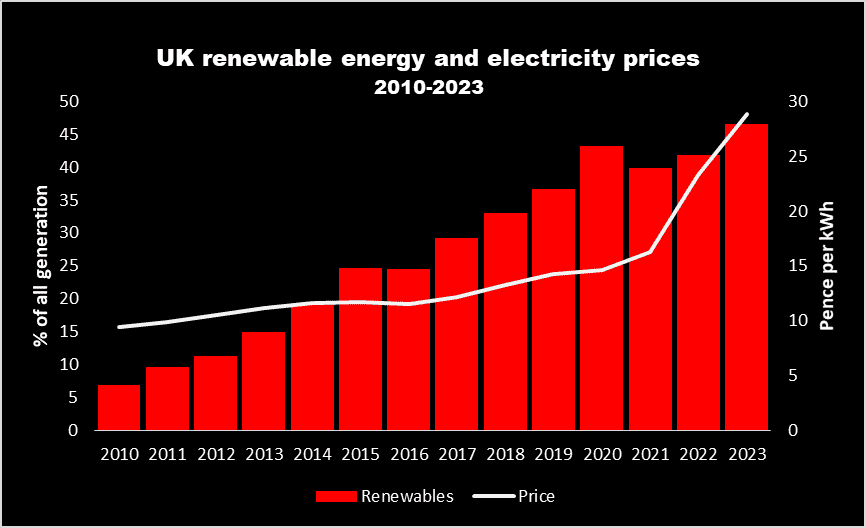
Source: Office for National Statistics

That’s because prices are still heavily influenced by the cost of wholesale gas, irrespective of how the energy is generated. Therefore, unless the market is fundamentally changed, SSE should continue to meet its target of delivering, for example, an 11% annual return on offshore wind.

Indeed, it has a target of increasing earnings per share by 13%-16% per annum over the next four years. If achieved, I’m sure this will help boost its share price.

And now could be a good time to consider adding SSE to my portfolio.

Based on a current (15 October) share price of 1,911p, the stock trades on a historical price-to-earnings (P/E) ratio of 12.1. Since 2020, its average has been around 17.

Blowing in the wind

But I have some concerns.

To demonstrate its commitment to clean energy, the government has created GB Energy. But its purpose — “to own, manage and operate clean power projects” — makes it sound like a state-owned replica of SSE.

Encouragingly, the company plans to grow its dividend per share from its FY24 level (60p) by 5%-10% a year, through until FY27. This sounds impressive. But even at the top end of this range, it would still be 17% lower than it was in FY23.

And its earnings can be volatile. The wind doesn’t always blow and with its income indirectly dependent upon gas prices, earnings per share have ranged between 78.4p and 166p over the past five financial years.

But the biggest concern I have is the company’s huge borrowings. Energy infrastructure doesn’t come cheap, which is why its ratio of net debt to EBITDA (earnings before interest, tax, depreciation and amortisation) is currently around 3. It has a target of 4.5, so SSE’s directors are probably not too concerned.

However, compare this to, for example, Centrica. It has a net debt target of just one times earnings. And its balance sheet is currently showing a net cash position.

Although I’m sure SSE will benefit from the green revolution, I believe there are less risky opportunities elsewhere.


James Beard has no position in any of the shares mentioned. The Motley Fool UK has no position in any of the shares mentioned. Views expressed on the companies mentioned in this article are those of the writer and therefore may differ from the official recommendations we make in our subscription services such as Share Advisor, Hidden Winners and Pro. Here at The Motley Fool we believe that considering a diverse range of insights makes us better investors.

More on Investing Articles

Friends and sisters exploring the outdoors together in Cornwall. They are standing with their arms around each other at the coast.
Investing Articles

£503 buys 14 shares in this FTSE 250 stock that returned 23.9% annually for the last 15 years

This FTSE 250 stock has averaged a huge return for 15 years. At today's price, £503 buys 14 shares. But…

Read more »

Black woman using loudspeaker to be heard
Investing Articles

£1,000 buys 25 shares in this FTSE 100 stock that’s returned 29.2% annually for the last 10 years

This FTSE 100 mining stock has returned close to 30% a year for a decade. At 3,995p, £1,000 buys 25…

Read more »

Female student sitting at the steps and using laptop
Investing Articles

Down 47%, is this growth stock finally worth buying in May?

With a £288m order book and a hidden pipeline of defence and nuclear contracts, is this growth stock now too…

Read more »

House models and one with REIT - standing for real estate investment trust - written on it.
Investing Articles

2 REITs yielding 7%+ to consider for passive income in 2026

A REIT backed by the NHS and another backed by Tesco and Sainsbury's with both yielding 7%+. Here's why I'm…

Read more »

Woman riding her old fashioned bicycle along the Beach Esplanade at Aberdeen, Scotland.
Investing Articles

Just 97 shares of this UK dividend stock generate £238 in passive income

A 5.7% yield, £238 in passive income from just 97 shares, and one of the most divisive dividend stocks on…

Read more »

ISA coins
Investing Articles

£10,000 in an ISA generates a second income of…

The London Stock Exchange is home to some of the world's most generous dividends. But how big a second income…

Read more »

Shot of a senior man drinking coffee and looking thoughtfully out of a window
Investing Articles

Expert recommendations: 2 top income stocks yielding 7%+!

With yields of 7.2% and 7.8% respectively, these two income stocks are catching the eyes of institutional analysts. Should investors…

Read more »

Illustration of flames over a black background
Investing Articles

3 top income-focused stocks to buy in May 2026, according to experts

Looking for a stock to buy for income in May 2026? Experts have flagged these three UK dividend shares as…

Read more »





