


We have some exciting news to share! The Motley Fool UK has now become The Twelfth Magpie -- an independent, UK-owned company, led by our long-serving UK management team — Mark Rogers, Chris Nials and Heather Adlington. In practical terms, it’s the same team you know, now fully focused on serving our UK readers and members.

Just as importantly, our approach remains unchanged: long-term, jargon-free, and on your side. This site is our new home, and there will be extra tweaks made across the coming few days as we settle in. So if anything looks a little off, please bear with us!

The content of this article was relevant at the time of publishing. Circumstances change continuously and caution should therefore be exercised when relying upon any content contained within this article.

I’ve just bought this 7.5%-yielding REIT to give me a second income

Our writer recently bought shares in a real estate investment trust (REIT) that he hopes will provide him with a healthy second income.

| More on:
A mixed ethnicity couple shopping for food in a supermarket

Image source: Getty Images

You’re reading a free article with opinions that may differ from The Motley Fool’s Premium Investing Services. Become a Motley Fool member today to get instant access to our top analyst recommendations, in-depth research, investing resources, and more. Learn More.

In my opinion, investing in the stock market is a great way to generate a second income. The majority of UK-listed companies and investment trusts regularly return cash to shareholders by way of dividends.

With this in mind, I recently took a position in Supermarket Income REIT (LSE:SUPR). I was particularly attracted by its yield of 7.5%. But as well as its potential to provide a decent income stream, it also has defensive qualities that could make it an ideal stock for the uncertain times in which we live.

XXX

What does it do?

The investment trust buys large grocery stores and then leases them to retailers. It currently has 82 premises on its books and can boast Tesco, J Sainsbury and Carrefour among its tenants.

The quality of its customer base meant it had no bad debts during the year ended 30 June 2024 (FY24). Also, it reported a 100% occupancy rate.

To maintain certain tax advantages, a real estate investment trust must return at least 90% of its annual profit to shareholders. In FY24, it reported adjusted earnings per share of 6.1p and paid all of this as dividends.

Please note that tax treatment depends on the individual circumstances of each client and may be subject to change in future. The content in this article is provided for information purposes only. It is not intended to be, neither does it constitute, any form of tax advice.

How does it fund its growth?

With large amounts of cash being distributed, the trust’s acquisitions are usually funded by borrowings. This makes it vulnerable to interest rate rises on its variable-rate loans. However, it appears to have its debt under control.

Following a recent re-financing of some of its borrowings, it claims to have a loan-to-value (LTV) of 31%. This is based on a portfolio valuation of £1.8bn.

I’m wary of commercial property valuations as the market can be volatile and, given the size of these stores, there are relatively few retailers that are large enough to occupy them. But the £1.8bn estimate would have to be massively over-stated — which I think is unlikely — for the LTV to be a concern to me.      

Encouragingly, the group’s borrowings are due to be repaid over a shorter period than the length of its customer contracts. All things being equal, this means the cash flows from each lease should improve over time. The weighted-average term of its unexpired leases is 12 years.
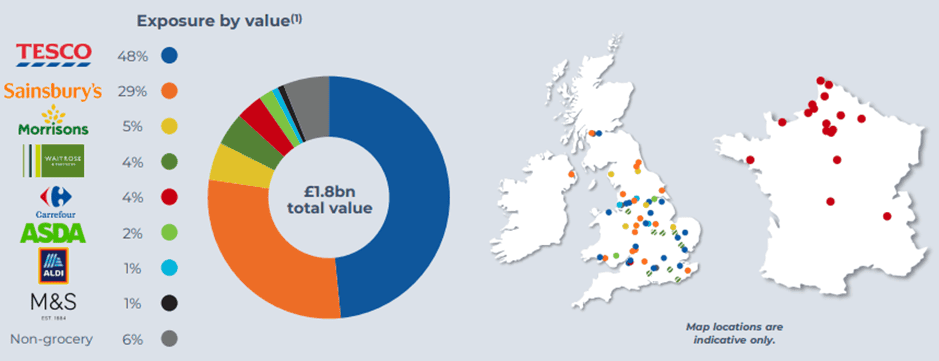
Source: 2024 annual report

Slow and steady

The trust’s currently trading at a 9.3% discount to its net asset value. This implies its shares are a bit of a bargain. But a discount is common among REITs.

However, the gap has closed over the past six months or so, suggesting that more and more investors are attracted to the trust’s defensive qualities and its dividend. The average discount over the past 12 months has been 18.1%.

Of course, defensive stocks generally don’t experience rapid increases (or falls) in their share prices.

However, the commercial property market in the UK and France is unlikely to be affected by Trump’s tariffs or a global trade war. Supermarkets will always need premises, even if their earnings fall. This makes them ideal tenants. And they’re tied in via long-term contracts, some of which have provisions for inflation-linked rent increases.

These reasons — along with its above-average dividend — are why I recently added Supermarket Income REIT to my portfolio. Other income investors could consider doing the same.


James Beard has positions in Supermarket Income REIT Plc and Tesco Plc. The Motley Fool UK has recommended J Sainsbury Plc and Tesco Plc. Views expressed on the companies mentioned in this article are those of the writer and therefore may differ from the official recommendations we make in our subscription services such as Share Advisor, Hidden Winners and Pro. Here at The Motley Fool we believe that considering a diverse range of insights makes us better investors.

More on Investing Articles

Friends and sisters exploring the outdoors together in Cornwall. They are standing with their arms around each other at the coast.
Investing Articles

£503 buys 14 shares in this FTSE 250 stock that returned 23.9% annually for the last 15 years

This FTSE 250 stock has averaged a huge return for 15 years. At today's price, £503 buys 14 shares. But…

Read more »

Black woman using loudspeaker to be heard
Investing Articles

£1,000 buys 25 shares in this FTSE 100 stock that’s returned 29.2% annually for the last 10 years

This FTSE 100 mining stock has returned close to 30% a year for a decade. At 3,995p, £1,000 buys 25…

Read more »

Female student sitting at the steps and using laptop
Investing Articles

Down 47%, is this growth stock finally worth buying in May?

With a £288m order book and a hidden pipeline of defence and nuclear contracts, is this growth stock now too…

Read more »

House models and one with REIT - standing for real estate investment trust - written on it.
Investing Articles

2 REITs yielding 7%+ to consider for passive income in 2026

A REIT backed by the NHS and another backed by Tesco and Sainsbury's with both yielding 7%+. Here's why I'm…

Read more »

Woman riding her old fashioned bicycle along the Beach Esplanade at Aberdeen, Scotland.
Investing Articles

Just 97 shares of this UK dividend stock generate £238 in passive income

A 5.7% yield, £238 in passive income from just 97 shares, and one of the most divisive dividend stocks on…

Read more »

ISA coins
Investing Articles

£10,000 in an ISA generates a second income of…

The London Stock Exchange is home to some of the world's most generous dividends. But how big a second income…

Read more »

Shot of a senior man drinking coffee and looking thoughtfully out of a window
Investing Articles

Expert recommendations: 2 top income stocks yielding 7%+!

With yields of 7.2% and 7.8% respectively, these two income stocks are catching the eyes of institutional analysts. Should investors…

Read more »

Illustration of flames over a black background
Investing Articles

3 top income-focused stocks to buy in May 2026, according to experts

Looking for a stock to buy for income in May 2026? Experts have flagged these three UK dividend shares as…

Read more »





