


We have some exciting news to share! The Motley Fool UK has now become The Twelfth Magpie -- an independent, UK-owned company, led by our long-serving UK management team — Mark Rogers, Chris Nials and Heather Adlington. In practical terms, it’s the same team you know, now fully focused on serving our UK readers and members.

Just as importantly, our approach remains unchanged: long-term, jargon-free, and on your side. This site is our new home, and there will be extra tweaks made across the coming few days as we settle in. So if anything looks a little off, please bear with us!

The content of this article was relevant at the time of publishing. Circumstances change continuously and caution should therefore be exercised when relying upon any content contained within this article.

UK shares look cheap to me! But not this one…

Our writer reckons there’s some strong evidence to suggest that UK shares generally offer good value at the moment. However, there are exceptions.

| More on:
Bus waiting in front of the London Stock Exchange on a sunny day.

Image source: Getty Images

You’re reading a free article with opinions that may differ from The Motley Fool’s Premium Investing Services. Become a Motley Fool member today to get instant access to our top analyst recommendations, in-depth research, investing resources, and more. Learn More.

There are two commonly used measures that point to UK shares being undervalued compared to most other international markets.

CAPE

The cyclically-adjusted price-to-earnings (CAPE) ratio considers the value of a market relative to the profits of all its component companies. It’s then adjusted to remove the impact of the irregular nature of earnings. The maths is complex but, fortunately, some clever people at Barclays have taken care of the calculations and published the results for all to see.

XXX

The latest figures show that UK equities have a CAPE of 16.7. Although not the cheapest, Australia (21.4), Japan (21.9), France (23), Germany (23.8), Canada (24.4), and the US (34.1) are all considered to be more expensive.

And the gap between the UK and America appears to be widening.

As the chart below shows, the two were closely matched towards the end of the 2008-2009 financial crisis. However, since then, thanks to a heavy exposure to tech stocks, the US market’s soared and — in theory — become increasingly expensive.
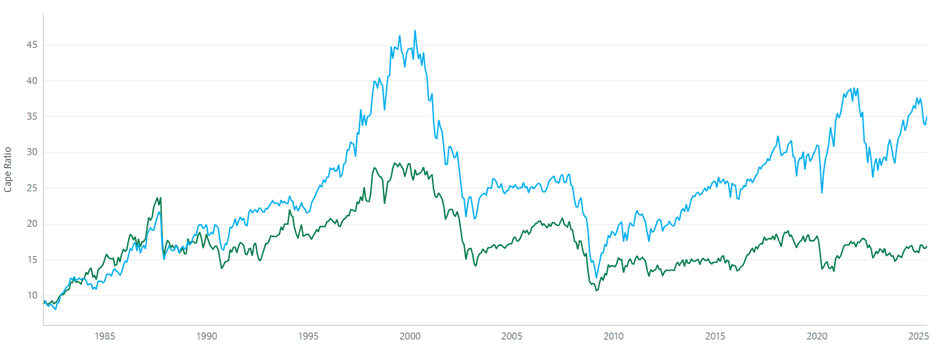
Source: Barclays / US = blue and UK = green

The Buffett indicator

It’s a similar story with Warren Buffett’s eponymous indicator.

Usually expressed as a percentage, it compares the value of a nation’s stock market (price) to that of its economy (using gross domestic product as a proxy for income).

Presently (4 July), the UK’s indicator is 105.6% compared to 207.8% for America.

However, it must be said that both these calculations are flawed. They are overly simplistic and evidence shows that Warren Buffett doesn’t track his own measure.

And they are useless when it comes to choosing individual stocks.

But they could highlight where rational investors – who are always, in theory, on the lookout for cheap assets – might deploy their funds.

Information is power

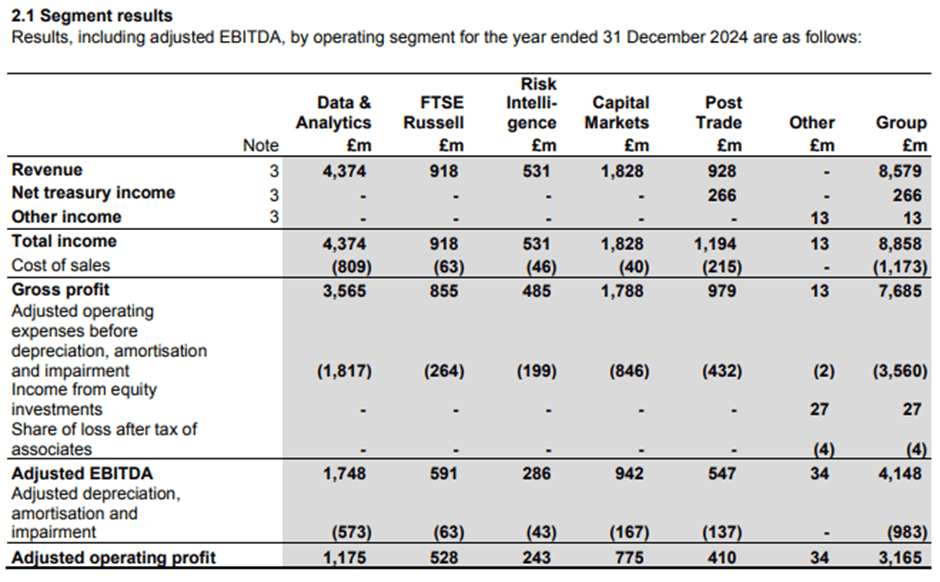
There’s one FTSE 100 stock that makes a lot of money from looking after all those ‘cheap’ UK shares. However, the London Stock Exchange Group (LSE:LSEG) also has a Data & Analytics division. This boasts of 40,000 customers and 400,000 users. The information available to subscribers can be tailored (using artificial intelligence, of course) to an individual’s specific needs or preferences.

And it’s easy to see why these types of businesses are so attractive. During 2024, the group’s gross profit margin was an impressive 86.8%.
And this has helped push its share price higher.

The stock currently trades on 29.6 times its adjusted 2024 earnings per share of 361.5p. This is approximately twice the average for the FTSE 100. It’s also straying into ‘Magnificent 7’ territory.

Like most, the principal challenge for the group is to continue to find new customers. But I suspect most finance professionals who can afford to pay for its data services are already using the group’s products.

To maintain such a healthy multiple, it’s going to have to continue to grow rapidly. Unfortunately, I don’t see where the additional revenue’s going to come from. And it doesn’t help that we regularly see stories about companies leaving the London market.

Its dividend’s also a little mean. With a payout of 130p, the stock’s yielding a disappointing 1.2%.

And with such a high earnings multiple, any sign of weaker-than-expected earnings will – I think – be punished heavily by investors. For these reasons, I believe there are better (less risky) opportunities elsewhere in the market that the London Stock Exchange Group runs so efficiently.


James Beard has positions in Barclays Plc. The Motley Fool UK has recommended Barclays Plc. Views expressed on the companies mentioned in this article are those of the writer and therefore may differ from the official recommendations we make in our subscription services such as Share Advisor, Hidden Winners and Pro. Here at The Motley Fool we believe that considering a diverse range of insights makes us better investors.

More on Investing Articles

Friends and sisters exploring the outdoors together in Cornwall. They are standing with their arms around each other at the coast.
Investing Articles

£503 buys 14 shares in this FTSE 250 stock that returned 23.9% annually for the last 15 years

This FTSE 250 stock has averaged a huge return for 15 years. At today's price, £503 buys 14 shares. But…

Read more »

Black woman using loudspeaker to be heard
Investing Articles

£1,000 buys 25 shares in this FTSE 100 stock that’s returned 29.2% annually for the last 10 years

This FTSE 100 mining stock has returned close to 30% a year for a decade. At 3,995p, £1,000 buys 25…

Read more »

Female student sitting at the steps and using laptop
Investing Articles

Down 47%, is this growth stock finally worth buying in May?

With a £288m order book and a hidden pipeline of defence and nuclear contracts, is this growth stock now too…

Read more »

House models and one with REIT - standing for real estate investment trust - written on it.
Investing Articles

2 REITs yielding 7%+ to consider for passive income in 2026

A REIT backed by the NHS and another backed by Tesco and Sainsbury's with both yielding 7%+. Here's why I'm…

Read more »

Woman riding her old fashioned bicycle along the Beach Esplanade at Aberdeen, Scotland.
Investing Articles

Just 97 shares of this UK dividend stock generate £238 in passive income

A 5.7% yield, £238 in passive income from just 97 shares, and one of the most divisive dividend stocks on…

Read more »

ISA coins
Investing Articles

£10,000 in an ISA generates a second income of…

The London Stock Exchange is home to some of the world's most generous dividends. But how big a second income…

Read more »

Shot of a senior man drinking coffee and looking thoughtfully out of a window
Investing Articles

Expert recommendations: 2 top income stocks yielding 7%+!

With yields of 7.2% and 7.8% respectively, these two income stocks are catching the eyes of institutional analysts. Should investors…

Read more »

Illustration of flames over a black background
Investing Articles

3 top income-focused stocks to buy in May 2026, according to experts

Looking for a stock to buy for income in May 2026? Experts have flagged these three UK dividend shares as…

Read more »





