

We have some exciting news to share! The Motley Fool UK has now become The Twelfth Magpie -- an independent, UK-owned company, led by our long-serving UK management team — Mark Rogers, Chris Nials and Heather Adlington. In practical terms, it’s the same team you know, now fully focused on serving our UK readers and members.

Just as importantly, our approach remains unchanged: long-term, jargon-free, and on your side. This site is our new home, and there will be extra tweaks made across the coming few days as we settle in. So if anything looks a little off, please bear with us!

The content of this article was relevant at the time of publishing. Circumstances change continuously and caution should therefore be exercised when relying upon any content contained within this article.

Could the BT share price take off?

Since October 2020, the BT share price has risen over 70%. But has the business made any progress since its stock was first offered to the public?

| More on:
Exterior of BT Group head office - One Braham, London

Image source: BT Group plc

You’re reading a free article with opinions that may differ from The Motley Fool’s Premium Investing Services. Become a Motley Fool member today to get instant access to our top analyst recommendations, in-depth research, investing resources, and more. Learn More.

The BT (LSE:BT.A) share price has been a steady performer since the pandemic. In October 2020, its shares were changing hands for just over 100p. Today (9 October), they sell for around 185p. This five-year performance just about puts it in the top third of those currently on the FTSE 100.

Then and now

The sale of BT shares to the public in 1984 was the first major privatisation of the Thatcher government. The idea was to free the telecoms group from state control and let it compete internationally without being held back by bureaucracy and union power.

XXX

But a look at the 1984 sales prospectus suggests that the group’s made little progress since. At the time, it was valued at £7.8bn — or £25.6bn in today’s terms. Now, its market cap is ‘only’ £18.2bn.

During the year ended 31 March 1984 (FY84), it made a profit after tax of £990m (£3.25bn in current money). Forty years later, in FY25, it reported adjusted post-tax earnings of £1.83bn.

So in real terms, it’s now worth less and isn’t as profitable as it was over four decades ago. Also, its dividend is less generous. In 1984, the stock was yielding 7.1%. Based on amounts paid over the past 12 months, it’s now offering a return of 4.4%. This is a reminder that payouts are never guaranteed.

Sectoral challenges

This disappointing performance is symptomatic of the telecoms industry, where the infrastructure is expensive and the returns are poor.

In 2023, Vodafone published research from Barclays that showed the ratio of capital expenditure to sales was the highest of any industry. The sector also had one of the lowest returns on capital employed (ROCE).
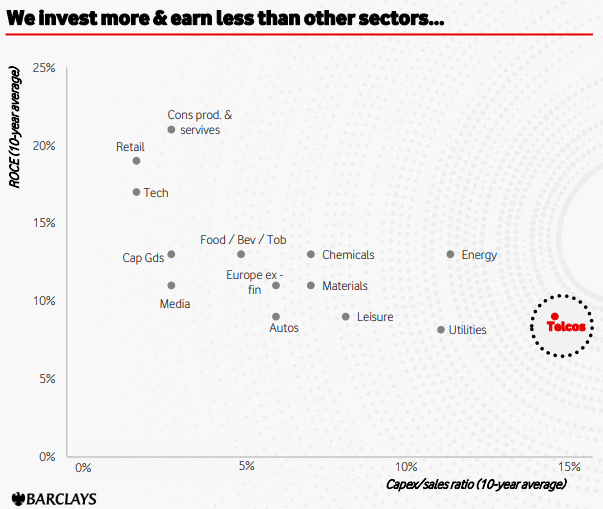
Source: 2023 Vodafone investor presentation

This is also evident from BT’s accounts. At the end of FY84, it had fixed assets of £8.8bn and debt (including leases) of £3.9bn. By the end of FY25, these had increased to £42.6bn and £23.3bn, respectively. Over the same period, its ROCE has fallen. And it’s remained largely unchanged over the past five financial years (FY21-FY25) fluctuating between 8.3% and 8.7%.

Pros and cons

One bright spot has been its adjusted EBITDA (earnings before interest, tax, depreciation and amortisation). It’s increased from £7.42bn in FY21 to £8.21bn in FY25. Although this is the group’s preferred measure of profitability, it can be controversial. Warren Buffett has described it as a “very misleading statistic” that “can be used in pernicious ways”. Pithily, he once asked: “Does management think the tooth fairy pays for capital expenditures?” This seems to be a highly relevant question in an industry where, as we’ve seen, the infrastructure isn’t cheap.

Adjusted earnings per share is probably a more reliable indicator. But in FY21, this was 18.9p. In FY25, it was slightly lower at 18.8p. The business appears stuck to me.

But brokers are optimistic. They have a 12-month share price target that’s 15% higher than its current value. And BT has some impressive names on its share register. The largest chunk of stock (24.5%) is held by Bharti Overseas. In my opinion, the group also retains a strong brand.

However, this isn’t sufficient to make me want to invest. BT looks like too much of a plodder in an industry that demands deep pockets. I think there are better opportunities for me elsewhere.


James Beard has positions in Vodafone Group Public. The Motley Fool UK has recommended Barclays Plc and Vodafone Group Public. Views expressed on the companies mentioned in this article are those of the writer and therefore may differ from the official recommendations we make in our subscription services such as Share Advisor, Hidden Winners and Pro. Here at The Motley Fool we believe that considering a diverse range of insights makes us better investors.

More on Investing Articles

Friends and sisters exploring the outdoors together in Cornwall. They are standing with their arms around each other at the coast.
Investing Articles

£503 buys 14 shares in this FTSE 250 stock that returned 23.9% annually for the last 15 years

This FTSE 250 stock has averaged a huge return for 15 years. At today's price, £503 buys 14 shares. But…

Read more »

Black woman using loudspeaker to be heard
Investing Articles

£1,000 buys 25 shares in this FTSE 100 stock that’s returned 29.2% annually for the last 10 years

This FTSE 100 mining stock has returned close to 30% a year for a decade. At 3,995p, £1,000 buys 25…

Read more »

Female student sitting at the steps and using laptop
Investing Articles

Down 47%, is this growth stock finally worth buying in May?

With a £288m order book and a hidden pipeline of defence and nuclear contracts, is this growth stock now too…

Read more »

House models and one with REIT - standing for real estate investment trust - written on it.
Investing Articles

2 REITs yielding 7%+ to consider for passive income in 2026

A REIT backed by the NHS and another backed by Tesco and Sainsbury's with both yielding 7%+. Here's why I'm…

Read more »

Woman riding her old fashioned bicycle along the Beach Esplanade at Aberdeen, Scotland.
Investing Articles

Just 97 shares of this UK dividend stock generate £238 in passive income

A 5.7% yield, £238 in passive income from just 97 shares, and one of the most divisive dividend stocks on…

Read more »

ISA coins
Investing Articles

£10,000 in an ISA generates a second income of…

The London Stock Exchange is home to some of the world's most generous dividends. But how big a second income…

Read more »

Shot of a senior man drinking coffee and looking thoughtfully out of a window
Investing Articles

Expert recommendations: 2 top income stocks yielding 7%+!

With yields of 7.2% and 7.8% respectively, these two income stocks are catching the eyes of institutional analysts. Should investors…

Read more »

Illustration of flames over a black background
Investing Articles

3 top income-focused stocks to buy in May 2026, according to experts

Looking for a stock to buy for income in May 2026? Experts have flagged these three UK dividend shares as…

Read more »





