


We have some exciting news to share! The Motley Fool UK has now become The Twelfth Magpie -- an independent, UK-owned company, led by our long-serving UK management team — Mark Rogers, Chris Nials and Heather Adlington. In practical terms, it’s the same team you know, now fully focused on serving our UK readers and members.

Just as importantly, our approach remains unchanged: long-term, jargon-free, and on your side. This site is our new home, and there will be extra tweaks made across the coming few days as we settle in. So if anything looks a little off, please bear with us!

The content of this article was relevant at the time of publishing. Circumstances change continuously and caution should therefore be exercised when relying upon any content contained within this article.

Phoenix share price may be flat, but its 8.3% yield could build a strong second income

The Phoenix share price has gone nowhere in five years, but its market-beating dividend yield could still deliver solid passive income over time.

| More on:
Rear view image depicting a senior man in his 70s sitting on a bench leading down to the iconic Seven Sisters cliffs on the coastline of East Sussex, UK. The man is wearing casual clothing - blue denim jeans, a red checked shirt, navy blue gilet. The man is having a rest from hiking and his hiking pole is leaning up against the bench.

Image source: Getty Images

You’re reading a free article with opinions that may differ from The Motley Fool’s Premium Investing Services. Become a Motley Fool member today to get instant access to our top analyst recommendations, in-depth research, investing resources, and more. Learn More.

Despite limited share price progress in recent years, the Phoenix (LSE: PHNX) share price continues to reward patient investors through reliable dividends. With one of the highest yields in the FTSE 100 and a solid record of payout growth, the insurer still offers appeal for those focused on building steady passive income over time.

XXX

Steady accumulator

Over the last 10 years, the insurer’s dividends per share (DPS) have grown at a compound annual growth rate of around 3.2%.

For income chasers, I believe it’s important to use historical DPS growth as a guide when modelling future returns. A 3% annual increase in the cash cost of the dividend looks a realistic assumption.

The following chart shows how a £5,000 investment could grow over the next 15 years, assuming a flat share price.
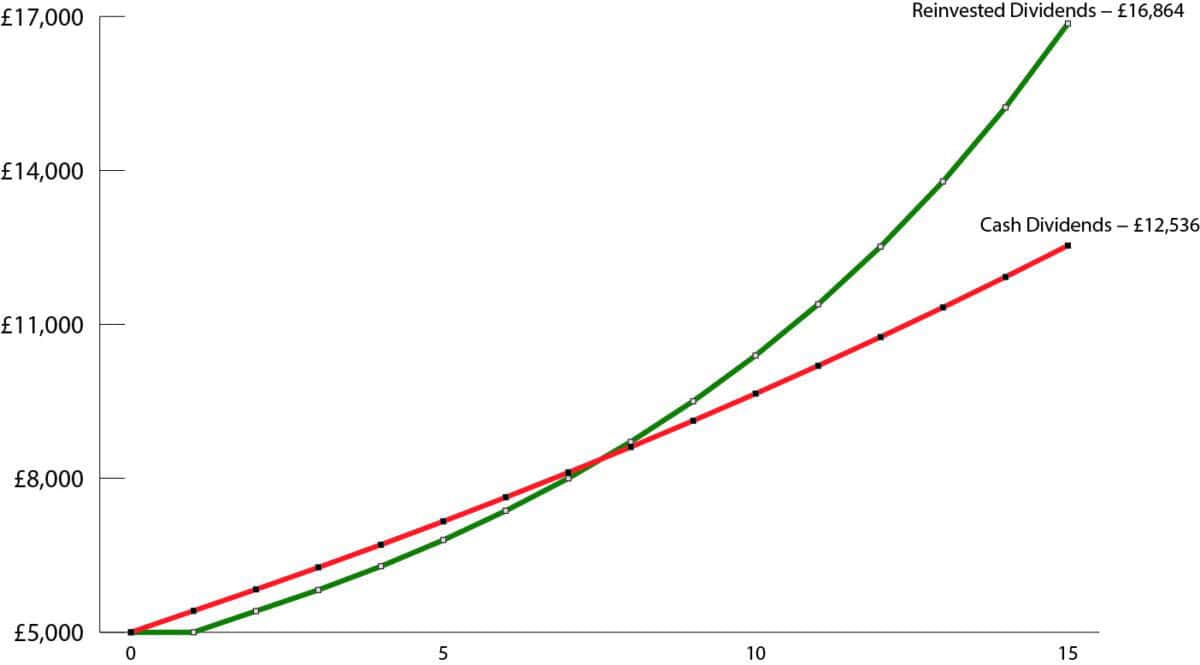
Chart generated by author

The key takeaway is that compounding is an investor’s best friend. Reinvesting dividends to buy additional income-generating units creates an exponentially growing curve, far more powerful than the linear growth achieved by withdrawing cash each year.

Dividend sustainability

It is all well and good building a future income model, but I also need confidence that profits will keep growing to sustain those payouts.

Phoenix operates with a clear capital allocation framework, with dividend increases linked to three factors.

First, and most importantly, is operating capital generation (OCG). At H1 2025, OCG stood at £705m, of which only £274m was paid out in dividends. That leaves the business with plenty of headroom to reinvest for growth.

Second is the solvency coverage ratio, currently 175%, placing it in the upper half of its operating range. Such a high figure reflects a robust balance sheet capable of absorbing financial shocks.

Finally, distributable reserves are extremely healthy at £5.5bn, up 20% year on year.

Accounting quirk

The insurer’s H1 results highlighted that shareholders’ equity, based on statutory accounting principles (IFRS), fell 37% to £768m. However, on an adjusted basis it came in at £3.5bn, a substantial discrepancy.

The company explained the decline as an “accounting mismatch” between IFRS and its preferred Solvency II framework. Under IFRS, long-term investment contracts such as annuities are valued using fixed economic assumptions, while Solvency II re-values them each period to reflect market conditions. Consequently, this can lead to vastly different valuation metrics for individual financial assets.

It may just be an accounting quirk, but if IFRS shareholders’ equity fails to recover over time, investors may begin to question the long-term sustainability of the dividend.

Bottom line

For now, Phoenix remains one of the FTSE 100’s most reliable income plays. The share price may be static, but the dividend is well-covered, supported by strong capital generation and solid reserves.

For patient investors seeking predictable cash flow and gradual compounding, the stock is worthy of consideration, even if capital growth remains elusive.


Andrew Mackie has no position in any of the shares mentioned. The Motley Fool UK has no position in any of the shares mentioned. Views expressed on the companies mentioned in this article are those of the writer and therefore may differ from the official recommendations we make in our subscription services such as Share Advisor, Hidden Winners and Pro. Here at The Motley Fool we believe that considering a diverse range of insights makes us better investors.

More on Investing Articles

Friends and sisters exploring the outdoors together in Cornwall. They are standing with their arms around each other at the coast.
Investing Articles

£503 buys 14 shares in this FTSE 250 stock that returned 23.9% annually for the last 15 years

This FTSE 250 stock has averaged a huge return for 15 years. At today's price, £503 buys 14 shares. But…

Read more »

Black woman using loudspeaker to be heard
Investing Articles

£1,000 buys 25 shares in this FTSE 100 stock that’s returned 29.2% annually for the last 10 years

This FTSE 100 mining stock has returned close to 30% a year for a decade. At 3,995p, £1,000 buys 25…

Read more »

Female student sitting at the steps and using laptop
Investing Articles

Down 47%, is this growth stock finally worth buying in May?

With a £288m order book and a hidden pipeline of defence and nuclear contracts, is this growth stock now too…

Read more »

House models and one with REIT - standing for real estate investment trust - written on it.
Investing Articles

2 REITs yielding 7%+ to consider for passive income in 2026

A REIT backed by the NHS and another backed by Tesco and Sainsbury's with both yielding 7%+. Here's why I'm…

Read more »

Woman riding her old fashioned bicycle along the Beach Esplanade at Aberdeen, Scotland.
Investing Articles

Just 97 shares of this UK dividend stock generate £238 in passive income

A 5.7% yield, £238 in passive income from just 97 shares, and one of the most divisive dividend stocks on…

Read more »

ISA coins
Investing Articles

£10,000 in an ISA generates a second income of…

The London Stock Exchange is home to some of the world's most generous dividends. But how big a second income…

Read more »

Shot of a senior man drinking coffee and looking thoughtfully out of a window
Investing Articles

Expert recommendations: 2 top income stocks yielding 7%+!

With yields of 7.2% and 7.8% respectively, these two income stocks are catching the eyes of institutional analysts. Should investors…

Read more »

Illustration of flames over a black background
Investing Articles

3 top income-focused stocks to buy in May 2026, according to experts

Looking for a stock to buy for income in May 2026? Experts have flagged these three UK dividend shares as…

Read more »





