


We have some exciting news to share! The Motley Fool UK has now become The Twelfth Magpie -- an independent, UK-owned company, led by our long-serving UK management team — Mark Rogers, Chris Nials and Heather Adlington. In practical terms, it’s the same team you know, now fully focused on serving our UK readers and members.

Just as importantly, our approach remains unchanged: long-term, jargon-free, and on your side. This site is our new home, and there will be extra tweaks made across the coming few days as we settle in. So if anything looks a little off, please bear with us!

The content of this article was relevant at the time of publishing. Circumstances change continuously and caution should therefore be exercised when relying upon any content contained within this article.

Does the Ferrari or Aston Martin share price offer better value?

It’s difficult being a luxury sportscar maker at the moment. But is the Aston Martin share price undervalued when compared to that of the Italian legend?

| More on:
Happy African American Man Hugging New Car In Auto Dealership

Image source: Getty Images

You’re reading a free article with opinions that may differ from The Motley Fool’s Premium Investing Services. Become a Motley Fool member today to get instant access to our top analyst recommendations, in-depth research, investing resources, and more. Learn More.

Since Aston Martin Lagonda (LSE:AML) made its stock market debut in October 2018, its share price has gone into reverse. In fact, as the table below shows, during the 86 months that it’s been a listed company, it’s fallen during 58 of them.
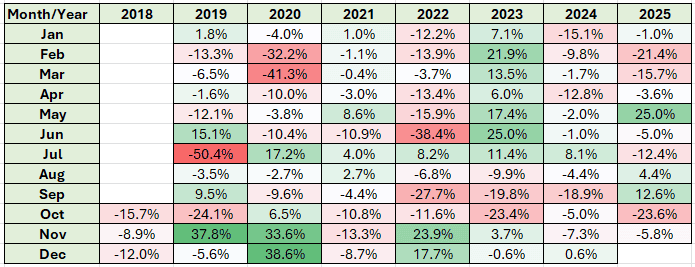
Source: London Stock Exchange Group

The last time it reported an annual adjusted profit was in 2018. Not surprisingly, the stock’s fallen in value by 99% since IPO.

XXX

On the other hand…

In contrast, Ferrari (NYSE:RACE) has seen its share price rise by over 250% since October 2018. Unlike the British sportscar maker, the Italian legend has been able to make cars profitably.

And a look at the results for the two companies for the nine months ended 30 September illustrates how different their financial performances have been so far this year.

MeasureAston MartinFerrari
Volume (no. cars)3,35210,488
Revenue (£m)7404,715
Average selling price (£’000)194380
Gross profit margin (%)28.351.6
Operating (loss)/profit (£m)(191)1,409
(Loss)/profit before tax (£m)(253)1,379
Net debt (£m)(1,381)(102)
Source: company reports for the nine months to 30.9.25. Ferrari figures converted from euros using the exchange rate on 14.11.25.

Ferrari has sold nearly three times more cars, reported a gross profit margin that’s 23.3 percentage points better, and achieved an average selling price that’s nearly twice as high. But most importantly of all, it reported a pre-tax profit per car sold of around £131,500 compared to a loss of £75,500 for Aston Martin.

However, despite this, Ferrari’s share price has struggled in recent weeks.

What’s wrong?

In October, it told investors that revenue for 2025 was likely to be €7.1bn and that EBITDA (earnings before interest, tax, depreciation, and amortisation) would be around €2.7bn. Both of these were higher than analysts were expecting.

But looking ahead to 2030, the ‘experts’ were apparently disappointed with the company’s forecasts of sales and earnings of €9bn and €3.6bn respectively.

Also, by the start of the next decade, electric vehicles are now expected to account for 20% of all Ferrari sales, compared to the 40% previously stated. Since these announcements, the group’s share price has fallen nearly 13%.

Indeed, a 13% improvement in earnings over five years isn’t particularly impressive.

Both Ferrari and Aston Martin are suffering from a downturn in the luxury goods market. Incomes are under pressure and Trump’s tariffs are hurting sales in North America, which accounts for around 30% of each brand’s sales. Also, switching to electric vehicles is expensive and technically challenging.

Could do better

However, I reckon Aston Martin could improve its result at a faster rate than Ferrari. Like its rival, it makes some beautiful cars and its brand is recognised across the world. Don’t get me wrong, I’m not expecting it to be profitable any time soon but I think its cost-cutting initiatives and upcoming new car launches could see its bottom line improve quicker.

Importantly, its vehicles are cheaper, which could be an advantage in a difficult market.

Significantly, the group’s currently (14 November) valued at 2.9 times adjusted EBITDA compared to a multiple of 25.8 for Ferrari. Suddenly, the British group looks much more attractive.

However, Aston Martin might not be a public company for much longer. According to the Financial Times, its chair is in talks with Saudi Arabia’s sovereign wealth fund to take the group private. This could be further evidence that the sportscar maker is seen as offering good value.

Even so, I like the companies I invest in to be profitable or, at least, able to demonstrate a clear path to being in the black. Unfortunately, Aston Martin meets neither of these criteria. As for Ferrari, its stock is too expensive for my liking.


James Beard has no position in any of the shares mentioned. The Motley Fool UK has no position in any of the shares mentioned. Views expressed on the companies mentioned in this article are those of the writer and therefore may differ from the official recommendations we make in our subscription services such as Share Advisor, Hidden Winners and Pro. Here at The Motley Fool we believe that considering a diverse range of insights makes us better investors.

More on Investing Articles

Friends and sisters exploring the outdoors together in Cornwall. They are standing with their arms around each other at the coast.
Investing Articles

£503 buys 14 shares in this FTSE 250 stock that returned 23.9% annually for the last 15 years

This FTSE 250 stock has averaged a huge return for 15 years. At today's price, £503 buys 14 shares. But…

Read more »

Black woman using loudspeaker to be heard
Investing Articles

£1,000 buys 25 shares in this FTSE 100 stock that’s returned 29.2% annually for the last 10 years

This FTSE 100 mining stock has returned close to 30% a year for a decade. At 3,995p, £1,000 buys 25…

Read more »

Female student sitting at the steps and using laptop
Investing Articles

Down 47%, is this growth stock finally worth buying in May?

With a £288m order book and a hidden pipeline of defence and nuclear contracts, is this growth stock now too…

Read more »

House models and one with REIT - standing for real estate investment trust - written on it.
Investing Articles

2 REITs yielding 7%+ to consider for passive income in 2026

A REIT backed by the NHS and another backed by Tesco and Sainsbury's with both yielding 7%+. Here's why I'm…

Read more »

Woman riding her old fashioned bicycle along the Beach Esplanade at Aberdeen, Scotland.
Investing Articles

Just 97 shares of this UK dividend stock generate £238 in passive income

A 5.7% yield, £238 in passive income from just 97 shares, and one of the most divisive dividend stocks on…

Read more »

ISA coins
Investing Articles

£10,000 in an ISA generates a second income of…

The London Stock Exchange is home to some of the world's most generous dividends. But how big a second income…

Read more »

Shot of a senior man drinking coffee and looking thoughtfully out of a window
Investing Articles

Expert recommendations: 2 top income stocks yielding 7%+!

With yields of 7.2% and 7.8% respectively, these two income stocks are catching the eyes of institutional analysts. Should investors…

Read more »

Illustration of flames over a black background
Investing Articles

3 top income-focused stocks to buy in May 2026, according to experts

Looking for a stock to buy for income in May 2026? Experts have flagged these three UK dividend shares as…

Read more »





