


We have some exciting news to share! The Motley Fool UK has now become The Twelfth Magpie -- an independent, UK-owned company, led by our long-serving UK management team — Mark Rogers, Chris Nials and Heather Adlington. In practical terms, it’s the same team you know, now fully focused on serving our UK readers and members.

Just as importantly, our approach remains unchanged: long-term, jargon-free, and on your side. This site is our new home, and there will be extra tweaks made across the coming few days as we settle in. So if anything looks a little off, please bear with us!

The content of this article was relevant at the time of publishing. Circumstances change continuously and caution should therefore be exercised when relying upon any content contained within this article.

I asked ChatGPT how the Autumn Budget could supercharge UK stocks – here’s what it said

The Autumn Budget’s new ISA rules caught my attention, and they’ve made me reconsider how I balance saving safely with aiming for long-term returns.

| More on:
UK financial background: share prices and stock graph overlaid on an image of the Union Jack

Image source: Getty Images

You’re reading a free article with opinions that may differ from The Motley Fool’s Premium Investing Services. Become a Motley Fool member today to get instant access to our top analyst recommendations, in-depth research, investing resources, and more. Learn More.

The Autumn Budget landed yesterday (26 November), and one change immediately caught my eye: the Cash ISA allowance for under-65s has dropped from £20,000 to £12,000. I asked ChatGPT what this could mean for the stock market – and the answer was clear: with less room for cash, more investors are likely to gravitate to Stocks and Shares ISAs.

Cash is king

I could have worked that out for myself. But ChatGPT was right about one thing – cash ISAs dominate the UK savings market. In the last financial year, for every new Stocks and Shares ISA opened, 2.42 Cash ISAs were opened.Of the total £103bn in ISA savings, over two-thirds is held in Cash ISAs. The full breakdown is shown in the chart below.
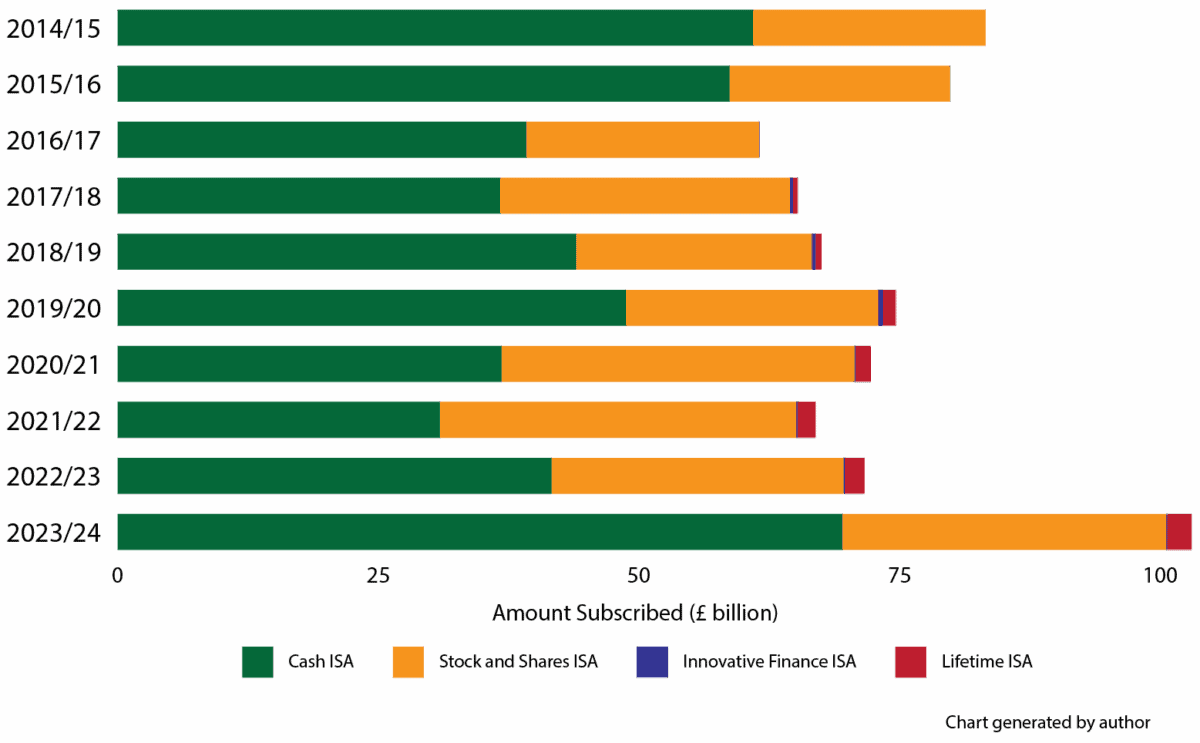
XXX

HMRC data

Most cash savers play it safe, so if they do begin to gravitate into a Stocks and Shares ISA, they’re likely to stick with what feels solid – FTSE 100 dividend payers. These household-name companies offer steady payouts and familiarity.

Dividend plays

The FTSE 100 is packed with dividend payers offering much more than a Cash ISA does. But I am conservative by nature and so I want to see really strong evidence that a stock could support its payments into the future.

One of my favourites remains household name Aviva (LSE: AV.). It holds number one positions in huge swathes of its business operations, including UK General Insurance, Protection, Workplace and individual annuities.

But it’s the mix of the portfolio that really is important to me. The acquisition of Direct Line group means that by 2028 over 75% of operating profit will be derived from capital-light operations. This mix is attractive for shareholders because it means stronger growth and better returns, but with less use of capital.

Recession fears

Of course, even the most cautious investors will want to weigh the risk of an economic slowdown. A weaker economy could hit key parts of Aviva’s business that rely on growth.

Workplace pensions provide a steady revenue stream, but if unemployment rises significantly, contributions could fall sharply. This is one of those hidden risks – not immediately obvious at first glance, but worth keeping in mind.

Another area to watch is General Insurance, the company’s biggest revenue generator. Premiums across home and motor insurance have dropped recently, and with the added costs of integrating Direct Line, profit margins could be squeezed.

Bottom line

The £12,000 cap on Cash ISAs may be controversial, but I think the UK stock market could be a beneficiary in the long run. Cash savers now have a clear reason to rethink where their money sits. That could drive meaningful change.

Beyond the Budget, the Mansion House Accord signalled a wider push for pension money to flow into private markets. If that idea is ever extended to everyday savers, I’m not convinced many cautious investors will embrace it. Most people naturally gravitate towards what they know and trust.

Aviva fits that profile. Over 40% of UK adults hold a policy with the company, putting it among the most recognisable and trusted financial brands in the country. It also offers a 5.5% dividend yield alongside growth opportunities across its diversified portfolio. These factors leave it well placed to benefit from the shake-up in Cash ISAs and I see it as worth considering.


Andrew Mackie has positions in Aviva Plc. The Motley Fool UK has no position in any of the shares mentioned. Views expressed on the companies mentioned in this article are those of the writer and therefore may differ from the official recommendations we make in our subscription services such as Share Advisor, Hidden Winners and Pro. Here at The Motley Fool we believe that considering a diverse range of insights makes us better investors.

More on Investing Articles

Friends and sisters exploring the outdoors together in Cornwall. They are standing with their arms around each other at the coast.
Investing Articles

£503 buys 14 shares in this FTSE 250 stock that returned 23.9% annually for the last 15 years

This FTSE 250 stock has averaged a huge return for 15 years. At today's price, £503 buys 14 shares. But…

Read more »

Black woman using loudspeaker to be heard
Investing Articles

£1,000 buys 25 shares in this FTSE 100 stock that’s returned 29.2% annually for the last 10 years

This FTSE 100 mining stock has returned close to 30% a year for a decade. At 3,995p, £1,000 buys 25…

Read more »

Female student sitting at the steps and using laptop
Investing Articles

Down 47%, is this growth stock finally worth buying in May?

With a £288m order book and a hidden pipeline of defence and nuclear contracts, is this growth stock now too…

Read more »

House models and one with REIT - standing for real estate investment trust - written on it.
Investing Articles

2 REITs yielding 7%+ to consider for passive income in 2026

A REIT backed by the NHS and another backed by Tesco and Sainsbury's with both yielding 7%+. Here's why I'm…

Read more »

Woman riding her old fashioned bicycle along the Beach Esplanade at Aberdeen, Scotland.
Investing Articles

Just 97 shares of this UK dividend stock generate £238 in passive income

A 5.7% yield, £238 in passive income from just 97 shares, and one of the most divisive dividend stocks on…

Read more »

ISA coins
Investing Articles

£10,000 in an ISA generates a second income of…

The London Stock Exchange is home to some of the world's most generous dividends. But how big a second income…

Read more »

Shot of a senior man drinking coffee and looking thoughtfully out of a window
Investing Articles

Expert recommendations: 2 top income stocks yielding 7%+!

With yields of 7.2% and 7.8% respectively, these two income stocks are catching the eyes of institutional analysts. Should investors…

Read more »

Illustration of flames over a black background
Investing Articles

3 top income-focused stocks to buy in May 2026, according to experts

Looking for a stock to buy for income in May 2026? Experts have flagged these three UK dividend shares as…

Read more »





