


We have some exciting news to share! The Motley Fool UK has now become The Twelfth Magpie -- an independent, UK-owned company, led by our long-serving UK management team — Mark Rogers, Chris Nials and Heather Adlington. In practical terms, it’s the same team you know, now fully focused on serving our UK readers and members.

Just as importantly, our approach remains unchanged: long-term, jargon-free, and on your side. This site is our new home, and there will be extra tweaks made across the coming few days as we settle in. So if anything looks a little off, please bear with us!

The content of this article was relevant at the time of publishing. Circumstances change continuously and caution should therefore be exercised when relying upon any content contained within this article.

How much do you need to invest in a FTSE 100 ETF for £1,000 monthly passive income?

Andrew Mackie tested whether a FTSE 100 ETF portfolio could deliver £1,000 a month in passive income – the results surprised him!

| More on:
Tŵr Mawr lighthouse (meaning "great tower" in Welsh), on Ynys Llanddwyn on Anglesey, Wales, marks the western entrance to the Menai Strait.

Image source: Getty Images

You’re reading a free article with opinions that may differ from The Motley Fool’s Premium Investing Services. Become a Motley Fool member today to get instant access to our top analyst recommendations, in-depth research, investing resources, and more. Learn More.

Earning passive income through a FTSE 100 ETF has become a hugely popular strategy. So I decided to dig into the dividend yields of two leading tracker funds to see how much an investor would actually need to reach £1,000 a month in passive income.

Tracker funds

First up, the iShares UK Dividend UCITS ETF offers a 4.9% yield, while the Vanguard FTSE U.K. Equity Income Index Fund yields 4.2%.

XXX

The iShares fund is relatively concentrated, holding just 51 stocks. Vanguard spreads its exposure over 104 holdings.

Despite the difference in breadth, both are dominated by FTSE 100 heavyweights such as BP, Rio Tinto, Legal & General, HSBC, and Shell. A handful of FTSE 250 names also appear, but with much smaller weightings.

Calculations

I do hold the Vanguard fund myself, but I don’t solely rely on it to build passive income. One reason is that several of its biggest holdings aren’t high-yield names, so the income stream is naturally limited.

If the goal is £1,000 a month (£12,000 a year), the 4% rule gives us a simple target: you’d need roughly £300,000 in your pot.

And this is where things get interesting.

As the chart shows, using fixed yearly contributions of £4,000 and straightforward compounding at today’s yields, neither ETF gets close to that £300,000 target over 25 years. The income levels just aren’t high enough for the pot to grow at the pace required.
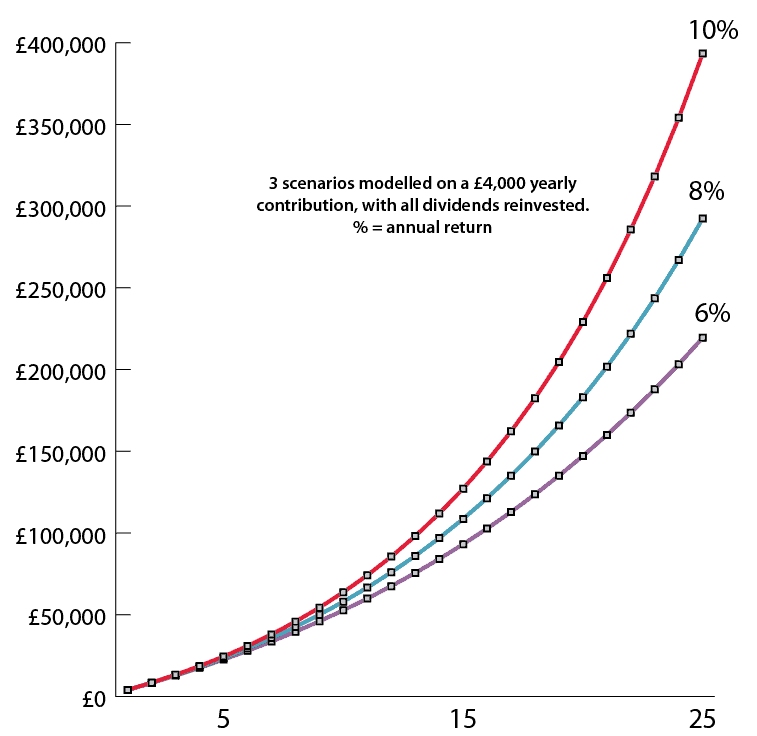
chart illustrating compound growth principle and reinvesting dividends

Chart generated by author

That’s why I prefer pairing a tracker fund with individual dividend shares that offer higher, more meaningful yields.

Income and growth

One big FTSE 100 name missing from both ETFs’ top 10 lists is Aviva (LSE: AV.). Its share price has jumped 32% in a year, which naturally pushed the dividend yield down from 8% to 5.5%.

But here’s the key difference with owning individual shares: when you reinvest dividends into a strong company, your holding grows much faster than the slow, spread-out growth you get from an ETF.

Refreshed targets

In its latest update, Aviva laid out three bold targets for 2028: grow operating earnings per share at an 11% compound annual rate, deliver an IFRS return on equity above 20%, and generate more than £7bn in cumulative cash remittances.

To hit these ambitious goals, the company is doubling down on its shift to a capital-light model. Within a few years, it expects over 75% of operating profit to come from areas like General Insurance and Wealth, which require far less capital to grow.

If it can smoothly integrate Direct Line, boost flows through Succession Wealth, and continue scaling via major partnerships such as Nationwide, then these targets start to look genuinely achievable.

No investment is risk-free. For Aviva, falling insurance premiums, regulatory changes, or interest-rate swings could pressure profits and dividends. Unexpected claims or slower growth in capital-light divisions could also limit cash generation, which is key for sustaining payouts.

Bottom line

For me, it’s all about building a reliable stream of passive income. Reinvesting dividends from strong, cash-generating shares has quietly built a growing income stream in my ISA over the years. While the FTSE 100 spreads risk broadly, I’ve found that carefully tracking a few high-yield names can turn steady payouts into a powerful compounding engine. And there are plenty of other high-income stocks to choose from.


Andrew Mackie has positions in Aviva Plc. The Motley Fool UK has no position in any of the shares mentioned. Views expressed on the companies mentioned in this article are those of the writer and therefore may differ from the official recommendations we make in our subscription services such as Share Advisor, Hidden Winners and Pro. Here at The Motley Fool we believe that considering a diverse range of insights makes us better investors.

More on Investing Articles

Friends and sisters exploring the outdoors together in Cornwall. They are standing with their arms around each other at the coast.
Investing Articles

£503 buys 14 shares in this FTSE 250 stock that returned 23.9% annually for the last 15 years

This FTSE 250 stock has averaged a huge return for 15 years. At today's price, £503 buys 14 shares. But…

Read more »

Black woman using loudspeaker to be heard
Investing Articles

£1,000 buys 25 shares in this FTSE 100 stock that’s returned 29.2% annually for the last 10 years

This FTSE 100 mining stock has returned close to 30% a year for a decade. At 3,995p, £1,000 buys 25…

Read more »

Female student sitting at the steps and using laptop
Investing Articles

Down 47%, is this growth stock finally worth buying in May?

With a £288m order book and a hidden pipeline of defence and nuclear contracts, is this growth stock now too…

Read more »

House models and one with REIT - standing for real estate investment trust - written on it.
Investing Articles

2 REITs yielding 7%+ to consider for passive income in 2026

A REIT backed by the NHS and another backed by Tesco and Sainsbury's with both yielding 7%+. Here's why I'm…

Read more »

Woman riding her old fashioned bicycle along the Beach Esplanade at Aberdeen, Scotland.
Investing Articles

Just 97 shares of this UK dividend stock generate £238 in passive income

A 5.7% yield, £238 in passive income from just 97 shares, and one of the most divisive dividend stocks on…

Read more »

ISA coins
Investing Articles

£10,000 in an ISA generates a second income of…

The London Stock Exchange is home to some of the world's most generous dividends. But how big a second income…

Read more »

Shot of a senior man drinking coffee and looking thoughtfully out of a window
Investing Articles

Expert recommendations: 2 top income stocks yielding 7%+!

With yields of 7.2% and 7.8% respectively, these two income stocks are catching the eyes of institutional analysts. Should investors…

Read more »

Illustration of flames over a black background
Investing Articles

3 top income-focused stocks to buy in May 2026, according to experts

Looking for a stock to buy for income in May 2026? Experts have flagged these three UK dividend shares as…

Read more »





