


We have some exciting news to share! The Motley Fool UK has now become The Twelfth Magpie -- an independent, UK-owned company, led by our long-serving UK management team — Mark Rogers, Chris Nials and Heather Adlington. In practical terms, it’s the same team you know, now fully focused on serving our UK readers and members.

Just as importantly, our approach remains unchanged: long-term, jargon-free, and on your side. This site is our new home, and there will be extra tweaks made across the coming few days as we settle in. So if anything looks a little off, please bear with us!

The content of this article was relevant at the time of publishing. Circumstances change continuously and caution should therefore be exercised when relying upon any content contained within this article.

How much would I need in an ISA to earn £20,000 a year in passive income?

This writer explores how an ISA could generate £20,000 annually in passive income – and what a simple chart reveals about the power of time and flexibility.

| More on:
Tŵr Mawr lighthouse (meaning "great tower" in Welsh), on Ynys Llanddwyn on Anglesey, Wales, marks the western entrance to the Menai Strait.

Image source: Getty Images

You’re reading a free article with opinions that may differ from The Motley Fool’s Premium Investing Services. Become a Motley Fool member today to get instant access to our top analyst recommendations, in-depth research, investing resources, and more. Learn More.

And ISA is one of those uniquely British inventions that are often viewed far too narrowly. The main point of them isn’t just how much you save, but how time turns those savings into long-term passive income – and the choices that come with it.

What time really buys

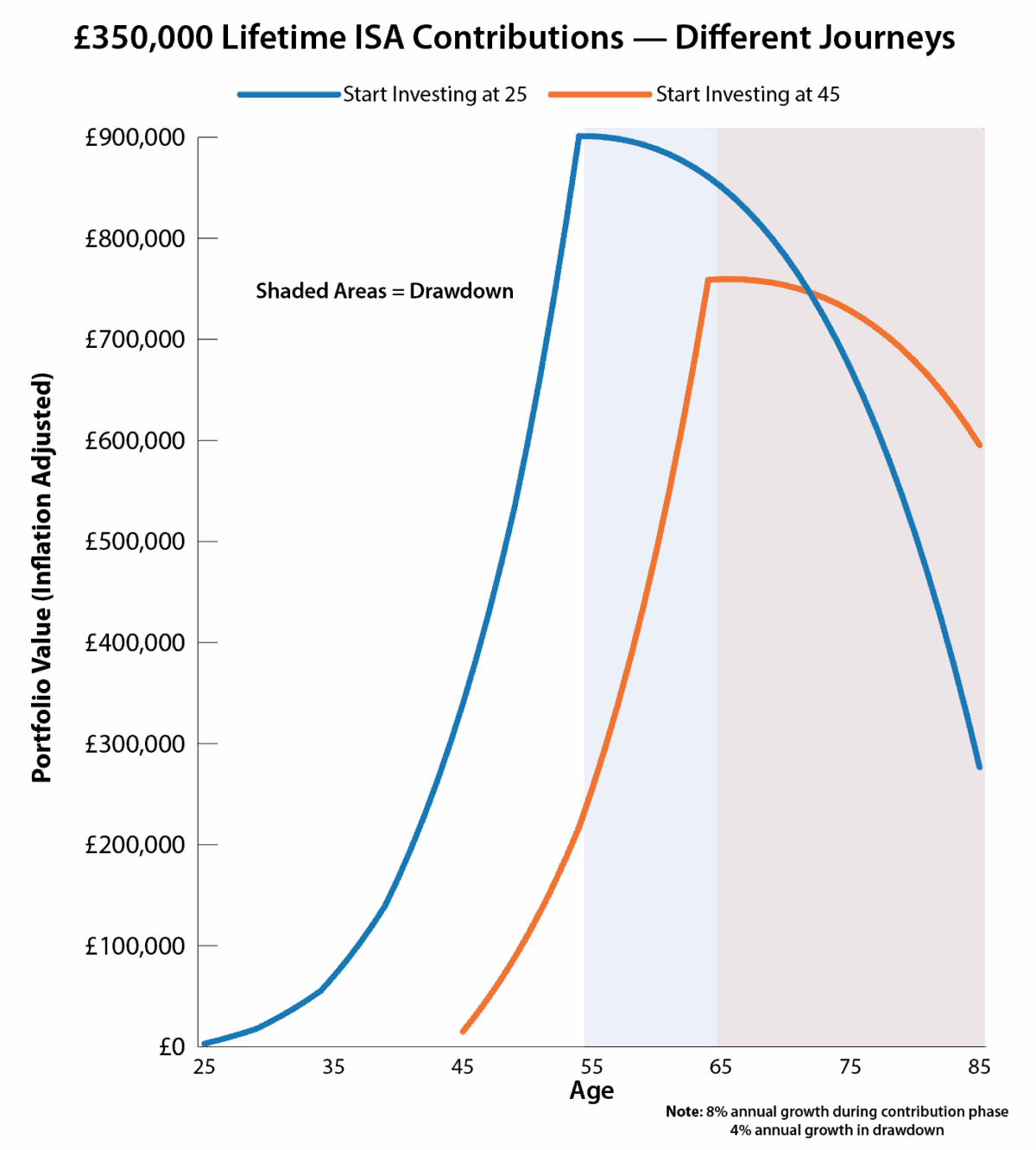
The chart tells the story better than any spreadsheet ever could. Two investors. The same total contributions. Very different starting points. One starts early and builds gradually. The other starts much later and saves hard. By retirement, the gap in portfolio size isn’t as dramatic as many might expect. But how they get there is everything.
XXX
Chart showing two investment journeys investing in an ISA

Chart generated by author

The £20,000 income shown is inflation-adjusted. That matters. It’s why the earlier starter appears to withdraw more at the outset – prices have had decades to rise quietly in the background. The later starter begins withdrawals sooner, so the initial income looks lower in today’s terms.

Returns are also assumed to fall in retirement. Not because markets suddenly stop working, but because most people naturally reduce risk once their salary ends. Growth gives way to preservation. It’s a subtle shift, but over long retirements, it really adds up.

Optionality

Where time really earns its keep is before retirement. Starting earlier creates choices during your working life: the freedom to pause contributions, take career breaks, ride out market crashes, or simply ease off when life gets in the way.

Early contributions do most of the heavy lifting. Later ones can still be powerful – but they’re far less forgiving.

The late-starter route can absolutely work. But it demands consistency, higher savings rates, and leaves much less room for error if plans change.

This isn’t about a right or wrong approach. It’s about understanding what time actually buys you. The chart doesn’t just show growth – it shows how starting earlier turns flexibility itself into an asset.

Under the radar

Many investors assume the only way to build passive income is by owning high-yielding shares. I don’t take that view.

You see, I didn’t buy Asian insurance giant Prudential (LSE: PRU) for its headline yield – currently around 2%. Instead I bought it for the long-term compounding opportunity across underinsured Asian markets. Insurance penetration remains in the low-single-digits, while the region’s protection gap is estimated at more than $100trn. That’s a powerful backdrop for growth.

In 2025, the shares are up 75%, making them the best performer among its FTSE 100 insurance peers. Even so, I’d argue the stock still sits under the radar for many investors.

China exposure does introduce volatility, and policy risk shouldn’t be ignored. The bursting of the property bubble has clearly dented the country’s growth story. But much of that uncertainty appears to be reflected in the valuation, in my opinion.

What really appeals to me is the capital flexibility. Between 2024 and 2027, Prudential expects to return more than $5bn to shareholders, combining a 10% annual increase in the dividend with a $2bn share buyback programme.

With the Chinese government actively encouraging stock market participation, Prudential looks well placed to benefit. Strong distribution, a trusted brand, and deep expertise across Asian markets are why it earns a place in my Stocks and Shares ISA. It’s not a pure income play today – but it gives me valuable optionality for the future.


Andrew Mackie owns shares in Prudential. The Motley Fool UK has recommended Prudential Plc. Views expressed on the companies mentioned in this article are those of the writer and therefore may differ from the official recommendations we make in our subscription services such as Share Advisor, Hidden Winners and Pro. Here at The Motley Fool we believe that considering a diverse range of insights makes us better investors.

More on Investing Articles

Friends and sisters exploring the outdoors together in Cornwall. They are standing with their arms around each other at the coast.
Investing Articles

£503 buys 14 shares in this FTSE 250 stock that returned 23.9% annually for the last 15 years

This FTSE 250 stock has averaged a huge return for 15 years. At today's price, £503 buys 14 shares. But…

Read more »

Black woman using loudspeaker to be heard
Investing Articles

£1,000 buys 25 shares in this FTSE 100 stock that’s returned 29.2% annually for the last 10 years

This FTSE 100 mining stock has returned close to 30% a year for a decade. At 3,995p, £1,000 buys 25…

Read more »

Female student sitting at the steps and using laptop
Investing Articles

Down 47%, is this growth stock finally worth buying in May?

With a £288m order book and a hidden pipeline of defence and nuclear contracts, is this growth stock now too…

Read more »

House models and one with REIT - standing for real estate investment trust - written on it.
Investing Articles

2 REITs yielding 7%+ to consider for passive income in 2026

A REIT backed by the NHS and another backed by Tesco and Sainsbury's with both yielding 7%+. Here's why I'm…

Read more »

Woman riding her old fashioned bicycle along the Beach Esplanade at Aberdeen, Scotland.
Investing Articles

Just 97 shares of this UK dividend stock generate £238 in passive income

A 5.7% yield, £238 in passive income from just 97 shares, and one of the most divisive dividend stocks on…

Read more »

ISA coins
Investing Articles

£10,000 in an ISA generates a second income of…

The London Stock Exchange is home to some of the world's most generous dividends. But how big a second income…

Read more »

Shot of a senior man drinking coffee and looking thoughtfully out of a window
Investing Articles

Expert recommendations: 2 top income stocks yielding 7%+!

With yields of 7.2% and 7.8% respectively, these two income stocks are catching the eyes of institutional analysts. Should investors…

Read more »

Illustration of flames over a black background
Investing Articles

3 top income-focused stocks to buy in May 2026, according to experts

Looking for a stock to buy for income in May 2026? Experts have flagged these three UK dividend shares as…

Read more »





