


We have some exciting news to share! The Motley Fool UK has now become The Twelfth Magpie -- an independent, UK-owned company, led by our long-serving UK management team — Mark Rogers, Chris Nials and Heather Adlington. In practical terms, it’s the same team you know, now fully focused on serving our UK readers and members.

Just as importantly, our approach remains unchanged: long-term, jargon-free, and on your side. This site is our new home, and there will be extra tweaks made across the coming few days as we settle in. So if anything looks a little off, please bear with us!

The content of this article was relevant at the time of publishing. Circumstances change continuously and caution should therefore be exercised when relying upon any content contained within this article.

Could a £250K ISA replace your salary? The numbers are revealing

Is a £250,000 Stocks and Shares ISA enough? This writer crunches the numbers and reveals why balancing growth and income really matters.

| More on:
Friends at the bay near the village of Diabaig on the side of Loch Torridon in Wester Ross, Scotland. They are taking a break from their bike ride to relax and chat. They are laughing together.

Image source: Getty Images

You’re reading a free article with opinions that may differ from The Motley Fool’s Premium Investing Services. Become a Motley Fool member today to get instant access to our top analyst recommendations, in-depth research, investing resources, and more. Learn More.

A £250,000 ISA sounds like a major financial milestone. But when it comes to replacing a salary, the reality is far more sobering than it first appears.

Sustainable income

Once contributions stop, the focus shifts from growth to sustainable income. That requires an understanding of how withdrawals, longevity, and inflation interact during the drawdown phase.

XXX

The chart below assumes a cautious long-term return of 4% a year and inflation of 2% during drawdown. By running the portfolio down to zero by age 85, it effectively stress-tests the maximum sustainable income over a 20-year retirement.
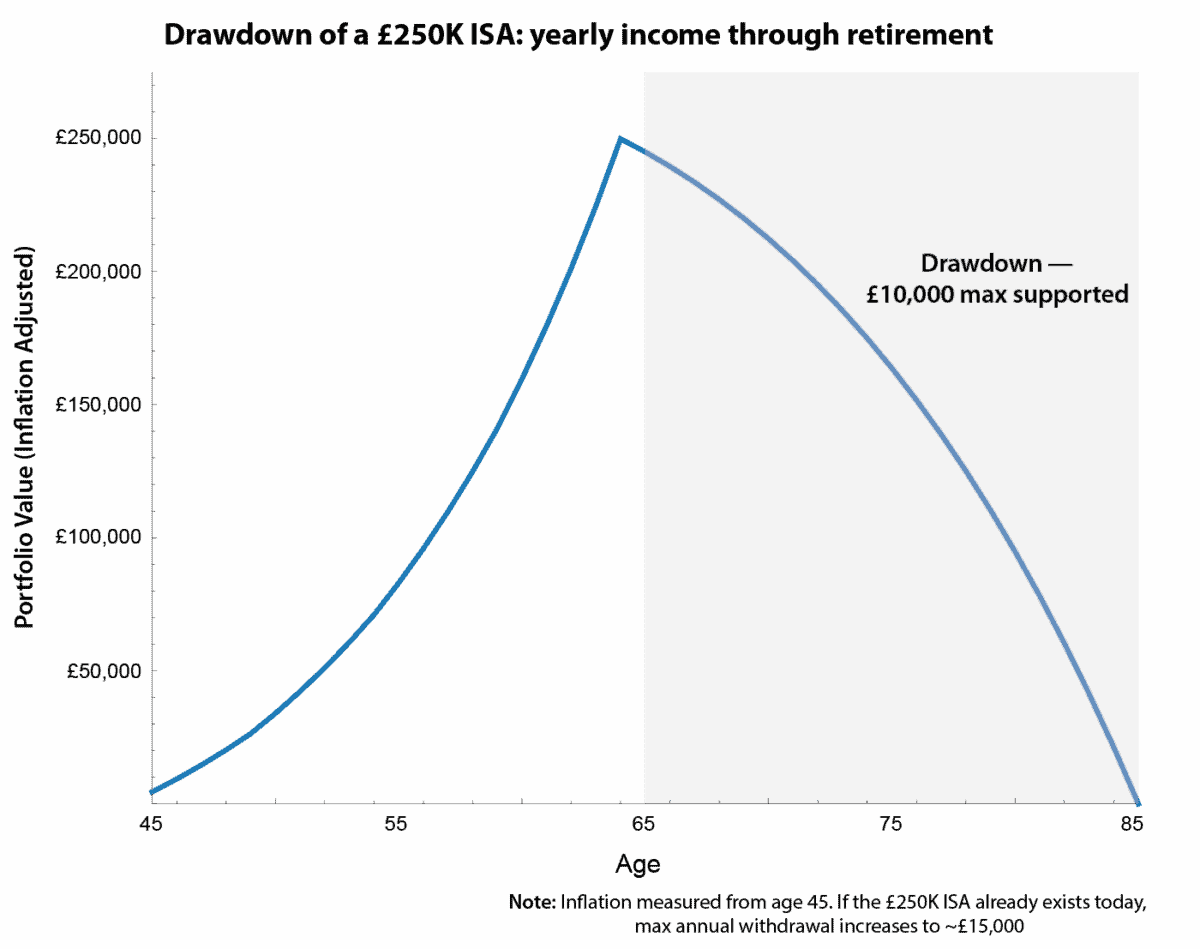
stress testing a £250,000 ISA during drawdown

Chart generated by author

Under these assumptions, a £250,000 ISA can generate around £10,000 a year, or roughly £833 per month, in inflation-adjusted income. That may cover some essentials or supplement other income, but it falls well short of replacing a typical salary.

Allowing for market volatility or longer life expectancy reduces sustainable income to around £750 per month, while leaving a residual balance of roughly £57,000.

Inflation timing

For investors who already hold the full £250,000 today, the inflation ‘clock’ starts now. In this scenario, the same modelling assumptions could support income closer to £15,000 a year, or about £1,250 per month.

This shows how prior accumulation improves flexibility. Even so, it still represents partial salary replacement rather than full financial independence.

The message is clear: a £250,000 ISA is a solid foundation, but not life-changing on its own. Its value lies in flexibility – supporting spending and supplementing pensions – rather than fully replacing earned income.

Growth and income

Few stocks are suited to both building an ISA and drawing income from it later, but Aviva (LSE: AV.) is one that deserves a closer look.

Its share price rose 42% in 2025, underlining its growth credentials. Supporting that performance has been an ongoing shift towards a capital-light business model, which has improved returns and cash generation.

The buyout of general insurance rival Direct Line at the end of last year should help accelerate this trend. By 2028, it’s targeting more than 75% of operating profit to come from capital-light divisions.

But there’s more to the business than Direct Line. The partnership with Nationwide Building Society has proved to be a winner, attracting new business and strengthening distribution. Meanwhile, in Commercial Lines, the successful integration of Probitas has given the company access to the lucrative Lloyd’s insurance market.

Dividends

The company’s strong share price performance has pushed the dividend yield lower. Even so, at a trailing yield of 5.2%, it remains comfortably ahead of the FTSE 100 average.

In the last financial year, dividend cover was just 0.66 times, meaning reported earnings did not fully cover the payout. That doesn’t overly concern me, as traditional accounting metrics can be misleading when assessing insurance businesses with complex capital structures.

Of greater concern is Aviva’s large corporate bond portfolio. If companies continue to struggle in a weak economic environment, default rates could rise, weighing on investment returns and, in turn, dividend sustainability.

Bottom line

Aviva is a stock with clear momentum. With management setting ambitious new three-year targets, including 11% annual EPS growth, I believe it has the potential to support both earnings growth and a rising dividend as I work towards a £250,000 ISA myself.


Andrew Mackie has positions in Aviva Plc. The Motley Fool UK has no position in any of the shares mentioned. Views expressed on the companies mentioned in this article are those of the writer and therefore may differ from the official recommendations we make in our subscription services such as Share Advisor, Hidden Winners and Pro. Here at The Motley Fool we believe that considering a diverse range of insights makes us better investors.

More on Investing Articles

Friends and sisters exploring the outdoors together in Cornwall. They are standing with their arms around each other at the coast.
Investing Articles

£503 buys 14 shares in this FTSE 250 stock that returned 23.9% annually for the last 15 years

This FTSE 250 stock has averaged a huge return for 15 years. At today's price, £503 buys 14 shares. But…

Read more »

Black woman using loudspeaker to be heard
Investing Articles

£1,000 buys 25 shares in this FTSE 100 stock that’s returned 29.2% annually for the last 10 years

This FTSE 100 mining stock has returned close to 30% a year for a decade. At 3,995p, £1,000 buys 25…

Read more »

Female student sitting at the steps and using laptop
Investing Articles

Down 47%, is this growth stock finally worth buying in May?

With a £288m order book and a hidden pipeline of defence and nuclear contracts, is this growth stock now too…

Read more »

House models and one with REIT - standing for real estate investment trust - written on it.
Investing Articles

2 REITs yielding 7%+ to consider for passive income in 2026

A REIT backed by the NHS and another backed by Tesco and Sainsbury's with both yielding 7%+. Here's why I'm…

Read more »

Woman riding her old fashioned bicycle along the Beach Esplanade at Aberdeen, Scotland.
Investing Articles

Just 97 shares of this UK dividend stock generate £238 in passive income

A 5.7% yield, £238 in passive income from just 97 shares, and one of the most divisive dividend stocks on…

Read more »

ISA coins
Investing Articles

£10,000 in an ISA generates a second income of…

The London Stock Exchange is home to some of the world's most generous dividends. But how big a second income…

Read more »

Shot of a senior man drinking coffee and looking thoughtfully out of a window
Investing Articles

Expert recommendations: 2 top income stocks yielding 7%+!

With yields of 7.2% and 7.8% respectively, these two income stocks are catching the eyes of institutional analysts. Should investors…

Read more »

Illustration of flames over a black background
Investing Articles

3 top income-focused stocks to buy in May 2026, according to experts

Looking for a stock to buy for income in May 2026? Experts have flagged these three UK dividend shares as…

Read more »





