


We have some exciting news to share! The Motley Fool UK has now become The Twelfth Magpie -- an independent, UK-owned company, led by our long-serving UK management team — Mark Rogers, Chris Nials and Heather Adlington. In practical terms, it’s the same team you know, now fully focused on serving our UK readers and members.

Just as importantly, our approach remains unchanged: long-term, jargon-free, and on your side. This site is our new home, and there will be extra tweaks made across the coming few days as we settle in. So if anything looks a little off, please bear with us!

The content of this article was relevant at the time of publishing. Circumstances change continuously and caution should therefore be exercised when relying upon any content contained within this article.

£5,000 in Aviva shares could unlock this much passive income…

Income investors love passive income – but what could a 25-year investment in FTSE 100 dividend star Aviva actually produce?

| More on:
Rear view image depicting a senior man in his 70s sitting on a bench leading down to the iconic Seven Sisters cliffs on the coastline of East Sussex, UK. The man is wearing casual clothing - blue denim jeans, a red checked shirt, navy blue gilet. The man is having a rest from hiking and his hiking pole is leaning up against the bench.

Image source: Getty Images

You’re reading a free article with opinions that may differ from The Motley Fool’s Premium Investing Services. Become a Motley Fool member today to get instant access to our top analyst recommendations, in-depth research, investing resources, and more. Learn More.

Passive income is the dream, but it only becomes real when you put a number on it.

Real-world modelling

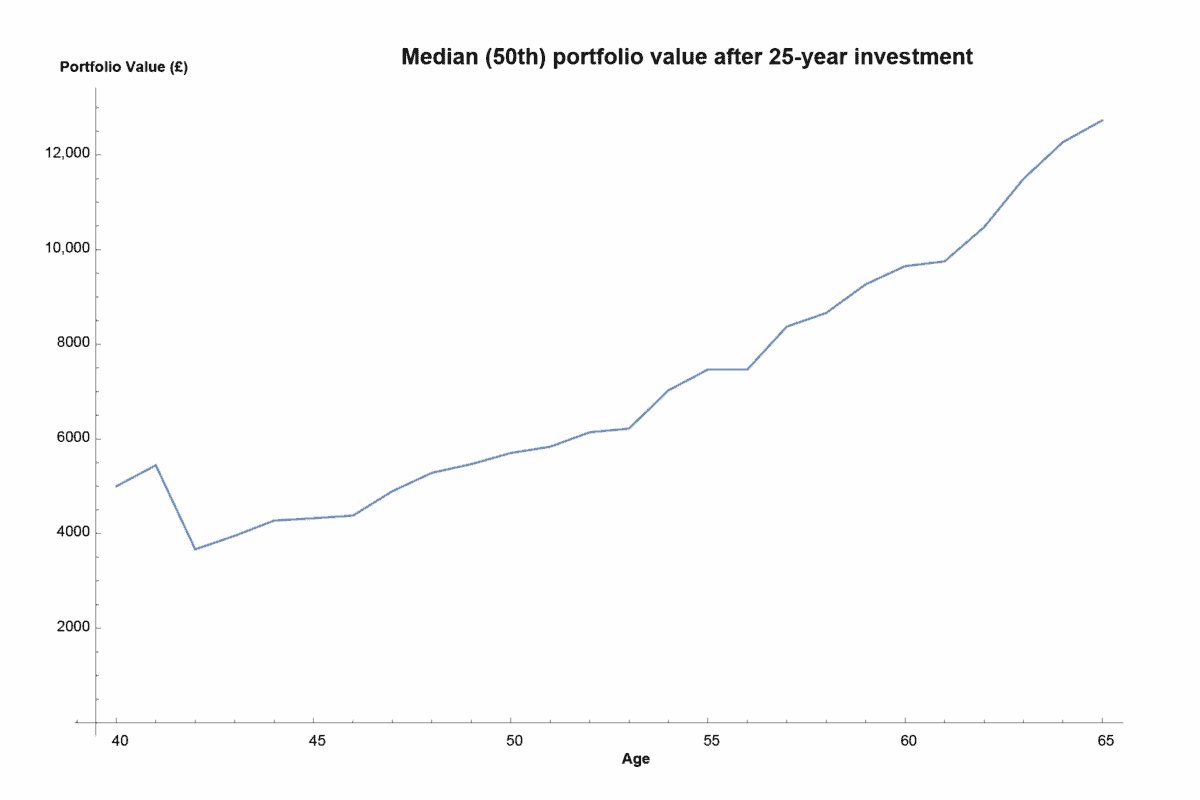
The following chart doesn’t claim to be a prediction – it’s a reminder of what can happen when you invest in a resilient business like Aviva (LSE:AV.) and stay invested for the long term. It shows the median outcome across 100 simulations, not one lucky path or a worst-case scenario.
XXX

Chart generated by author

I modelled a stock market crash just two years into the 25-year timeline. That’s the moment every long-term investor fears: the portfolio drops sharply and the urge to sell becomes loud.

The model assumes a realistic, 30% share-price drop during the crash year, and dividends are reduced too. Yet the crash isn’t a fixed event. The model builds in volatility, so outcomes vary –  sometimes better, sometimes worse, just like real markets.

Across all 100 simulations, the median value of the portfolio after 25 years is around £12,000. Of course, some simulations were higher and some lower. But the median result is what matters here.

Dividend engine

What matters isn’t the occasional outlier, but the steady trend: dividends continue, are reinvested at lower prices, and buy more shares when the market is down. That’s compounding in action.

The following chart highlights how that £7,000 gain is created. The vast majority comes from dividends collected and reinvested, with a small amount from modest price growth baked into the model. The chart is normalised to 1, so over 25 years the typical run doubles the number of shares owned – meaning reinvested dividends buy roughly twice as many shares as were started with.
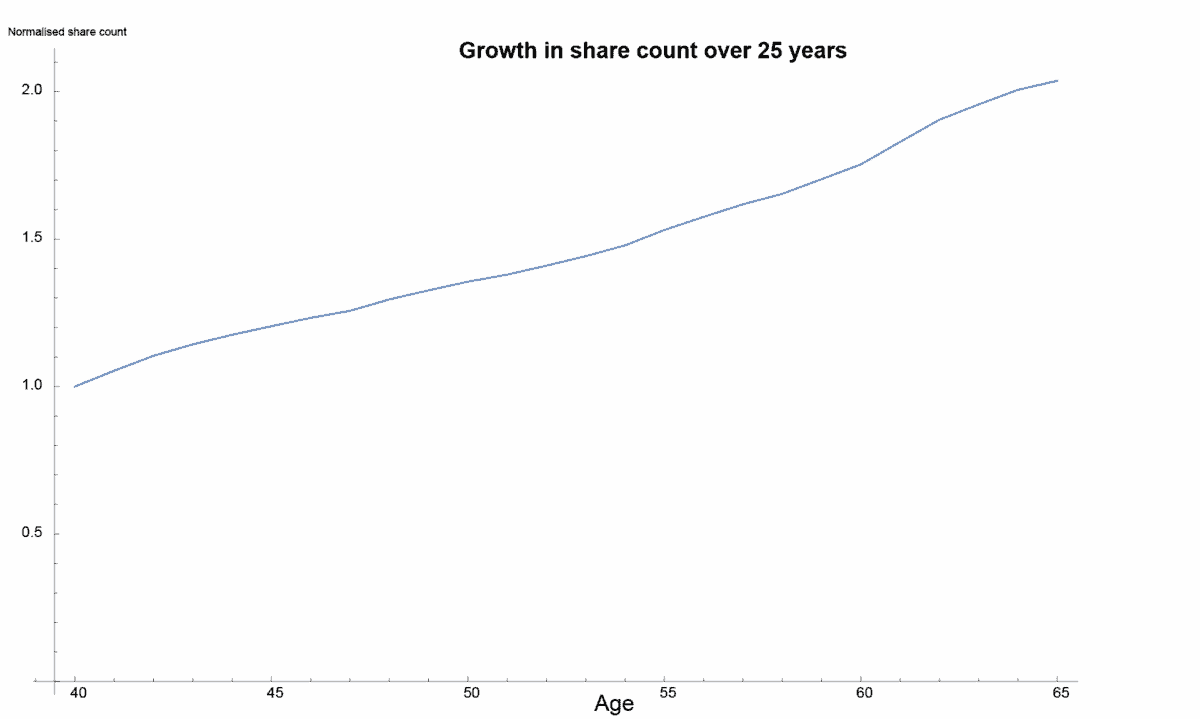
Chart created by author

Dividend sustainability

Last year was the insurer’s best since the global financial crisis, with the stock up about 42%. But for income investors like me, the bigger question is whether the dividend can stay reliable once the market stops paying attention.

In the last financial year, earnings didn’t cover the dividend, but cash flow certainly did – by over nine times. That matters because cash flow is what actually funds the payout. Still, accounting metrics like earnings and cash flow aren’t the only lens I use when looking at an insurer.

Most of Aviva’s future profits are tied up in the CSM (contractual service margin). Think of it as a reserve of future profits built into the business. As policies mature, that profit is released gradually, which helps smooth earnings over time. And it’s been growing fast: year on year, the CSM is up about 58%.

That’s important because it suggests the company has a steady pipeline of profits to support the dividend, even when markets wobble.

Of course, there are risks. Motor and home premiums have been falling recently, and if that continues it could squeeze margins at Direct Line. High competition and persistent claims costs could force further price cuts, which would pressure future earnings and the dividend.

Even so, Aviva remains a stock I’m happy to hold for passive income. The dividend yield is attractive, the cash flow cover looks solid, and the business has a steady profit engine beneath it. 2025 may have been a standout year, but the company’s core ability to generate cash and pay dividends feels more durable than its ‘boring’ reputation suggests.


Andrew Mackie has positions in Aviva Plc. The Motley Fool UK has no position in any of the shares mentioned. Views expressed on the companies mentioned in this article are those of the writer and therefore may differ from the official recommendations we make in our subscription services such as Share Advisor, Hidden Winners and Pro. Here at The Motley Fool we believe that considering a diverse range of insights makes us better investors.

More on Investing Articles

Friends and sisters exploring the outdoors together in Cornwall. They are standing with their arms around each other at the coast.
Investing Articles

£503 buys 14 shares in this FTSE 250 stock that returned 23.9% annually for the last 15 years

This FTSE 250 stock has averaged a huge return for 15 years. At today's price, £503 buys 14 shares. But…

Read more »

Black woman using loudspeaker to be heard
Investing Articles

£1,000 buys 25 shares in this FTSE 100 stock that’s returned 29.2% annually for the last 10 years

This FTSE 100 mining stock has returned close to 30% a year for a decade. At 3,995p, £1,000 buys 25…

Read more »

Female student sitting at the steps and using laptop
Investing Articles

Down 47%, is this growth stock finally worth buying in May?

With a £288m order book and a hidden pipeline of defence and nuclear contracts, is this growth stock now too…

Read more »

House models and one with REIT - standing for real estate investment trust - written on it.
Investing Articles

2 REITs yielding 7%+ to consider for passive income in 2026

A REIT backed by the NHS and another backed by Tesco and Sainsbury's with both yielding 7%+. Here's why I'm…

Read more »

Woman riding her old fashioned bicycle along the Beach Esplanade at Aberdeen, Scotland.
Investing Articles

Just 97 shares of this UK dividend stock generate £238 in passive income

A 5.7% yield, £238 in passive income from just 97 shares, and one of the most divisive dividend stocks on…

Read more »

ISA coins
Investing Articles

£10,000 in an ISA generates a second income of…

The London Stock Exchange is home to some of the world's most generous dividends. But how big a second income…

Read more »

Shot of a senior man drinking coffee and looking thoughtfully out of a window
Investing Articles

Expert recommendations: 2 top income stocks yielding 7%+!

With yields of 7.2% and 7.8% respectively, these two income stocks are catching the eyes of institutional analysts. Should investors…

Read more »

Illustration of flames over a black background
Investing Articles

3 top income-focused stocks to buy in May 2026, according to experts

Looking for a stock to buy for income in May 2026? Experts have flagged these three UK dividend shares as…

Read more »





