


We have some exciting news to share! The Motley Fool UK has now become The Twelfth Magpie -- an independent, UK-owned company, led by our long-serving UK management team — Mark Rogers, Chris Nials and Heather Adlington. In practical terms, it’s the same team you know, now fully focused on serving our UK readers and members.

Just as importantly, our approach remains unchanged: long-term, jargon-free, and on your side. This site is our new home, and there will be extra tweaks made across the coming few days as we settle in. So if anything looks a little off, please bear with us!

No savings at 45? Here’s how investors could still build a £17,360 second income

It’s never too late to start investing, and with compounding working over time, Andrew Mackie shows how investors could still generate a sizeable second income.

| More on:
Two female adult friends walking through the city streets at Christmas. They are talking and smiling as they do some Christmas shopping.

Image source: Getty Images

You’re reading a free article with opinions that may differ from The Motley Fool’s Premium Investing Services. Become a Motley Fool member today to get instant access to our top analyst recommendations, in-depth research, investing resources, and more. Learn More.

Building a second income may feel out of reach for anyone starting from scratch at 45. But with 20 years ahead until retirement, investors still have time to put compounding to work — and potentially build a £17,360 annual income stream in later life.

Starting later in life doesn’t mean building a second income is simply a case of investing more each month. While higher contributions can help, the real driver of long-term wealth is how long money is invested and how effectively it compounds over time.

XXX

Making up for lost time

Importantly, both scenarios in the chart below assume the same annual return of 8%. In other words, the rate of compounding is identical in each case.

Even with a 20-year horizon, those effects can still be powerful. The key is getting money into the market and allowing returns to build on themselves, rather than leaving cash on the sidelines.

The chart below isn’t just about contribution levels. Instead, it highlights how putting more money to work earlier — and keeping it invested — can significantly increase the income a portfolio is capable of generating over time.
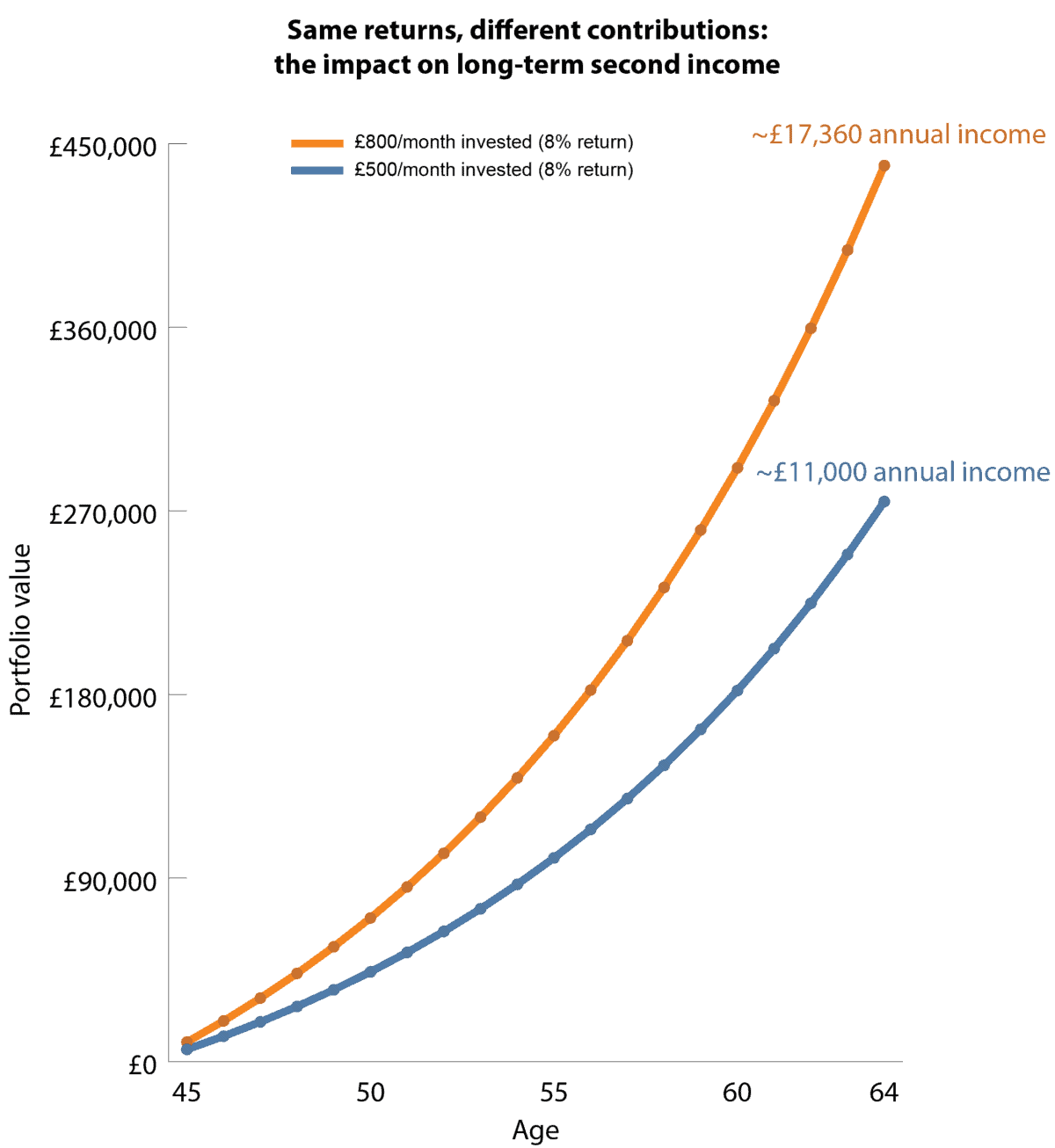
Chart generated by author

The key takeaway is that both portfolios grow at the same rate. However, the higher monthly contribution simply results in a larger pool of capital for that same compounding effect to work on over time.

A steady income compounder

Headline-grabbing yields don’t come much higher than Legal & General (LSE: LGEN). With a forward dividend yield of around 8.2%, the appeal for income-focused investors is obvious. But the real attraction lies in the consistency of the cash generation behind it.

The group is not simply paying out a high dividend; it’s operating a business model built around long-term pension risk transfer, annuities, and asset management. That creates highly predictable, recurring cash flows that support both dividends and buybacks over time.

FY25 results reflected that resilience. Core operating earnings per share rose 9%, sitting at the top end of the firm’s long-term 6%-9% growth target range, while the Solvency II coverage ratio remained strong at 203%. Shareholder returns were further underpinned by a £1.2bn share buyback, funded largely through portfolio optimisation.

Looking ahead, structural demand in the UK retirement market remains a key driver. Defined contribution pensions are still expanding, and demand for annuity and pension risk transfer solutions is expected to remain strong over the long term. The company also retains visibility on a significant pipeline of potential deals, supporting medium-term income stability.

However, risks remain. As an asset-heavy insurer, it’s exposed to movements in bond markets and credit conditions. A sustained rise in defaults or a sharp deterioration in fixed income valuations could pressure both earnings and dividend capacity. Likewise, weaker equity markets could reduce assets under management and fee income.

Despite this, the core appeal remains unchanged: a high-yielding business with relatively visible cash generation, returning capital steadily through cycles rather than relying on short bursts of growth.

Bottom line

The chart above illustrates the power of compounding in building a second income over time. Legal & General operates on a similar principle internally: consistent cash generation is reinvested into shareholder returns, primarily through dividends and buybacks, allowing investors to benefit from compounding at both the portfolio and business level.


Andrew Mackie has positions in Legal & General Group Plc. The Motley Fool UK has no position in any of the shares mentioned. Views expressed on the companies mentioned in this article are those of the writer and therefore may differ from the official recommendations we make in our subscription services such as Share Advisor, Hidden Winners and Pro. Here at The Motley Fool we believe that considering a diverse range of insights makes us better investors.

More on Investing Articles

Friends and sisters exploring the outdoors together in Cornwall. They are standing with their arms around each other at the coast.
Investing Articles

£503 buys 14 shares in this FTSE 250 stock that returned 23.9% annually for the last 15 years

This FTSE 250 stock has averaged a huge return for 15 years. At today's price, £503 buys 14 shares. But…

Read more »

Black woman using loudspeaker to be heard
Investing Articles

£1,000 buys 25 shares in this FTSE 100 stock that’s returned 29.2% annually for the last 10 years

This FTSE 100 mining stock has returned close to 30% a year for a decade. At 3,995p, £1,000 buys 25…

Read more »

Female student sitting at the steps and using laptop
Investing Articles

Down 47%, is this growth stock finally worth buying in May?

With a £288m order book and a hidden pipeline of defence and nuclear contracts, is this growth stock now too…

Read more »

House models and one with REIT - standing for real estate investment trust - written on it.
Investing Articles

2 REITs yielding 7%+ to consider for passive income in 2026

A REIT backed by the NHS and another backed by Tesco and Sainsbury's with both yielding 7%+. Here's why I'm…

Read more »

Woman riding her old fashioned bicycle along the Beach Esplanade at Aberdeen, Scotland.
Investing Articles

Just 97 shares of this UK dividend stock generate £238 in passive income

A 5.7% yield, £238 in passive income from just 97 shares, and one of the most divisive dividend stocks on…

Read more »

ISA coins
Investing Articles

£10,000 in an ISA generates a second income of…

The London Stock Exchange is home to some of the world's most generous dividends. But how big a second income…

Read more »

Shot of a senior man drinking coffee and looking thoughtfully out of a window
Investing Articles

Expert recommendations: 2 top income stocks yielding 7%+!

With yields of 7.2% and 7.8% respectively, these two income stocks are catching the eyes of institutional analysts. Should investors…

Read more »

Illustration of flames over a black background
Investing Articles

3 top income-focused stocks to buy in May 2026, according to experts

Looking for a stock to buy for income in May 2026? Experts have flagged these three UK dividend shares as…

Read more »





